
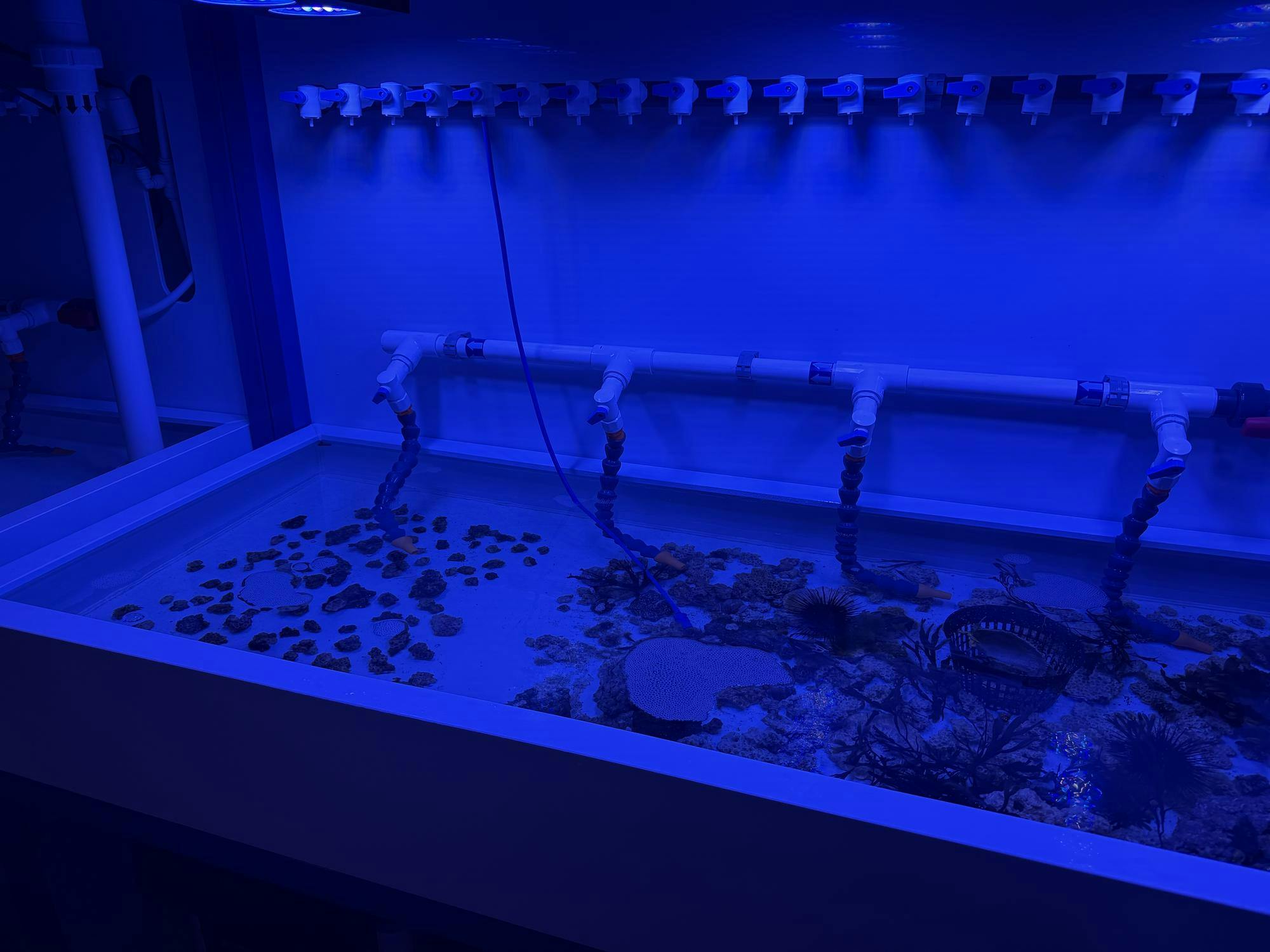
This fall, the Rotjan Marine Ecology Lab settled into its new home within the Department of Biology. Previously located at Boston University, the lab has brought along exciting marine biological research and bright researchers in its move to Tufts.
Principal investigator Randi Rotjan (AG’07) is a Tufts alumna, earning her Ph.D. in biology prior to pursuing a postdoctoral fellowship at Harvard University. Prior to serving as a principal investigator and professor at BU, Rotjan ran a coral reef research program with the New England Aquarium. Today, she continues to work with nonprofit organizations supporting ocean conservation.
In addition to conducting research at Tufts, Rotjan is an associate professor of biology and a Provost Catalyst Leader. This spring, Rotjan taught “Population and Community Ecology” and will be leading a seminar in marine biology in the fall alongside other biology faculty.
Rotjan’s lab broadly focuses on marine ecology and evolution. For example, through research in metabolism, researchers in the lab can study how the ecology and evolution of organisms are predicted to shift with a changing climate.
Additionally, the lab studies how deep-sea organisms work, what they do and how they fit into an ecosystem. Through thinking about corals and conservation, Rotjan believes that they can think more generally about “how to protect and buffer marine ecosystems from the coming change.”
Located in the newly renovated Bacon Hall of the Medford/Somerville campus, the Rotjan lab is home to an impressive array of equipment. Their aquarium systems have been designed to accommodate the needs of various species, from those that typically thrive in tropical environments to those that live in temperate environments. The precision of these systems allows for the safe collection of organisms from the field and enables the lab to store organisms for long-term research projects.
The lab hosts many researchers, including principal investigator Rotjan, two visiting affiliate principal investigators, a lab coordinator, a lab tech, two postdocs, two Ph.D. students, 11 master’s students and 25 undergraduates.
Jacob Jaskiel is a Ph.D. candidate at BU who began working for the Rotjan lab in the winter of 2017. He just defended his thesis on the early life history and population dynamics of larval tuna. Following his graduation this spring, Jaskiel plans to pursue a post-doctoral fellowship at Tufts.
“Randi [has been] like a ‘Noah’s Ark’ for a lot of students,” Jaskiel said.
He mentioned that she’s always trying to get people involved, which has greatly helped in both the relocation of the lab and its various research projects. Both Jaskiel and Rotjan alluded to the phrase “a rising tide floats all boats” as their lab’s motto.
Recently, many researchers in the Rotjan lab have been sifting through a large data set of plankton that came from the Sea Education Association in the Pacific Ocean. They had been collecting samples on their cruises for many years, and now undergraduates and Ph.D. students alike are working together to quantify the data.
Having been processing, sorting and quality-checking this data since he was an undergraduate, Jaskiel is excited to finally have enough data to “synthesize some of the things we’ve been working on for over a decade.” He contends that there are many ecological projects to be explored from the data, such as the potential to work with different zooplankton and fish assemblages.
Being a 10-year member of the Rotjan lab, Jaskiel is amazed at the progress of the plankton project, from the collection of samples to finally seeing the data come to life.
“The life cycle of that project has been really awesome,” he said.
Taylor Lindsay, a postdoctoral researcher for the Rotjan lab, specializes in a species of temperate coral called ‘Astrangia poculata.’ She’s interested in how mothers invest in their eggs, as well as variations in energetics along different gradients, such as light, food or latitude. Beginning her position in September, Lindsay mentioned that much of her work thus far has been supporting the lab’s move to Tufts. From buying new equipment to building up the facility, she remarked that, until recently, they hadn’t had the necessary resources in place to conduct research.
With the aquarium systems up and running, Lindsay has recently been able to conduct her first fieldwork period alongside other researchers. Regarding future research with Astrangia poculata, Lindsay plans to collect specimens along the East Coast, from North Carolina to Cape Cod. She’s interested in how they “differ along that latitudinal gradient.” On a closer scale, she’s interested in exploring local specimens and how they spawn over the course of the summer.
Lindsay believes that it’s been beneficial to have such a large network of people to rely on with varied research focuses. She joked that Rotjan is “like an octopus,” using her expertise in marine biology to support numerous research endeavors and curious young scientists.
Despite their varying research interests, Rotjan believes her lab members collectively lean into complexity, embracing intricacy and intersectionality.
“We don’t just work with one organism. We ask questions and then, whatever tools we need, or organisms lend themselves to those questions in whatever ecosystem, that’s what we follow,” she said.
To strike a balance, Rotjan tries to run a field program, a wet lab program and a computational program simultaneously. She contends that all three are necessary to truly understand the ocean’s complexities. First, time in the field allows researchers to experience organisms firsthand, situating them within the context in which they are studying through scuba, snorkel or intertidal work.
Locally, an agreement with the University of Rhode Island has enabled lab members to conduct scuba diving projects at its facilities. Through this, they can collect data or conduct underwater experiments, such as studying the natural ecology of a species in its habitat.
Requiring a longer journey, the lab also plans to embark on research cruises in the coming years. The team conducted a trip to the Miami area in February, collecting samples and getting used to working on the water.
In addition to sampling along the East Coast, the Rotjan lab also collects organisms from the equatorial Pacific. Deep-sea coral research is one of the academic areas supported by these expeditions. To fully understand the research, however, computational analysis is required. While far away and often time-limited, computer modeling technology allows researchers in Medford to simulate the deep-sea environment their fellow researchers are experiencing. One expedition can support the work of many, spanning oceans and bridging research gaps.
Finally, wet-lab work might involve taking corals from the field and measuring various aspects of their metabolism, from heart rate to responses to changing conditions.
Interest in ecological research is currently growing on the Medford/Somerville campus and beyond. Tufts is currently developing a new program in collaboration with the Bigelow Laboratory for Ocean Sciences to accommodate this interest, in which master’s students have the opportunity to live in Maine and take classes related to the marine sciences.
“There’s about to be a whole lot of marine bio here at Tufts,” Rotjan said.
All three lab members praised the Tufts biology department for its welcoming nature throughout the move.
“It just feels a little different,” Jaskiel said. “It’s fresh and new and exciting.”
Lindsay seemed to share the same sentiment, reflecting that it’s been a learning curve.
“There’s so much to learn when you join a new institution, and we’re all just trying to figure it out,” she said.
“The vibes in the department have not changed over 20 years, which is pretty amazing,” Rotjan said. “It’s a really collaborative, really joyful, really, really high standard-of-excellence department.”
Rotjan also remarked that she’s excited to be sharing a space with other departments and welcomes the possibility of collaboration this brings, especially with peers within the School of Engineering and the Department of Earth and Climate Sciences.
“You share the same space. You run into each other all the time. Your students are back and forth, taking each other’s classes, and the collaborative potential just kind of unfolds,” she said.
Only time can tell what fascinating discoveries will come out of the Rotjan Marine Ecology Lab. Whatever they may be, the lab’s arrival on campus has certainly ushered in a new wave of excitement surrounding marine biological research at Tufts.



