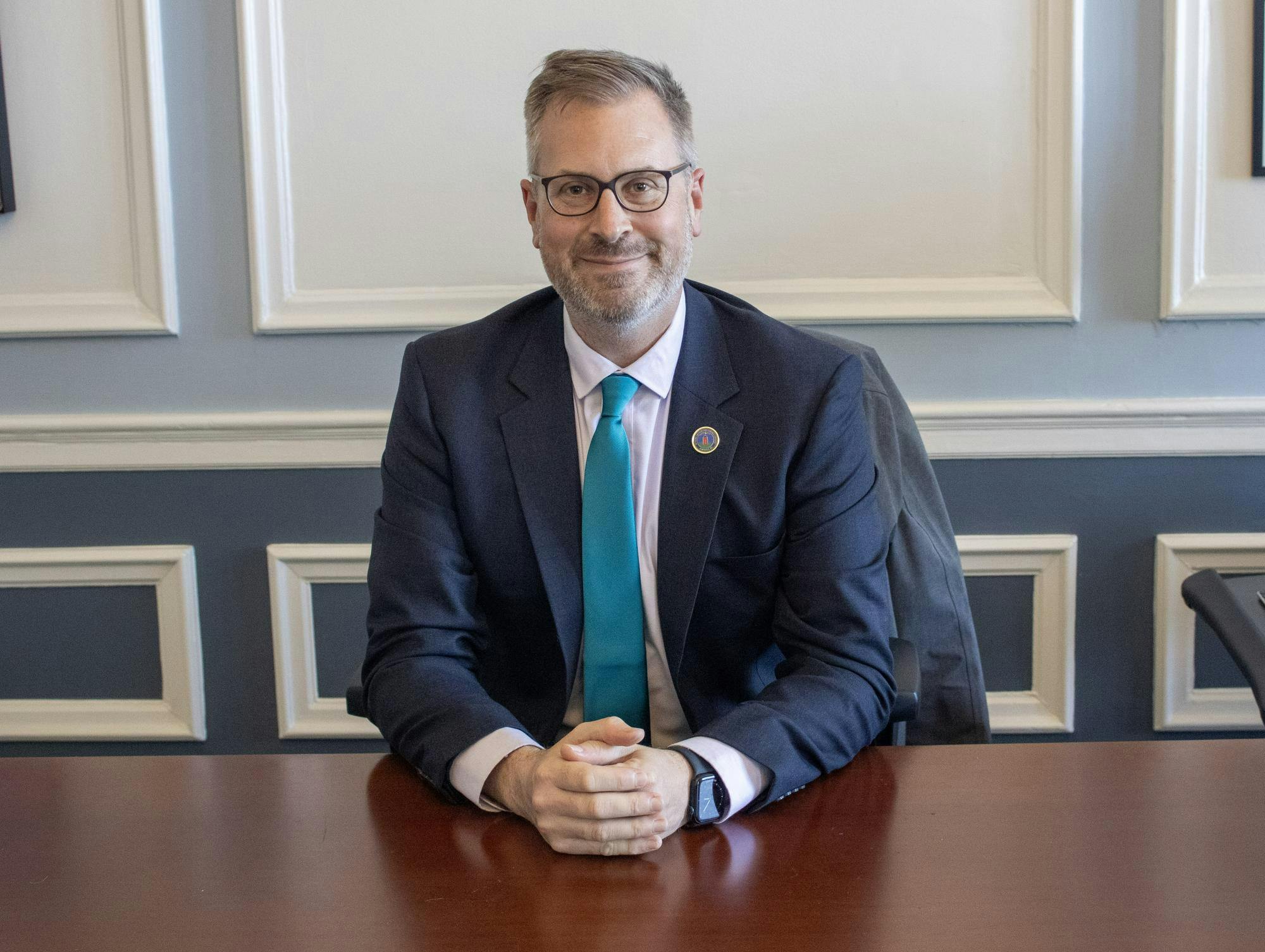
The Daily spoke with Somerville Mayor Jake Wilson on April 22 about new initiatives, his open office and challenges that come with being mayor.
Wilson was inaugurated as mayor on Jan. 3 following his election in November 2025. He defeated incumbent mayor Katjana Ballantyne and then-city councilor-at-large Willie Burnley Jr.
Editor’s note: This interview was edited for length and clarity.
Tufts Daily (TD): What has been your favorite moment in office so far?
Jake Wilson (JW): There have been a lot, honestly, I’m really enjoying the job. So it’s tough for me to pick out just one. … It felt really good signing that executive order around [Immigration and Customs Enforcement] with a bunch of the city council and school committee members there as a display of how united we are as a city.
TD: What is the biggest challenge that you faced in the first 100 days, and how did you manage to overcome it?
JW: The one that jumps out is that first big snowstorm we got, the eighth largest snowfall in recorded history here for Somerville, and it was in our first month. … We were all new in the mayor’s office. And it became clear pretty quickly that the plan that we had, which had never really been tested by a significant snowfall, just was not up to snuff.
I was really happy that the interim [Department of Public Works] Commissioner — now the DPW Commissioner — without any prompting, sent me basically a post-mortem. You know, here’s what went wrong … here’s what we’re going to do to make sure it doesn’t happen again. And we were much better prepared for the second snow storm.
TD: Since taking office, one of the things you’ve pursued is restructuring the city administration to a cabinet-style system. What motivated that change and what impact of it have you seen so far?
JW: People want to collaborate. It’s about formalizing that and making sure that the structures are placed. That’s what those cabinet meetings really do. Things come up, and then we got 10 people sitting around the table, and we talk about how we’re going to solve it, and it works.
TD: You’ve been holding Thursday night office hours. How have those been going so far?
JW: We want to keep it conversational. We don’t want to be sitting around a conference table. … We’re here to talk to people, to listen to people [and to] try to help people solve problems. A lot of constituent services issues come up, from a water bill to an issue with a neighbor and construction. People love that they can come to City Hall and actually have someone who will listen to their problem. … We can’t solve everything … [but] we’re basically out to see what we can do to make people’s lives better.
TD: In February, you fired former Somerville Arts Council Executive Director Greg Jenkins after nearly 25 years in the role, a decision that surprised a lot of people in the Somerville community. What factors led to that decision and how does it fit into the broader changes in the city’s administration?
JW: I can’t discuss a personal matter, but I’ll say I disagree with the characterization of that move.
We’re looking to always take the arts forward in Somerville. … We’re adding a cabinet level position for culture and community. … It’s really important that the arts have that seat at the table.
TD: The city is facing a $4.7 million budget reduction for the upcoming fiscal year. How is your administration approaching these cuts, and how are you responding to concerns from residents, especially around schools?
JW: We’ve been very clear [that] schools are the top priority. They’re going to see at least north of a 7% increase. I don’t know of any other community in the state investing at that level in the schools.
We’re trying to address [the cuts] on the revenue side. The easiest and best way to address it is [asking] how can we raise more revenue so we don’t have to make cuts? Then, when we look at cuts, what are the least painful ones we can do — where are the ‘nice to have’ things we can do without.
We’re not talking about cutting educator positions. We’re not looking at student facing positions at all for these cuts.
TD: You’ve been pushing for new approaches to affordable housing. What initiatives have you taken so far, and what impact are you hoping they’ll have?
JW: The old Star Market site, [at] 290 Broadway — work is underway there. I think there’s an official groundbreaking coming up in the next few weeks. … That project, to me, is a model of what we should be doing here in terms of the affordability percentages. It’s 319 new rental units. 136 of those are affordable. 42% by square footage [is] way beyond the 20% inclusion rates required by the ordinance.
The city gave a 20-year tax break, we gave them four and a half million from the Affordable Housing Trust Fund. The state did low-income housing tax credits for them and … $2.5 million in MassWorks grants. For a while, it looked like it wasn’t going to happen, but we were able to get the project over the line and now work is underway.
When developers come to me saying, ‘Is there any way to get a break on the 20% inclusionary zoning?’ My response is, ... ‘What if you went way higher on affordability?’ What if we found money to actually make that work ... and build the kind of projects that have broad support?
TD: What initiatives are you currently working on that you think people should look out for in the coming months?
JW: The big thing we’re working on is bringing SomerStat back. It’s the data operation of the city. It’s been used as performance management in the past. We’re thinking more [about] performance measurement — working with the departments and divisions in terms of identifying key performance indicators. Basically, how do we define success for you through data?
It’s more than just symbolic. We’ll bring it out when we meet with departments and divisions and go through the data with them and look at how things are going and identify areas for improvement.
To me it’s about reflecting reality in data. … How do you get meaningful data, and then, how do you use that to inform decisions?
TD: What progress should Tufts students expect to see when they return in September?
JW: Hopefully you see a Davis Square that feels really robust, vibrant and active. We’re looking to fill Davis Square with really good programming.
[Davis Square] has been having rough times lately. … We want to really push [the square] in a good direction, where Davis becomes a place that people are really flocking back to.