
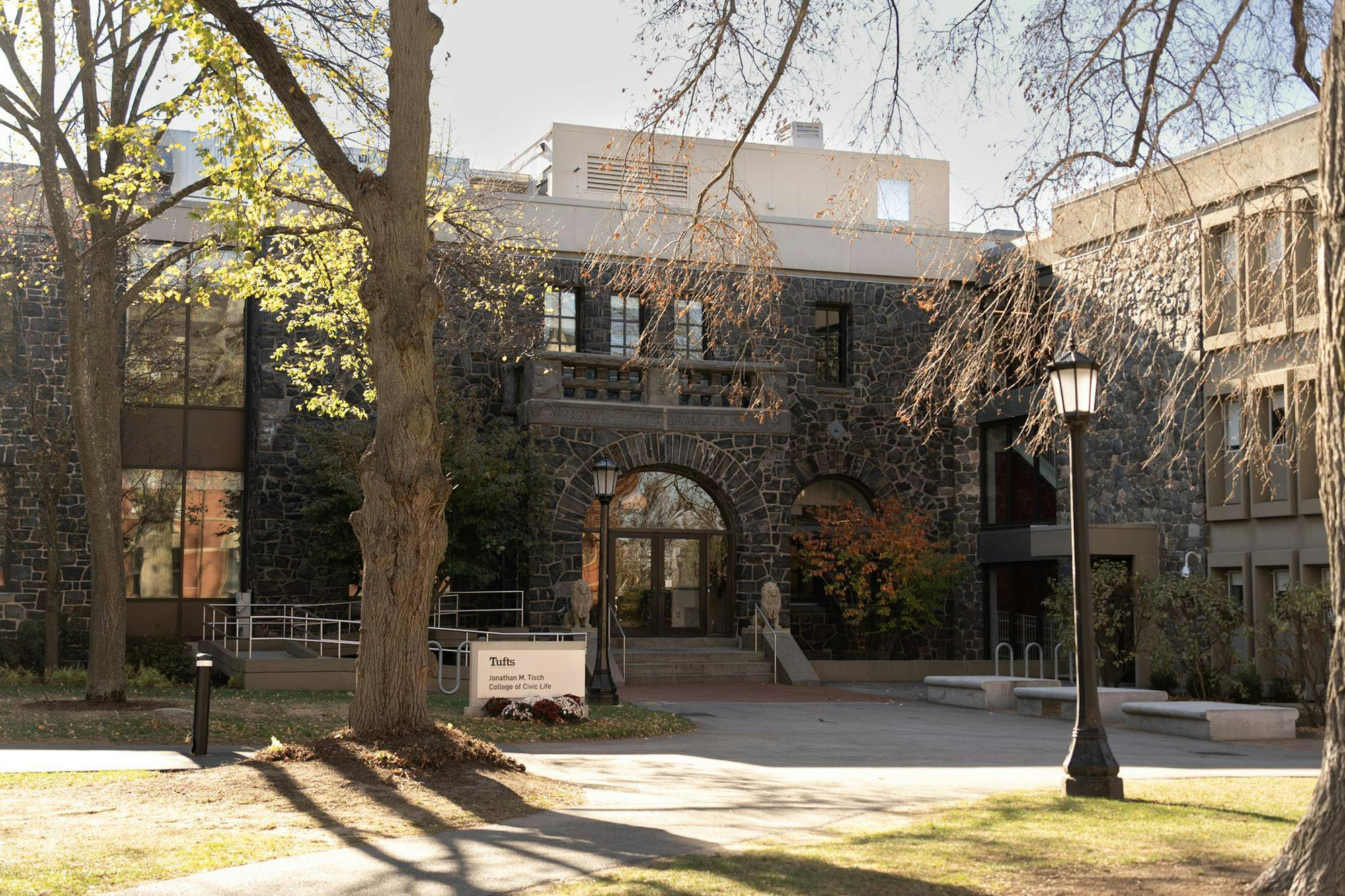
All on-campus classes in the MyTERN re-entry program run by the Tufts University Prison Initiative of the Tisch College of Civic Life were suspended in July for the 2026-27 academic year following a May shooting involving a former participant in the program.
The suspension will only affect students in the School of Arts and Sciences, as no participants in MyTERN’s re-entry program — which assists formerly incarcerated individuals in reentering society through education, career and housing support — were enrolled for this academic year, according to Joseph Auner, Tufts’s interim provost and senior vice president. Auner announced the suspension in an email addressed to faculty and students involved in TUPIT.
Auner added that, for the time being, most of TUPIT’s other programming, including in-person prison education classes, courses for formerly incarcerated students and admission to a Bachelor’s program, will continue as scheduled.
Tyler Brown, a former MyTERN participant, allegedly fired about 60 rounds from an assault-style rifle at random targets along Memorial Drive in Cambridge on May 11, critically injuring two men who were taken to the hospital.
He pleaded not guilty to eight felony charges, including armed assault with intent to murder, carrying a firearm without a license, possession of a large-capacity firearm and assault and battery by means of an attempted discharge of a firearm. He is currently being held before trial without bail.
In his email, Auner addressed concerns about TUPIT and MyTERN and said that a working group would be convened to make recommendations on the programs’ future.
He said that in response to the shooting, the university launched an independent review of MyTERN to ensure that the program “provides access to appropriate non-academic supports to participants and follows appropriate university-wide protocols to protect the safety and well-being of all students, faculty, and staff.”
The independent review will be conducted by Hunton Andrews Kurth LLP, a Virginia-based law firm.
The decision to pause MyTERN for the upcoming year was made “in consultation with university senior leadership,” Auner added.
Through MyTERN, formerly incarcerated individuals partake in a yearlong, trauma-informed reentry program that allows them to take Tufts courses on campus and earn a Civic Studies certificate; they also receive support from partner organizations in areas like housing and employment.
Housed in Tisch College, MyTERN classes, which have been active since 2020, sometimes include Tufts undergraduate students learning alongside MyTERN participants.
Brown had already undergone multiple stints in prison for opening fire on Boston police officers, a stabbing and other incidents before he was released on parole and entered into MyTERN via court order in 2025.
Brown had also participated in Tufts violence reduction, criminal thinking and bachelor’s programs while in prison, according to Boston 25 News. He stopped attending his courses at Tufts in February 2026.
On May 11, Brown called his parole officer to say he was ready to take his own life and proceeded to fire 60 rounds at seemingly random targets on Memorial Drive. Two drivers were critically injured before Brown was incapacitated.
Auner’s working group, which consists of faculty and staff from the School of Arts and Sciences, Tisch College and the provost’s office, will consider feedback provided by the independent review.
He added that civic studies program leadership will reach out to School of Arts and Sciences students scheduled to be students or teaching assistants in upcoming MyTERN courses to find alternative courses.
TUPIT also offers in-prison courses for currently incarcerated individuals through Tufts and Bunker Hill Community College. Participants can earn an Associate in Arts Degree in the Liberal Arts from BHCC from their courses in prison, many of which are taught by Tufts professors. They can then apply to continue an additional two years of coursework to earn a Bachelor of Art in Civic Studies from Tufts.
These offerings will continue — at least for now. Auner, who is slated to teach an in-prison class through TUPIT this coming semester, said that all in-prison courses will continue; students already enrolled in the BA program will be allowed to finish their degrees; the BA program will continue to accept applications through the Resumed Education for Adult Learning program; incarcerated students who have completed their associate degrees may continue their coursework.
However, the future of TUPIT is uncertain. The independent review seems to include TUPIT as a whole, not just MyTERN.
The university’s relationship with TUPIT has historically been one of resigned support. Professors in the past have voiced their frustrations with TUPIT courses not counting towards their required teaching load. Furthermore, a Tufts Now article from 2025 states that TUPIT relies almost entirely on outside donations and grants, rather than direct university funding, according to the program’s founder and executive director, Hilary Binda. Program directors declined comment requests from the Daily and referred questions to Patrick Collins, executive director of media relations.
Collins said that there is no specific date when the working group will release more information. “It will make suggestions to the provost ad interim after taking the time needed to evaluate the independent review’s findings,” he said.



