This review contains spoilers for “Over the Garden Wall” by Patrick McHale.
With the leaves changing color on Tufts campus, it’s time to talk about the perfect cozy fall mini-series. Patrick McHale’s 2014 animated television series “Over the Garden Wall” is a modern classic; its 10 episodes, each only 11 minutes long, overflow with whimsy and wonder. But behind it all, the show grapples with themes of changing seasons and stages of life, dreams versus reality and childhood wonder.
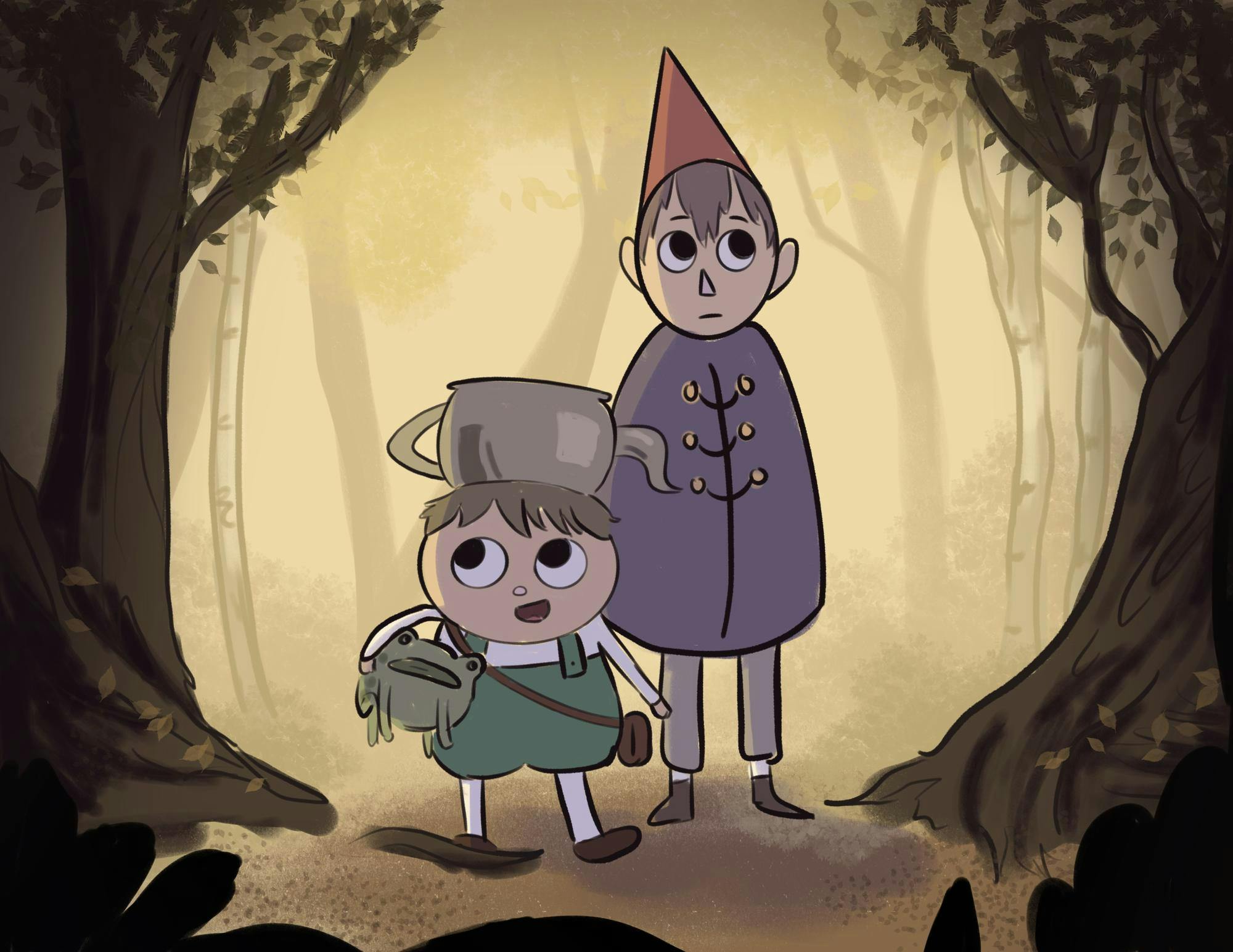
“Over the Garden Wall” tells the tale of two brothers, Wirt and Greg, and their journey through “The Unknown,” a magical, dream-like forest world containing a vast cast of interesting and diverse autumnal characters.
In episode 2, the brothers meet Beatrice, a talking bluebird whom Wirt, voiced by Elijah Wood, initially discredits as fake, since “a bird’s brain isn’t big enough for cognizant speech.”
He gets over this quickly, however, once they encounter more fantastical creatures like the Pottsfield pumpkin-headed skeletons, Miss Langtree and her animal schoolhouse, Fred the talking horse, the enormously wealthy Quincy Endicott and the Beast. The first half of the show is very whimsical but leaves some surreal aspects to be explained, like why Greg has a tea kettle on his head.
Later, we learn that Beatrice was once a human, and that she had mistakenly gotten her and her family placed under a curse which turned them into bluebirds. She is searching for Adelaide, a witch who possesses a pair of magical scissors with which she can cut off her wings to return her and her family to a human state.
Cutting off her wings is symbolic of losing the ability to dream and to fly. Beatrice encounters so much wonder on her journey with Greg and Wirt that it’s disappointing to know that her goal is this loss. This is one aspect of the show’s allegory for the downsides of maturing and conforming to society.
Similarly, Greg’s pet frog, who remains unnamed and ambiguous throughout most of the show, is yet another metaphor for growing up. Throughout their journey, Greg is constantly coming up with new names for the frog, trying to find the one that sticks. In life, not only are you trying to make a name for yourself, but you’re trying to find out who you even are. The frog not having any name for the majority of the show teaches us that it is okay to not know who you are and to have multiple different ideas of yourself.
It is only near the end of the show, in episode 9, that it is revealed that the entirety of Wirt and Greg’s adventures occurred in a brief liminal space while the brothers sank into a freezing lake on Halloween night. We learn of Wirt’s anxious plan to talk to his crush at a Halloween party and Greg’s attempts to help, how the nameless frog was found and that Greg’s tea kettle hat is actually an elephant trunk costume!
Waiting until the end of the show to give us this much-needed context is a powerful decision. Because of this, the viewer spends the majority of the show without answers, and learns to accept and appreciate the unexplained wonder of “The Unknown.”
Greg embodies the idea of youthful, ignorant wonder at the world. His ability to instantly accept and connect with the fantastical elements of the forest contrasts Wirt’s fear and skepticism, and helps to get them out of trouble on many occasions.
As the brothers’ relationship begins to strain in the final episodes of the show, the season shifts from autumn to winter. The once warm, whimsical landscape turns a cold blue. This represents growing up, maturing and losing your childhood because of the expectations of the “real world.” Greg finally realizes what Wirt had been emphasizing the whole show — that they are, in fact, lost.
The show concludes with Greg giving in to the Beast — further representing the loss of childhood wonder — to try and save Wirt, and Wirt ultimately rejecting the Beast to save Greg and escape “The Unknown.” There is a quote from Greg in episode 8: “You can do anything if you set your mind to it, that’s what the old people say!” Ultimately, it’s actually the “old people” who lose sight of that very concept, and it is up to the children to maintain the wonder and believe in their dreams. It is this very realization that helps Wirt defeat the Beast.
Speaking of dreams, they are another key element of “Over the Garden Wall.” “The Unknown” itself is very dreamlike in nature, and the entirety of episode 8 is a dream taking place inside Greg’s mind. Only at the end does the story emerge into the “Real World,” with its stark lack of fantastical characters.
Furthermore, in the opening sequence of the show, and again at the end, there is a brief shot of a few of its characters, such as Quincy Endicott and Auntie Whispers, portrayed as toy dolls on a shelf. These two frames are easily missable, but could reframe one’s entire perception of the show. Are Greg and Wirt simply playing with dolls and making it all up? Or are they lucid dreaming while sinking in the lake?
This ambiguity furthers the core message of the show that it is okay not to have all the answers. As adults, we are constantly searching for the solutions to our problems and striving to “fit in” to the arbitrary societal structures that surround us. “Over the Garden Wall” reminds us to think like we did when we were children. You don’t need to have all the answers, care what others think or fit into a certain societal mold. Sometimes, the most important thing is to simply pay attention to the wonder and beauty all around us.
So, take the crisp autumn wind and changing leaves as a sign to give this show a try. Plus, you can watch it free on Amazon Prime Video! What are you waiting for?