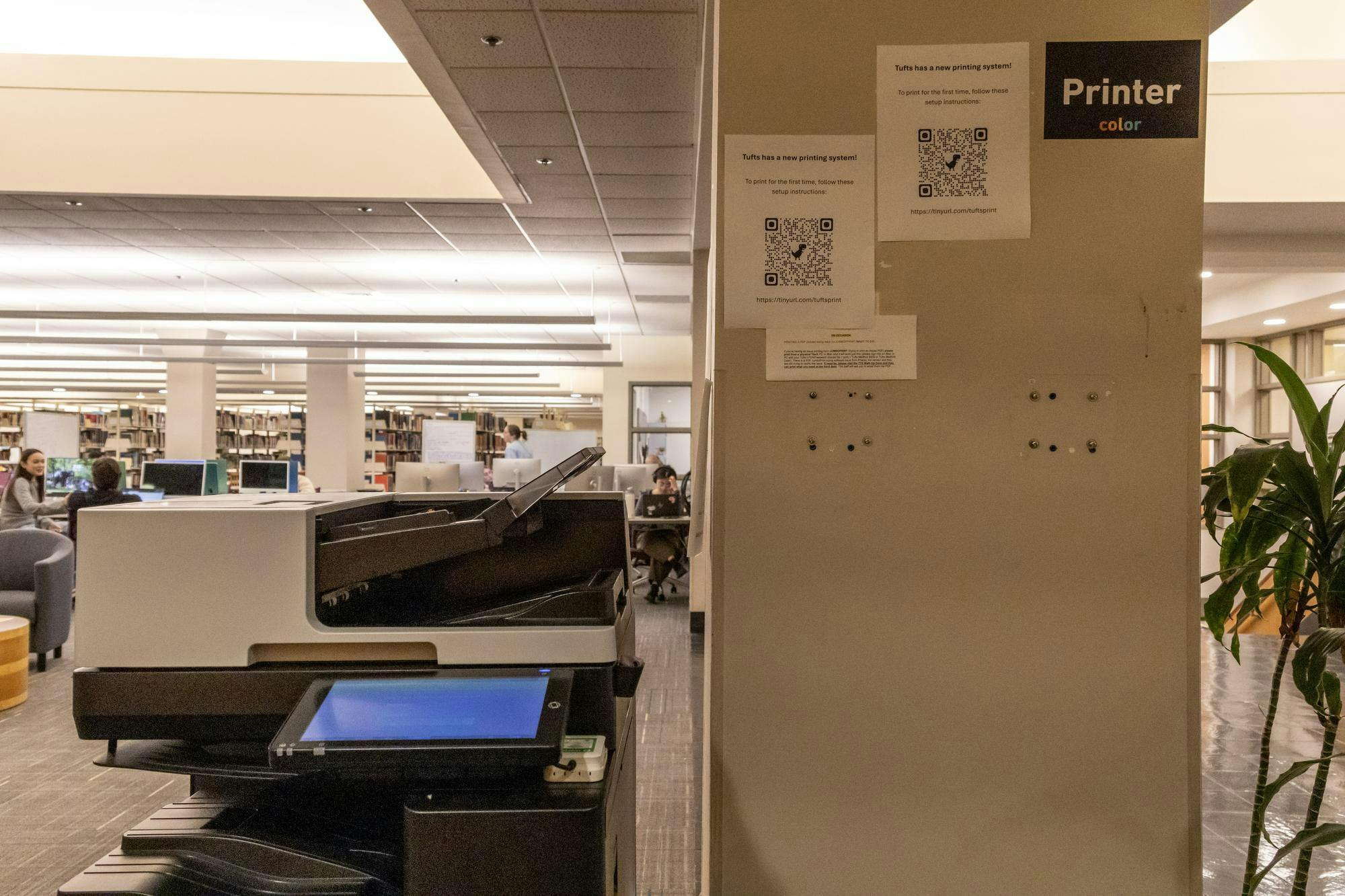
Printing is one of the age-old elements of college life that unites all Jumbos. For those of you who try to avoid it, good luck if you have a professor who wants assignments turned in physically. Before the printing demand increased again this semester, Tufts University updated its printing service from Pharos Print to PaperCut Mobility Print and secured Ricoh and Canon as the printing hardware suppliers.
This was the first shift for printing at Tufts in 17 years. In 2009, JumboCash became the only way to pay for printing, replacing $10 complimentary print cards the university used to supply. The $10 stipend for full-time students ($5 for part-time students) is maintained even with the transition — be it online — and spillover costs draw from general JumboCash.
The change was long overdue. “The old fleet (predominantly Hewlett-Packard, but also some Konica units) was over ten years old, and we were having significant reliability issues,” Helen Rose, project sponsor and associate director of client support services for Tufts Technology Services, wrote in a message to the Daily.
Instead of heading to the JumboPrint site and uploading files to print, students now download software on their devices which connects them to the larger system. What remains the same is that when students submit a request to print something, they can print their documents from almost anywhere on campus.
Rose described the large undertaking of replacing the printing system at all of Tufts locations. She was hopeful that the reliability issues of the old system would be improved.
“The project entailed replacing all of the HP and Konica units with Ricohs … [and] included two external vendors and several teams inside of TTS,” Rose wrote. “We expect the new hardware and software to be easier to use, more reliable and be easily supported by our 7x24 Service Desk.”
Despite this, some students are not convinced of the new system’s effectiveness.
“I find that I’m unable to print from my laptop. … I can only do it from my phone, so every time I print, I have to send the PDF to my phone, which is inconvenient and annoying,” first-year Max Baldauf said. “There’s always a line of people at the printer who are still trying to figure it out.”
Senior Kate Weyant has experienced the same issue and even initiated a support ticket with TTS.
On the other side of the process, sophomore and TTS Walk-Up Tech Help Desk & Repair Center worker Aadi Aggarwal described issues he has encountered in helping students with technical issues. He explained that the beginning of the semester has been rocky since Tufts did not send out any communications about the system being switched.
“I think the success rate would have been higher initially when this school year began … if Tufts just sent out an email [to everyone] saying, ‘Hey, we changed the printer system,’” Aggarwal said.
Tech Desk workers were sent an email a couple of weeks before school started detailing the setup process and the particularities about the software itself. They were also instructed to set it up on their own devices to troubleshoot any issues they had before working through other students’ problems.
“[If] there’s an issue with JumboCash, because [PaperCut] is a new software, it’s unfortunately not a Tech Desk issue. It’s the software itself, and … the JumboCash system hasn’t transitioned over for some people,” Aggarwal explained. “For the most part, we’re helping people either print it at the desk for them if it’s under a certain amount of pages, or we’ll escalate it to … the group behind the software, and they’re currently working on a fix.”
However, some students have had positive takeaways from interacting with the new system.
“Once you get it set up, it’s very simple,” Baldauf said. “I press one button and then go to the printer and scan my card.”
Rather than uploading a document to JumboPrint, the new system streamlines the process into one button before scanning an ID.
“When it does work, it does work really well,” Aggarwal said. “All you have to do the first time you use the new printing system [is] … log in with your Tufts login. After that, as long as you send it correctly through your printer queue and your laptop, you tap your ID and you print it.”
The shift has also inspired students to think about what additional improvements and changes could be made for printing on campus. Weyant stated that the flexibility of the system is weakened by not having accessible documentation of all the print locations.
“It would be really cool if there was a map of all the printers on campus,” Weyant stated. “If I was somewhere on campus and I knew where the closest printer was, that would be awesome, as opposed to having to trek up to Tisch every time.”
Accessibility is not only a location-related concern; students also expressed concerns about the lack of free printing.
“My professor required us to print out an assignment that we had written the first week of classes, and I didn't know about this [new] printing system. … I had to run over to the sociology offices and then beg the office administrator to let me use her printer,” Weyant said. “I think students being able to access their department’s printer would be really awesome, especially if it’s a professor requiring you to print something, because we have to spend money on it.”
Many students want to see free printing return to Tufts. Printing was free until the spring semester of 2003 when it was removed because “soaring costs and wasted paper necessitated the implementation of the current Pay-for-Print system, under which copies and prints cost ten cents each.”
The Pay-for-Print system is still in operation, of course — but the prices now range from eight cents per page up to 30 cents for two-sided printing. However, some campus locations, such as affinity centers, do offer workarounds for students to get free printing.
Baldauf thinks the Pay-for-Print system is a fair option for students.
“It’s fairer if everyone pays for the amount of printing they use instead of it all being priced in … [as] someone could be exploiting that and technically getting more welfare out of that printing service,” Baldauf said.
Due to the confusion she experienced with the switch, Weyant is unsure if she’s being charged for printing, but believes that free printing would advance financial equity among students.
Similarly, Aggarwal said he feels that JumboCash serving as the form of payment is limiting PaperCut’s potential to be an efficient and effective service.
“I know [Tufts] gives us $10 to print, but given the fact that it’s such a basic necessity for students, everyone needs to print eventually,” Aggarwal said. “I don’t think the printing credits do enough in terms of ensuring that everyone can print. I think that people just should be able to print for free.”