Skip to Content, Navigation, or Footer.

Opinion


The Setonian
Opinion

Keeping state government functional

This fall, Massachusetts residents will vote on the ability of their state government to remain effective. On the November ballot, voters will consider Question 1, which proposes the elimination of the state's income tax. While many families could use additional money in these tough economic times, Massachusetts residents must recognize that taxes pay for vital governmental programs. In order to preserve these services, we urge residents to vote no to Question 1 and keep the income tax intact.


The Setonian
Opinion

Palin falls short at VP debate

On Thursday, there was unprecedented buzz concerning the vice-presidential debates. In light of the abysmal interview, Gov. Sarah Palin (R-Alaska) gave with CBS's Katie Couric, no one was expecting much of her. Republicans were anxious to see a performance that would put former Vice President Dan Quayle's now-infamous potato incident to shame. Democrats couldn't wait to see Sen. Joe Biden (D-Del.) tear the Alaskan hockey mom to shreds.


The Setonian
Opinion

Corrections

An Oct. 3 article titled "Tufts Mountain Club looks to get Senate funding for Trips Cabin" incorrectly stated that the Tufts Mountain Club owns the Loj. The university owns the house, and the student organization operates it. The Oct. 1 article "TCU senators may get assigned districts" had an accompanying box that incorrectly stated that senior Ryan Pallathra would represent Hillsides. Instead, the proposal listed sophomore Ryan Heman as the representative.


The Setonian
Opinion

A conflict of interest?

Anytime that oversight vacuums and taxpayer dollars come together, questions of whether conflicts of interest are involved always arise. Recently, United States Senator Chuck Grassley (R-Iowa) wrote a letter to the National Institutes of Health (NIH) requesting that they clarify the employment status of Dr. Marvin Konstam, who has been working as a senior adviser to the National Heart, Lung and Blood Institute (NHLBI) while simultaneously retaining his positions at Tufts Medical Center and Orqis, a private medical device company. It is too early to pass judgment, but in the meantime, we support Grassley's efforts to get to the bottom of the situation.


The Setonian
Opinion

Quilting is not a substitute for sexual assault education

On Sept. 26, a Tufts alum wrote an article in the Wall Street Journal lambasting female students at liberal colleges, and more specifically, at Tufts. Ashley Samelson recalls, with clear bitterness, the shock of joining the liberal community at Tufts after moving from the "reserved evangelical" community in her home town, Colorado Springs, Colo. She contrasts this college experience with her most recent college encounter, that of taking her younger sister to Hillsdale College in Michigan.


The Setonian
Opinion

Low expectations

On Thursday night, family rooms and dormitory common rooms across the country were packed in anticipation of the vice presidential debates. With Sen. Joe Biden's track record of either horrific slip-ups or marvelous triumphs and Gov. Sarah Palin's abysmal interview with Katie Couric still fresh in the minds of Americans, supporters of Sens. Barack Obama (D-Ill.) and John McCain (R-Ariz.) alike gathered around their television sets with bated breath and that buzzing excitement that comes with knowing that anything can happen. While it can certainly be agreed that neither candidate crashed and burned, success, as we all know, is relative and, in the case of Palin, it may have had less to do with her ability to answer tough questions honestly and effectively than the painfully low expectations many in both parties held for her.


The Setonian
Opinion

Voting in college not as easy as it seems

Today, a typical American man sits at his desk in his office and contemplates which candidate will receive his vote on Nov. 4. He knows that this will be a very important election in the midst of a financial crisis, so he must weigh his options carefully. He might even be wondering how to get to the polls on Election Day, but his electoral worries do not extend much further than this. This man is a registered voter.


The Setonian
Opinion

Making ourselves heard

This election is about us … or so all the political pundits tell us. We've all heard the phrase "the Democrats/Republicans could win if the youth vote turns out this time" ad nauseam at this point. But it is a big "if."


The Setonian
Opinion

Mikey Goralnik | Paint The Town Brown

The instrumental solo has, sadly, long been one of rock music's most celebrated live gimmicks. It always kills me when the band clears out some space during a song for one of the members to literally mess around for a while or to play the same solo that's on the record and the person next to me geeks out like it's the most incredible thing ever.


The Setonian
Editorial

From the Office of the Tufts Daily

Dear Tina Fey, As you prepare for your highly-anticipated debate with Joe Biden tonight, we at the Daily thought you might appreciate hearing a few pointers:   1) You might want to think about putting a stop to your impersonator, Sarah what's-her-face, who keeps saying things like, "But one in five jobs being created in the trade sector today, we've got to look at that as more opportunity. All those things under the umbrella of job creation. This bailout is a part of that." She's totally stealing your act; the comically ignorant vice presidential candidate is a tough character to master.   2) Brushing up on your foreign policy experience couldn't hurt. Sure, video clips from your "SNL" days have made their way around the world via the Internet and you live in the cosmopolitan city of New York, but it's not real experience until you've met with world leaders. Try speed dating at the U.N.; we hear that's fun.   3) Put all that "Baby Mama" (2008) drama behind you. If there's one thing America hates more than an assault on the traditional ways of baby-making, it's when such actions are promoted via a Lorne Michaels-produced post-"SNL" flop. The world knows you're capable of getting pregnant, as you demonstrated in 2006, so maybe it's time to give that another go. Then give birth two days before the election and nobody would dare vote against (or interview) you. 4) Make sure you channel your mediating skills that worked so well for the high school girls in "Mean Girls" (2004). I mean, it's not like Joe Biden is going to call you a drug pusher (well, maybe), but it's good that you know you can hold your own (confidence is always a plus). Oh, and if you spill coffee on your sweater and need to take it off, make sure you don't take the bottom layer with it. Showing your bra on national TV might be embarrassing… The Arts Department has faith in you and is certain that victory shall be yours. Keep these pointers in mind, good night and have a pleasant tomorrow! Sincerely, The Daily Arts Department


The Setonian
Editorial

Starting a needed dialogue

    Most Tufts students have their fair share of pet peeves. Some are even quite vocal about them. But even for the most miffed of students, Tufts Community Union (TCU) senators don't usually make it onto the radar. But senators are looking to change that, and we are cautiously optimistic.     The Senate is currently considering a proposal that would give each undergraduate senator a "district" consisting of at least one dorm to represent. This would allow them to further inspect the issues facing individual residential communities and would potentially open new avenues of communication between the Senate and the student body.     As part of the plan, senators would hold at least half of their office hours in dorm common rooms rather than in the campus center. They would be able to collect comment cards, hear student complaints and take those concerns to the Senate as whole. By having a more direct line of communication, they would be able to submit more informed and effective proposals to the Senate floor.     That is, as long as students talk to senators and they, in turn, create concrete policy proposals. There is a largely unnoticed but very real barrier of apathy separating students from their senators. Students care about the issues, but often lack the confidence that expressing opinions to senators can lead to change. Senators, for their part, sometimes get lost in the clouds and forget that it is with the meat and potatoes that they can win respect.     This new proposal has the right ingredients to keep the Senate on exactly that track. Tufts, for example, has numerous dorms that could benefit from an injection of student leadership. The Office of Residential Life and Learning (ORLL) has left many students dissatisfied, and there is certainly no shortage of problems to fix. By getting paired with dorms, the senators could become better advocates for residential issues and strengthen the residential communities.     The challenge ahead is the translation of the idea into a reality. This proposal is certainly not the most important to come out of the Senate recently, but it will serve as a microcosm of the body's interaction with students.     In this effort, perspective is important. In 2007, the Senate formed a liaison program that paired its members with student organizations. As part of the initiative, senators attended several club meetings to gauge how the Senate could better serve student groups. Despite the liaison program's potential, it ultimately did not achieve its goals. Individual senators were often wallflowers at meetings and the program is currently being restructured. The Senate must take great care moving forward with its new system to ensure it does not meet with the same fate. New communication channels must lead to improved student representation and clear action. Otherwise, they are irrelevant.     When Duncan Pickard was running for TCU president, he spoke of the need for a better flow of information between the Senate and the student body. We endorsed Pickard in part for this promise and are happy to see  him and other senators make attempts to follow through.    


The Setonian
Opinion

Political posturing gone awry

Yesterday afternoon, the House fell 12 votes short of the majority needed to pass an unprecedented and controversial $700 billion bailout package designed to avert the looming financial disaster. The (at times) bipartisan cooperation on the issue quickly crumbled as the Democrats castigated the two-thirds of Republicans who voted against the measure, and John Boehner, the House minority leader, blamed Speaker Nancy Pelosi's "partisan" speech for turning off Republican congressmen.


The Setonian
Opinion

Jessie Borkan | College Is As College Does

I cannot be alone. I can't eat alone, walk alone, pee alone, work alone, work out alone — hell, I can't even sleep alone, which is why I brought the embarrassingly named Bunny-Bun to school.


The Setonian
Opinion

Science and the 2008 Election

            Last Thursday, the Chinese spacecraft Shenzhou VII rocketed into orbit carrying three taikonauts bound for China's first spacewalk, which was completed successfully on Saturday. What are the chances that the Chinese will beat the American expedition to the moon set for 2020? Rather likely, according to the Administrator of NASA, Michael D. Griffin.     Several weeks prior, the 27 kilometer, $8 billion Large Hadron Collider (LHC) came online on the French-Swiss border. When the LHC becomes fully operational next spring, it will be capable of accelerating particles to energies unseen in 14 billion years, unraveling mysteries from the early days of the universe.     The United States' contribution to this project? Five percent of the budget. The current popularity of physics among students? According to one study, it is the lowest it has been since the 1957 launch of Sputnik by the Soviet Union. In a country where a majority of the population rejects the basic premises of evolutionary theory, where the purchasing power of the National Institutes of Health has declined by 13 percent since 2003 and where students fare only slightly better than the average on international math and science test scores, the above may not be so shocking.     America remains the world's technological and scientific leader, producing about 40 percent of research and development expenditures, 70 percent of all Nobel Prize winners and containing 75 percent of the top research universities. But how long can the United States maintain its competitive advantage?     As the 2008 election draws near, it is time for us to carefully consider what the next four years will look like for the United States in a science-dominated world. The last eight have seen a presidential administration that has, among other things, misrepresented and altered scientific reports for its own ends, slashed research funding, dismissed climate change, advocated for the teaching of creationism in schools and ignored the scientific community. The results of these policies have been, to put it lightly, highly unfavorable. Researchers have fled to friendlier environments, the threat of climate change remains unmitigated, science education in public schools is dismal and the list goes on. In the meantime, countries as diverse as Ireland and China have invested in developing technologically sophisticated workforces, have funded new and exciting ventures and have attracted many of the same leading researchers and students that once came to the United States. As we enter what some have called a golden age for science, the United States remains grossly unprepared.      When the electorate cannot understand the fundamentals of climate change, the differences between scientific fact and theory or the issues behind the autism-vaccine debate, we as a nation face grave problems. But why should these subjects matter to the average voter? Ignoring the possible catastrophic ramifications of global climate change, the remaining topics offer a fundamental insight into how science affects our daily lives. Take evolutionary theory, for example. When the SARS virus outbreak spread through China, scientists rapidly employed DNA microarrays and compared the composition of the SARS virus with that of known viruses. Within one day researchers had assigned the virus to a particular evolutionary family of viruses and characterized its common traits. A blood test to screen for the virus was then developed and work began in search of a vaccine.     Take the second example of the autism-vaccine debate. After the publication of the controversial Wakefield paper (1998), many wondered whether a link existed between the measles-mumps-rubella vaccine (MMR) and autism. Hundreds of families with autistic children rallied behind the idea that vaccines caused autism and hundreds more refused vaccines for their children. The Wakefield research, however, was largely discredited and serious ethical breaches were observed in the study. Wakefield may now be barred from practicing medicine in the United Kingdom if convicted of the charges brought against him. Unfortunately, the resulting frenzy ensured that many children were not vaccinated and measles outbreaks have now occurred in countries ranging from Britain to Israel. Despite 11 studies showing that the MMR vaccine does not cause autism, many continue to ignore the dangers of stopping vaccinations.     We can clearly see that in one case, evolutionary theory helped to identify a potentially devastating disease, while in another, scientific misunderstanding endangered the lives of thousands of children. So, why isn't science viewed as a more important priority?     Efforts to inject science into the presidential debates have proven largely unsuccessful, despite attempts by the organization Science Debate 2008. The group has garnered the signatures of leading American scientific organizations and over 175 universities (including the support of Tufts University and President Bacow). Though neither Sen. Barack Obama (D-Ill.) nor Sen. John McCain (R-Ariz.) accepted the offer to participate in a live debate, both presidential candidates submitted responses to 14 questions posed by the group.     The candidates' answers reflect a commitment to preserving the integrity of science during their respective administrations, increasing funding and addressing issues ranging from climate change to restoring America's technological superiority. Nevertheless, real differences exist between the two candidates. While Obama draws upon advisers in the academic arena for his science policy (e.g., President Memorial Sloan-Kettering Cancer Center, Harold Varmus), McCain's experts come from more business and technology-oriented fields (e.g., former CEO of Hewlett-Packard, Carly Fiorina). Obama supports embryonic stem cell research, while McCain's views are unclear. McCain argues for the prioritization of the space program, while Obama is more interested in addressing terrestrial concerns. The candidates offer both broad and specific proposals in their platforms that reflect their own unique perspectives on the issues. For those interested in finding out more about the candidates' views on a plethora of scientific topics, the Sept. 25 issue of Nature magazine and the Science Debate 2008 Web site both offer an in-depth overview of the candidates' platforms and views.     But no matter who is elected president on Nov. 4, I urge every single voter to carefully consider the ramifications of his/her presidential choice on the future of science in this country. Though financial affairs and international concerns will continue to dominate the news in the coming weeks, remember that while banks and administrations may rise and fall, the issues of climate change, energy independence, ethical concerns with biotechnology, the exploration of space, the strength of our workforce in the global technologically oriented economy and hundreds of other big and small issues will not go away. In fact, each day will bring new discoveries and challenges for the next president. The 21st century is upon us. The age of science is here.


The Setonian
Opinion

Understanding economic depression

"It's kind of like basic physics — what goes up must come down," former President Bill Clinton said of the economy in an interview with David Letterman on the "Late Show." Even so, when it seems like companies are falling left and right, many Americans are worried about just how low the economy can go. Yesterday, lawmakers reached a tentative agreement on a bailout bill that, if passed, would allocate $700 billion to buy out companies' failed loans. The bill, which will go to the House today for a vote,


The Setonian
Opinion

Surveying the problem

This year, Tufts' Health Service office has added an extra service to its repertoire. Students who go in for a regular checkup may get a little extra bang for their buck — an unwarranted, spontaneous mental health screening. In an attempt to curb depression, suicide and other psychological issues, the office recently began requesting students to fill out a survey used to evaluate their mental health. Although we recognize the seriousness of depression among college students and understand the need for more services to help students recognize and treat mental sicknesses, we question the validity and effectiveness of Health Service's actions.


The Setonian
Opinion

Mikey Goralnik | Paint the Town Brown

Let's play word association! "Pandas" — cute. "Sarah Palin" — librarian porn. "Boston clubs" — gold chains, yuppy dress code, hulking bouncer, red velvet walls, girls dancing in cages and a gigantic aquarium with exotic-looking fish.


The Setonian
Editorial

Emergency care has no language

    Among its diverse offerings, the ExCollege introduced a new course this semester entitled "Medical Spanish." The class, which is aimed at students considering careers in medicine, interpretation and social work, focuses on the specific vocabulary and skills necessary to translate between doctors and Spanish-speaking patients in emergency situations. During a time when immigration continues to be a hot political topic, this course acknowledges that, despite policy implications, all people who enter an emergency room, regardless of their native tongue, should receive the appropriate level of treatment.     While many Americans decry the use of bilingual signs and other tactics used to aid non-English speakers, this class has been greeted with enthusiasm from the Tufts community.             And that's a good thing.     Aside from English, Spanish is the most common language in the United States. As part of the 2000 Census, 28.1 million people living in the country indicated they spoke Spanish; just over half of them reported the ability to speak English "very well." The number of Spanish speakers has undoubtedly swelled, as immigrants from Latin American countries continue to settle in the United States. And in the case of medical care, this linguistic barrier can be the difference between life and death.     It is important to remember that this barrier also applies to legal residents and citizens, many of whom speak English well.  When faced with the frightening reality of a medical emergency, most people would feel best expressing themselves in their native language. Especially given the technicalities required for an accurate diagnosis, we should leave open as many options as possible.     Still,  classes like this certainly benefit undocumented immigrants as well. But while many argue that we should not cater to such immigrants — many of whom receive emergency-room care without paying taxes — that does not negate the fact that medical professionals  across the country are obligated to treat all patients equally and often lack the language skills to do so effectively. Something is obviously wrong with this situation, and proactive measures are a must.     Some say that undocumented immigrants take advantage of the medical system, waiting until their situations require emergency treatment that they can get for free. But so  do countless American citizens who cannot afford health insurance. Either way, ignoring the reality of the situation doesn't make it disappear, especially in cities like El Paso, Texas, where 74 percent of the population speaks Spanish at home.     Although most Americans consider English to be their native language, the United States remains without an official language — and for good reason. Throughout its history, the country has been heralded as a melting pot, one in which all people, regardless of their native languages, have been accepted into the population. Courses that focus on medical Spanish reflect the type of cultural fluidity that has come to define our country, while also allowing it to adjust to the times. Isn't that what a Tufts education is all about?


Op-ed submissions are an integral part of our connection with you, our readers. As such, we would like to clarify our guidelines for submitting op-eds and what you can expect from the process.

Read More
The Tufts Daily Crossword with an image of a crossword puzzle
The Print Edition
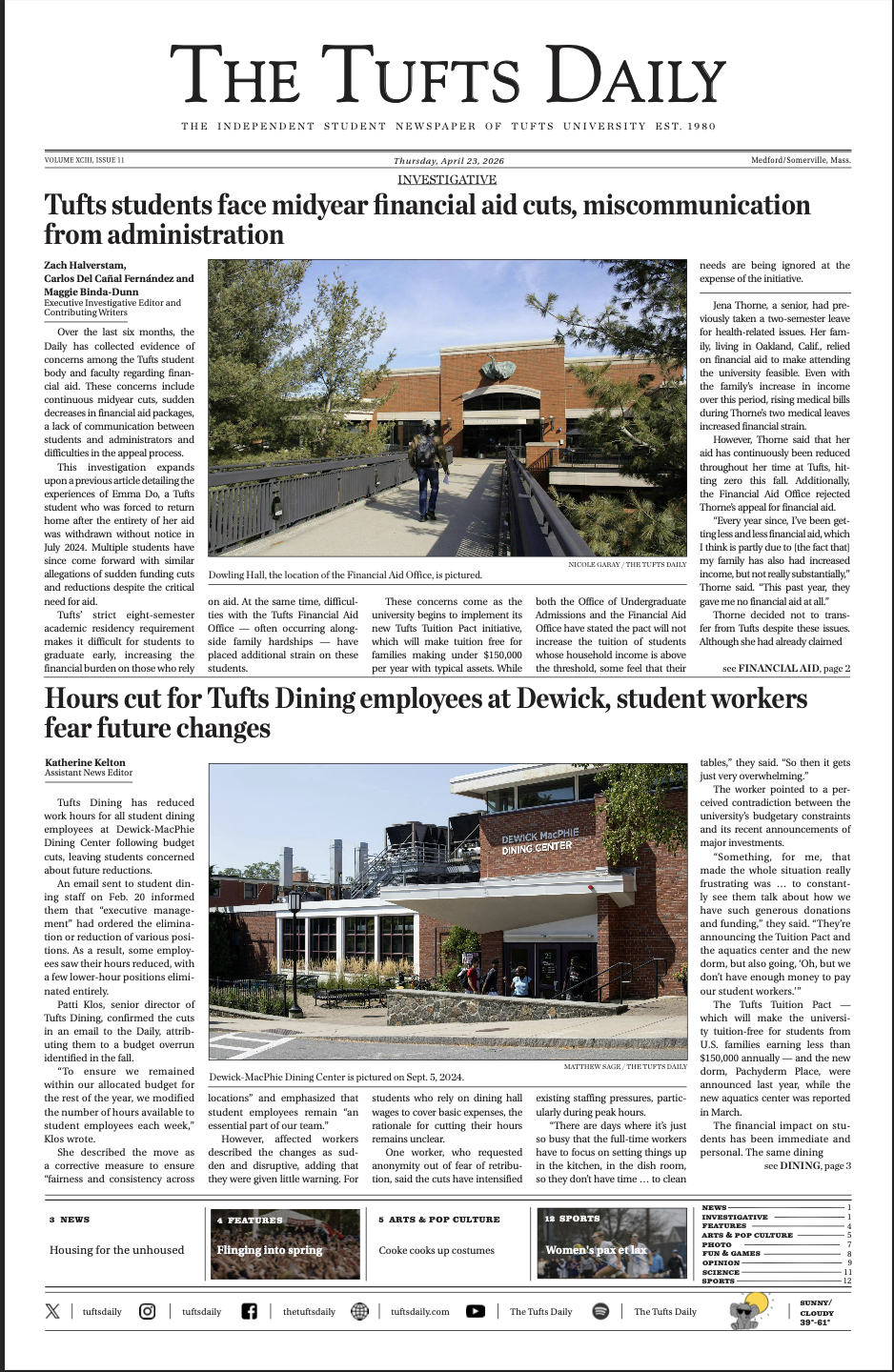
Tufts Daily front page