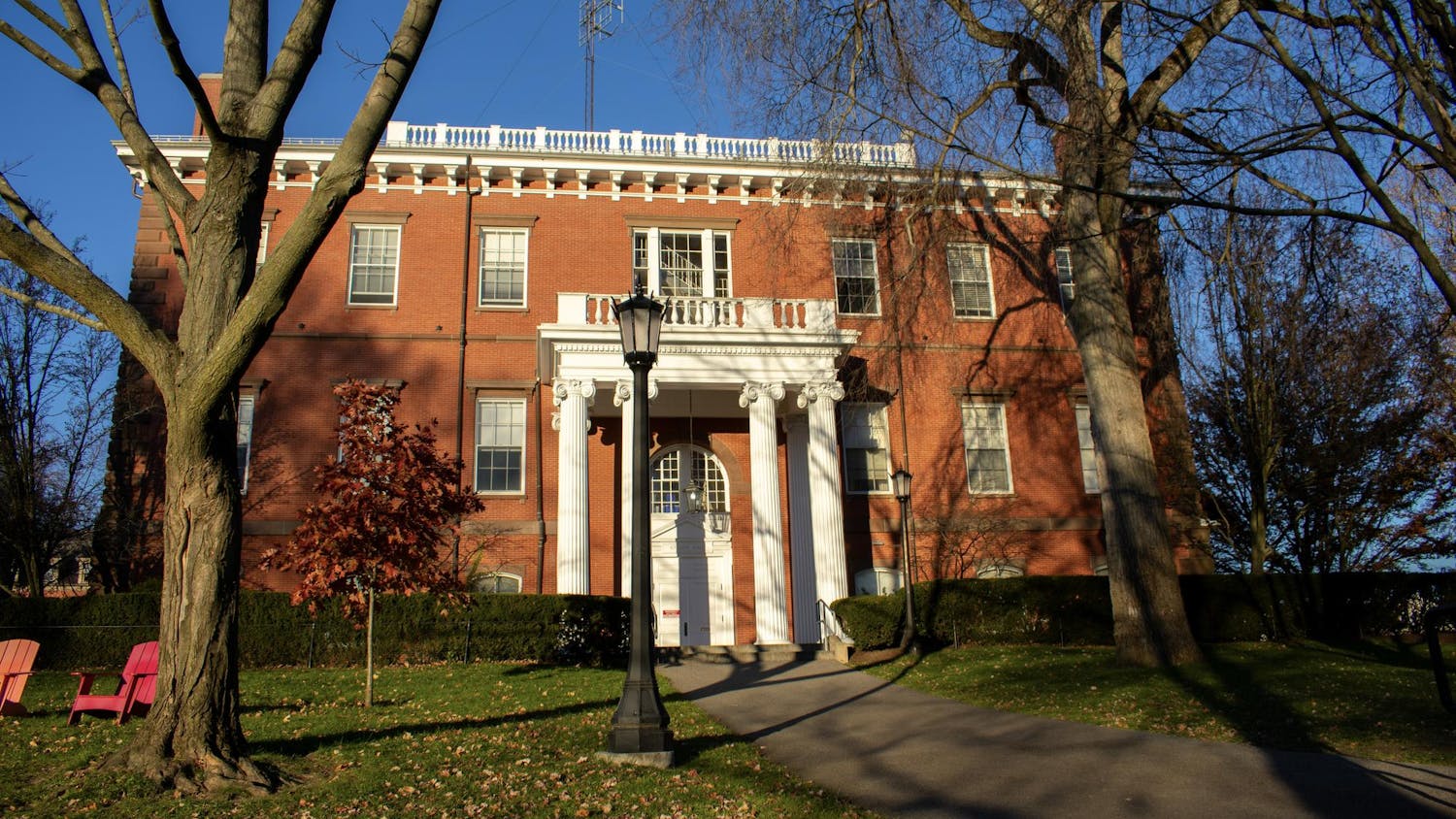
Associate Professor at the Harvard Business School Nava Ashraf delivered a presentation titled Do Gooders and Doctors: Evidence on Selection and Performance of Health Workers in Zambia yesterday afternoon in Braker Hall.
Ashraf presented findings from an experiment she conducted along with two research partners on the importance of differing motivations in civil service jobs. Ashraf concluded that motivation was significant in studying performance and selection, and that career-oriented people seem to outperform their socially motivated peers.
According to Ashraf, the quality of many public services depends heavily on the skills and motivation of those selected for the jobs. Such jobs have two main benefits. Some people enter civil service jobs thinking of their career track and the personal benefits they can gain the doctors. Others, the do-gooders, are socially motivated and want principally to serve their communities. These varying motivations can affect how well workers do their jobs.
The fact that these jobs have these duel attributes could pose a trade-off to the extent that career benefits could draw in people who have higher skills and social benefits could draw in people with motivations more in line with those of the organization, Ashraf said.
Currently, there is little empirical evidence to suggest one motivation is more productive than another, she explained. When her team learned that the Republic of Zambia was launching a new public service program by employing community members as Community Health Assistants (CHAs), she hoped she and her team could help to fill that knowledge gap.
This [program] allowed an opportunity to shape the job attributes to a new pool of applicants, she said.
Ashraf spoke a little about the state of community health at the time of the experiment. With over 12 million inhabitants and only 646 doctors, Zambia was experiencing a major health crisis, especially in rural areas where few doctors went. Government officials realized that fully-trained doctors were not needed to remedy many peoples health concerns, and so they decided to create a program that would train community members to provide services in their own neighborhoods.
The idea has been to select people from the communities themselves and upscale them, Ashraf said.
Ashrafs study was conducted during the governments first phase of its program, during which it recruited two CHAs from 165 communities.
Importantly, she said, the CHA programs mission was consistent with both kinds of job motivations social and career-oriented.
The government of Zambia very much wants people to advance their career and build up their skills, she said. They also really want people to commit to their community and serve for the social benefit.
Ashrafs experiment tested three things, she said. First, the researchers wanted to know if the mission expressed in the job application affected the applicant pool. They also tested how the mission affected decisions by the selection panel, which narrowed down the number of accepted applicants, as well as how applicants with different motivations ultimately performed.
What we actually looked at was whether, when you put weights on these different job attributes in terms of the mission of the job, do you get a difference, she said. Because of the way that we were able to design the experiment, we were able to separate out the effect of these attributes on selection from the affect on effort on the job. Performance is usually a combination of both.
To create conditions for the two different motives, Ashraf sent one of two separate application posters to various districts. Half of the districts received posters that emphasized the social benefits, asking people to serve their communities. The other half saw posters that stressed the personal benefits, such as boosting ones career. Ashraf explained that these conditions reflected the salience theory.
The neuro-foundations of that is just that we as human beings have limited attention, and if you emphasize one thing thats going to be at the top of your mind when your making the decision to apply, she said.
After conducting a series of psychometric tests, including one where people self-reported the importance of certain job benefits and another where applicants could anonymously give away part of their wages to patients, Ashraf and her colleagues concluded that the poster conditions reliably reflected applicants actual motivations.
[The results] lined up so well across all of these things, she said. They are all very correlated.
At the end of the experiment, Ashraf and her researchers found those motivated by career interests out-performed the socially motivated employees in making house calls to sick community members and administering diagnostic tests. They also tended to be more highly skilled in terms of their math and science knowledge.
The career poster drew in a significantly more skilled sample than the community poster, she said. The social mission treatment panel tried to choose the highest skilled of the applicants that they saw, but since they didnt have access to the highest skilled applicants that the career people did, they werent able to completely reduce the differential.
The experiment seems to suggest the importance of mission salience in job descriptions, and may have implications on the way that organizing bodies should try to attract civil service employees like teachers.
Research suggests that more of those community-oriented people are in these jobs, so if you never thought to emphasize [the career aspects], maybe thats the way of bringing out even more people, she said.