Dan Barber (LA '92) returned to his alma mater last night as part of the annual Janover Family Lecture Series to speak about his career and the future of food with Sarah Janover (LA ’85), former chief of staff at People Magazine. The event, hosted by the Experimental College (ExCollege), took place before a sold-out audience in Barnum 008.
Director of the Experimental College Howard Woolf gave the introduction, during which he announced a new minor for the environmental studies track — food systems and nutrition.
Woolf, who is also the associate dean of undergraduate education at the ExCollege, went on to speak to Barber’s career and accolades, highlighting Barber's multiple James Beard Foundation Awards — an honor frequently likened to the “Oscars for food.” He also spoke about Barber's spot as one of TIME magazine’s 100 most influential people and his status as a high-profile writer, as the author of "The Third Plate: Field Notes on the Future of Food" and numerous New York Times and Gourmet Magazine articles.
Janover relayed a series of student questions to Barber, to which the chef and writer detailed how he burgeoned from an uncertain senior majoring in political science to a world-renowned chef at Manhattan’s Blue Hill restaurant and Blue Hill at Stone Barns. Barber attributes his career path to former professor Sol Gittleman.
“It became senior year, [and] I had no idea what I was going to be doing," he said. "Every couple of weeks, I was calling [Gittleman’s] secretary … at that point, [he was] a little annoyed.”
Barber recalled Gittleman probing him with questions about what he wanted to do, and the first thing that came to Barber's mind was bread.
“[He told the class], ‘Don’t just go into finance. I met a person yesterday who wanted to become a baker,’" Barber said. "I didn’t want to let him down … A couple of months later, I was out in LA, baking bread.”
Other questions Barber answered hit on themes of forging a sustainable food system and reinventing the dinner plate, as well as the marketplace, in order to create a food culture that fits society’s needs better — all of which are concepts that Barber has championed in his book. Specifically, he spoke about how privilege restricts the ability of people to marry economics, nutrition and sustainability in cooking.
“My restaurant is certainly elitist," he said. "I charge a lot of money to sit in my restaurant, but my ideals are still egalitarian because they are about democratizing the food system … Flavor and good agriculture and good health are all the same subject."
In particular, Barber explained how the prevailing food culture in the United States differs from that of other countries like France and Italy and has perpetuated systemic food waste and overproduction. He highlighted how, historically, the country has enjoyed large farms that made ecological sense and also made the United States the agricultural envy of the world, but that this laid the foundations for the current issues that plague food production.
“The answer is not to go to small farms, [but]…we need to supply a market where the farmer can sustain a wide variety of crops, not a monoculture,” Barber said.
He explained that by incorporating crops primarily planted in rotations to promote healthy soil, people can ameliorate some of the most salient issues with modern agriculture. Many of those crops are often discarded or used for feed rather than taken to market, he said.
“The biggest challenge is that we are a country of waste ... we were horrifically wasteful because we produced so much...[and] wasted in ways that shocked Europeans," Barber said. "It was blasphemy happening at the dinner table."
He went on to explain that agricultural malpractices, degrading soils and ecosystems and food waste can be traced to problems with declining health. The result of a culture that inculcates a sense of waste could be that foods that are depleted of their nutrients, he said.
As for changes at the student level, Barber said there is a simple call for action.
“Cook — just cook … When you cook, you opt out of the food chain, and when you opt out of the food chain in this country, you are opting out of a lot of bad stuff…for health and the environment,” he said. “It is important to engage with food at a developmental level.”
Tufts alumnus and chef Dan Barber discusses future of food, envisions changing plate
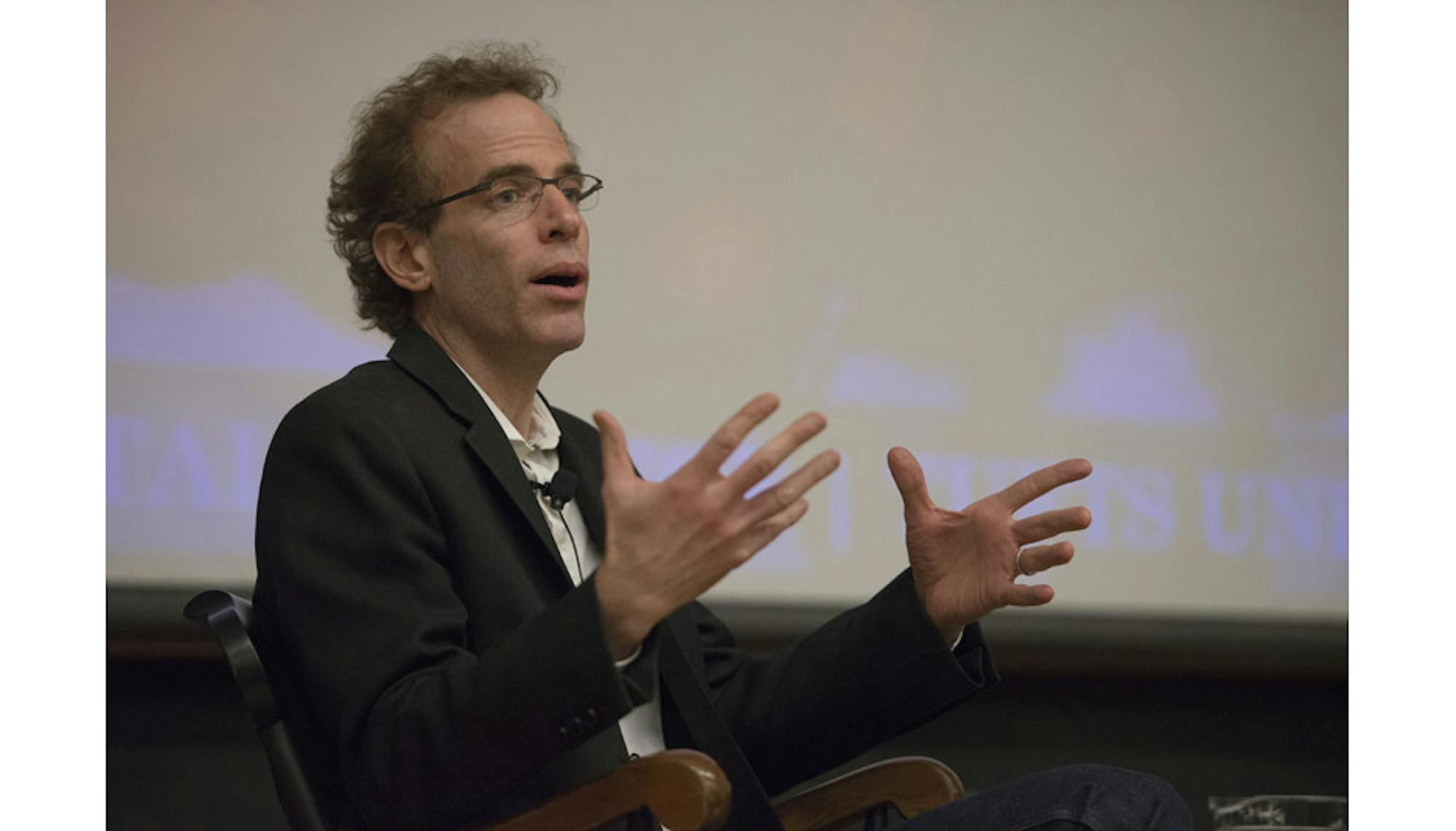
Chef of Blue Hill and Blue Hill at Stone Barns and author of "The Third Plate" Dan Barber speaks in Barnum 008 in a conversation with Sarah Janover hosted by the ExCollege on April 21.