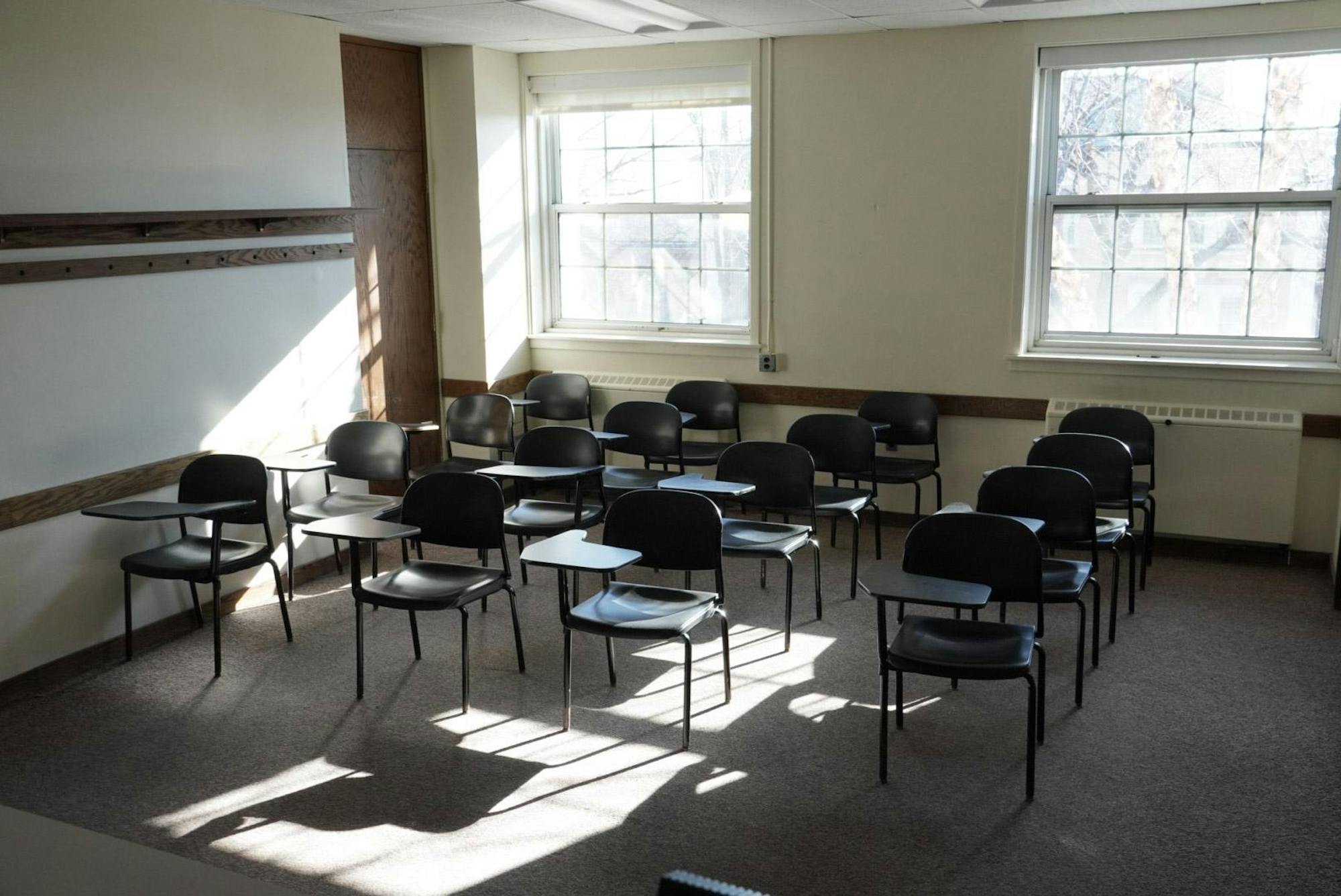
There’s a special kind of anxiety I feel sitting in a room full of students, suspended in the silence between a professor’s question and the first raised hand. As I’ve spent the past week preparing to teach a class as part of Tufts’ Explorations program — a part of our Experimental College in which upper-level students instruct incoming first-years about a topic of their choice and help them adjust to college — I’ve been thinking, and worrying, about that dreaded silence. Why, in so many classrooms full of skilled learners, is this such a familiar phenomenon?
If you’ve turned on the news at any point in the past decade, you’ve probably seen a rather insidious suggestion: political censorship. The phantom of cancellation, some claim, looms over the heads of well-meaning students, forcing them to bite their tongue on any speech that doesn’t fit their professor’s agenda. Particularly, this is a critique lobbied by conservative circles, who (admittedly correctly) point out that colleges tend to be left-leaning spaces.
However, the reality isn’t so simple. Data shows that the gap in self-censorship between liberal and conservative students is not as wide as it can often be made out to be, being only around 6% higher for conservative students. This is hardly a surprise in a day and age where a fellow Tufts student can be kidnapped solely for voicing a left-leaning opinion. And while these political fears are legitimate, they might merely be a scapegoat for a more deeply entrenched, self-censorship-causing fear: social anxiety.
Social anxiety can often be found lurking in the background of self-censorship issues. Of the 55% of Americans who said they censored themselves in a 2022 survey from The New York Times, 57% said they were worried about retaliation. However, even more people had social concerns; 65% were afraid of being harshly criticized, and a whopping 94% were trying to avoid conflict. These social anxieties thrive in the classroom, where self-censorship stretches beyond a student’s personal beliefs to their interpretations of books or solutions to math problems. Many students fear being judged by other students for a wrong answer, thinking it will reflect poorly on their level of intelligence. This isn’t a new issue, either; it’s a seed planted in our early years, watered by the hellscape of pandemic-era Zoom classes and blooming in a competitive academic environment.
As I approach teaching my students, I’ve been asking myself the question: What’s so wrong with being wrong? That feeling of shame or embarrassment that comes with a wrong answer is teaching us a lesson that shouldn’t go anywhere near our classrooms — that if we don’t feel 100% confident in our answers, we shouldn’t speak up. But while we may save ourselves a moment of unpleasant emotions, we’re in reality depriving ourselves, and our peers, from a crucial opportunity for learning.
Studies show that making mistakes in the classroom is an extremely effective learning technique, which makes sense: Why would we even be sitting in a classroom if we already fully understood what’s being taught? Unfortunately, shutting down instead of speaking up is a difficult instinct to train out of people. Our brains will oftentimes nearly shut down their centers of reasoning as a reaction to the fear of being wrong.
What we need instead are classrooms of students and teachers who are ready to accept and encourage mistakes. This doesn’t mean we shouldn’t help a person find their way to a correct answer, or educate someone if they say something unintentionally (or even intentionally) offensive. It means that we need to resist our urges to immediately correct and attack, and instead focus on the more nuanced process of educating. The most crucial first step to this process of education is creating an environment where making mistakes is normalized.
Now that I’m standing on the other side of the classroom, my biggest wish — my challenge to my students, to all students — is this: Speak up. Be proudly wrong, or proudly misguided or even proudly and unexpectedly correct. By doing this, we can take the first steps toward a new culture of being wrong and learning from our mistakes.