To understand why Geese’s new record “Getting Killed” — released Friday via Partisan Records — sounds the way it does, you must understand what came before.
On their 2021 album “Projector,” Geese presented itself as a weird indie band from New York’s underbelly, making dark, slanted art rock. On “3D Country” (2023), Geese pivoted to a full concept album, embracing mythology with falsetto and fiery, bombastic riffs — you would be forgiven for mistaking them for a Led Zeppelin cover act, just not the annoying kind. Then came “Heavy Metal” (2024), the debut solo album of lead singer Cameron Winter, which exchanged their huge sound for misanthropy and unforgiving sadness.
Beneath each effort thus far — with their varying claims to genre and style — has been a desperate grasp at an unknowable truth, an existential longing for more than their sound alone could provide. In other words, “Getting Killed” has been there all along: an album that does not synthesize the band’s sound so much as it sits it down, interrogates it and cuts it wide open. What spills out is messy, half-rotten, misaligned and distracted, but digs further into the unknown than the band ever has before. “Getting Killed” reveals the truth of Geese, the revelations that drive their art.
(Note: descriptions and reviews of individual tracks are absent here. It would be easy, even fun, to fixate on standout songs, highlight what makes them great, target the apparent filler, or revel in moments of pure shock and awe moments. But the record is created with the inherent value of the whole statement over the individual song, an idea with lineage from Prince to Mk.gee. Any other approach would betray that tenet.)
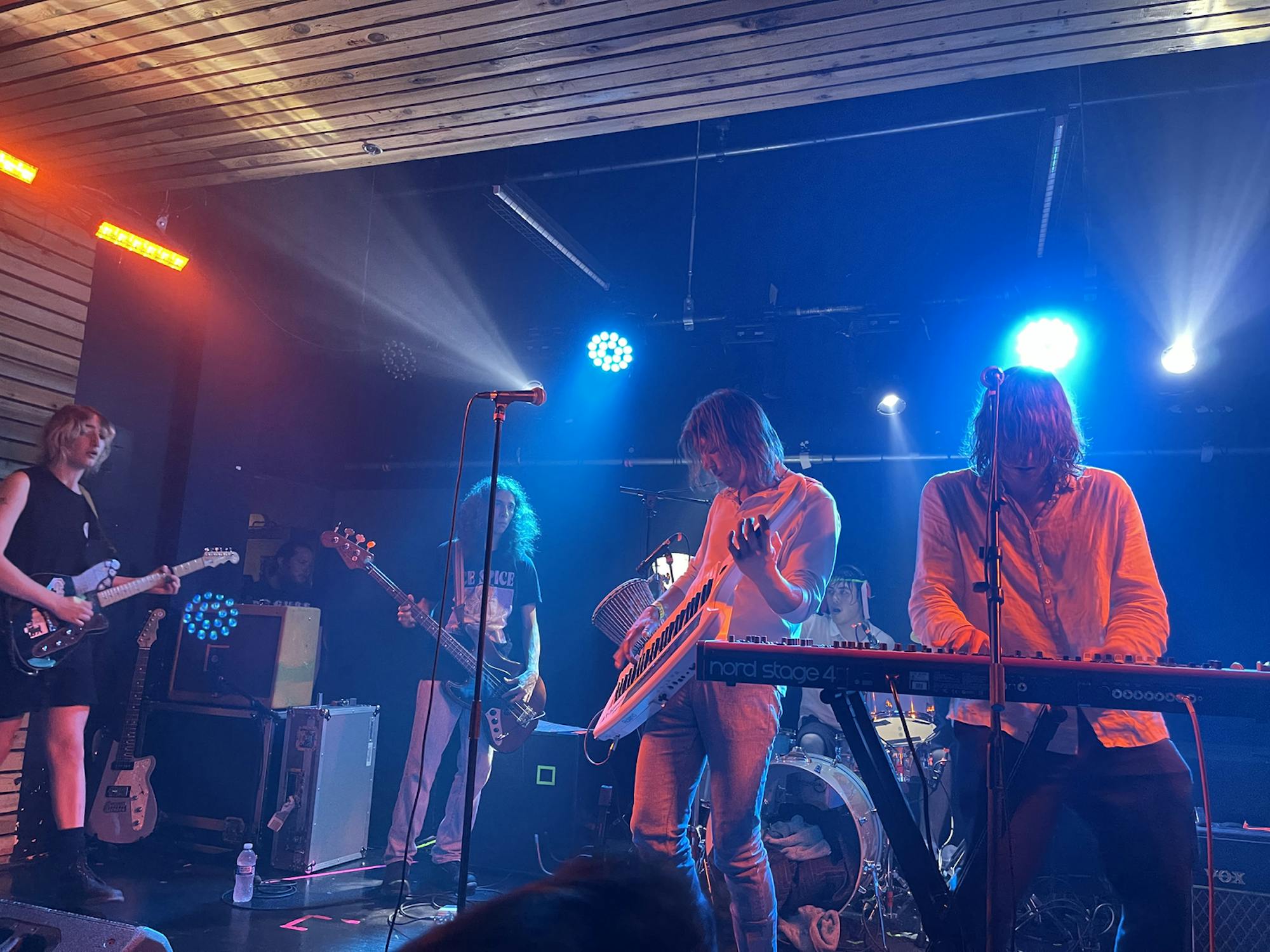
The record is unashamed. Instruments blend, bleed and glitch into and between each other. Winter sings as one might imagine he’s always wanted to sing, and he wants you to hear his lyrics so much that he shouts them, repeats them, drags them out and whispers them in your ear. Bassist Dominic DiGesu walks a slow, shuddering path; guitarist Emily Green wields her instrument like a weapon, alternating between bold, complex leads and fiery shouts of anger. There is not a percussion solo so much as a sea of rhythm, an undercurrent propelling every track, with drummer Max Bassin letting the typical kit take a back seat to a wider percussive toolbox of sounds that shake, ring and twinkle.
But “Getting Killed” is not at its best when it uses Ukrainian choir samples (the band really seems to want you to know it’s using Ukrainian choir samples) or sneaks in the voice of JPEGMAFIA. It’s not at its best when famed hip-hop producer and DJ Kenny Beats (now Kenneth Blume) reminds you that he is a famed hip-hop producer and DJ.
“Getting Killed” triumphs when it makes choices that nobody else would even consider — not for the coolness or indie cred of it, but simply because they can. Only Geese could feel comfortable enough to write the metaphor “like a sailor in a big green boat / like a sailor in a big green coat.” On “Getting Killed,” Geese have finally embraced all the strange ideas they’ve always had — which could be read as brilliance, self-obsession or (ideally) some combination of the two.
Perhaps the record’s most striking truth is its total abandonment of genre. A press release for the album described the band as “seemingly trading their love of classic rock for a disdain for music itself.” This is partly attention-grabbing writing and partly true. While the album might appear at times like a rock record, because it was made by a rock band using rock instruments, it never — not once — felt like rock ‘n’ roll to me.
So, what is it?
Throughout the 45 minutes of twisting, jittering, unrelenting music, the only grasp at categorization I could make came around the four-minute mark of the album closer “Long Island City Here I Come,” when something strange occurred to me: that this might be concert music.
“Concert music,” is a modern redefinition (or attempted redefinition) of what we colloquially call “classical music.” An eagle-eyed listener might find some interesting common ground between the classical genre and “Getting Killed” with its religious themes, formality and complexity in arrangement, the centering of emotion and grandiose scope. An even more eagle-eared historian might refute those commonalities, pointing to a closer allegiance with folk music. A further eagle-minded critic might raise larger questions: Since classical music is ‘art music,’ is Geese making art music? What do we gain from trying to apply outdated terminology to contemporary music-makers?
In its simplest terms, concert music is music that is made to be performed — and that is the only categorization that could (or should) be applied to “Getting Killed.” Indeed, this record, though it has been engineered and mixed like any other, embraces imperfection, improvisation and mistake-making in ways that most other records very distinctly do not.
The thesis of the record, the basis for its revelatory, driven-by-holy-inspiration intensity, lies in its rough and sharp edges. It chases after the idea — in the style of Romantic composer Gustav Mahler (in the words of musicologist Theodor Adorno) — that “fractures are the script of truth.”
“Getting Killed” is a sacred mess. It represents a strong evolution from both “Heavy Metal” and “3D Country” and offers a glimpse into new strains of contemporary music that are both lived-in and living. For a more corporeal performance, see Geese on Nov. 14 in Boston during their world tour.