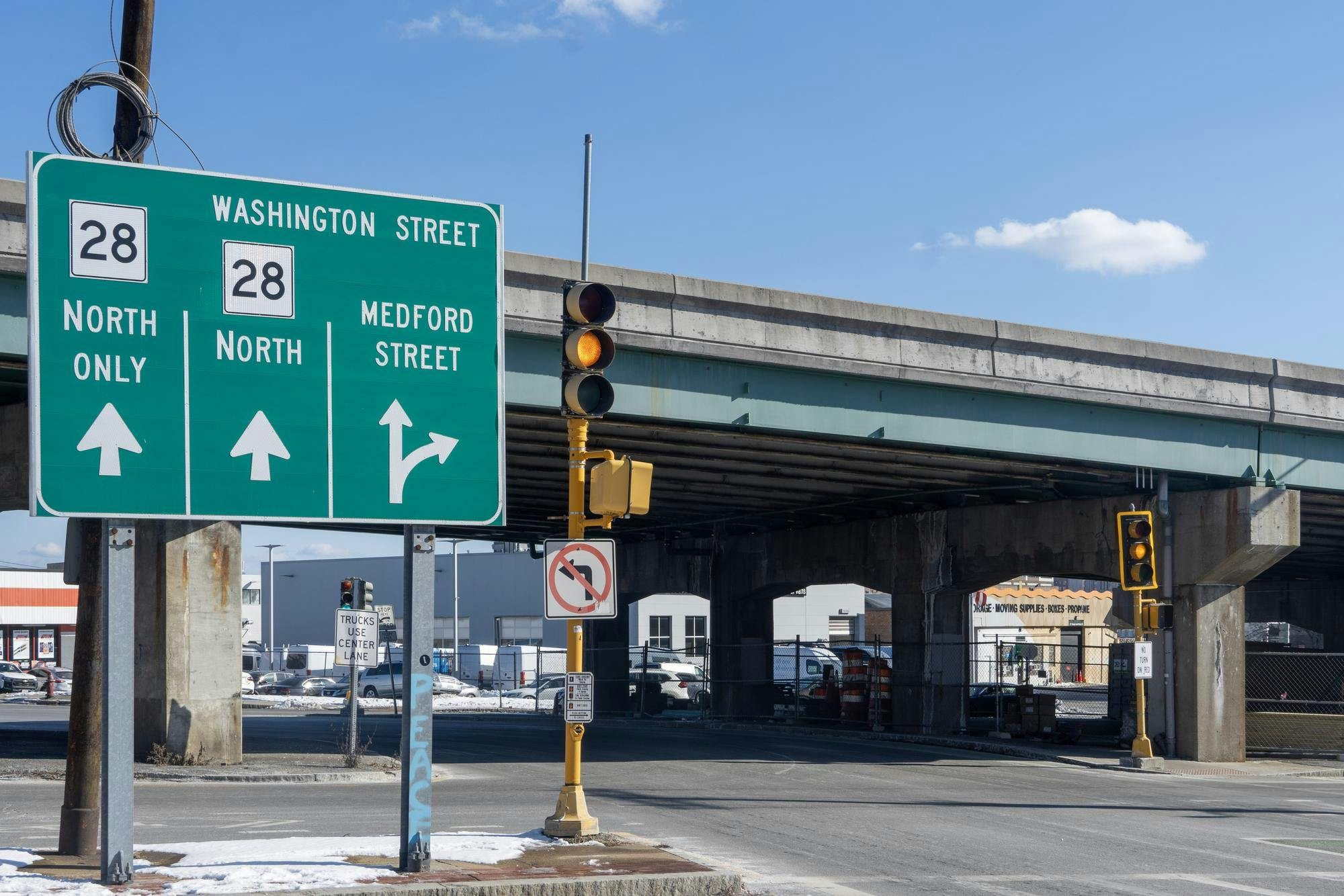
Medford is planning a citywide update to its wayfinding — the system of signs, markers and design elements that help guide people through an area — to improve navigation and highlight local landmarks.
The city’s Department of Planning, Development and Sustainability shared a survey for residents to provide feedback on their experience navigating Medford and to weigh in on potential signage options. The survey is offered in English, Spanish, Brazilian Portuguese, Haitian Creole and Arabic and is available until Sept. 30. The department aims to have a second round of public input later in the fall.
Medford Mayor Breanna Lungo-Koehn emphasized the importance of wayfinding in “[creating] a sense of identity and connection” to Medford’s local landmarks.
“Wayfinding is about more than just the signs; it helps our community be welcoming and accessible for all to explore,” Lungo-Koehn wrote in a statement to the Daily.
Based on survey results, Medford will seek signage recommendations from OverUnder, an architecture and design firm that has designed unique wayfinding for the city of Chicopee, Mass., and for Harvard University.
“[OverUnder has] been taking the lead on designing … offering ideas around the outreach strategy, and then implementing or showing up at these events and engaging folks in conversation, hosting focus groups and reporting back to us regularly,” Amanda Centrella, the city’s open space planner, said. “Then we collectively make choices about next steps.”
Medford and OverUnder are working in tandem with MassDevelopment, the state’s economic development agency, to finance the project and will provide the city with recommendations on signage details such as colors, materials and shapes.
OverUnder will also identify priority areas in Medford for new signage, given that the planning department may not receive funding for the entire project at once.
Signage will likely highlight business districts, commercial areas, squares, natural spaces, cultural and historical landmarks and transit stops.
“Good wayfinding connects different parts of the city, it makes the city easier to navigate and it also showcases local identity, so it can help visitors get where they’re going, strengthen a resident’s sense of identity … and bolster the local economy,” Centrella said.
Kayla Myros, Medford’s economic development planner, said that the wayfinding study could build on previous pedestrian safety efforts, including the Complete Streets project launched in 2019, which added curb extensions, beacons and pavement markings to reduce traffic and allow for safer traffic crossings.
The wayfinding plan also expands on the 2022 FindMedford pilot initiative, which focused on added wayfinding for cyclists and motor vehicles, as well as continuing to improve wayfinding for pedestrians.
“The idea with this is to make sure that all modes have the right signage, right information at the right scale. The scale for somebody driving and what that looks like is going to be different than somebody on foot or rolling or bicycling,” Myros said.
Survey results may also inform future bicycle and pedestrian safety efforts.
“What we’ve been asking of folks through various outreach methods is: what are pain points in the city for navigation and places that don’t maybe feel as safe for cyclists or pedestrians,” Centrella said. “We will have in place template signage as the city develops better or more pedestrian and bike infrastructure so we can tie into work that we’re doing in the future.”
Currently, funding for the wayfinding project comes from the Massachusetts Gaming Commission’s Community Mitigation Grant, which supports communities neighboring casinos by allowing them to apply for funding for community development projects.
City officials said the project would help draw people into Medford by improving wayfinding for casino patrons.
“The casino is a massive commercial presence in this region, and there’s a real opportunity. … Without proper wayfinding, [casino visitors might] bypass communities like Medford without even realizing it,” Centrella said. “Wayfinding is actually a real boon or tool to capture the interest of folks that may not be familiar with the area, especially, and are coming to this area anyway.”
Centrella also mentioned that many residents want more signage for Medford’s natural spaces.
“Twenty-five percent of [Medford] is open space by land area, which is pretty significant for a Boston metro area,” Centrella said. “We’ve been hearing from folks that more wayfinding installments that identify parks and open space for what they are … could be really valuable.”
Centrella echoed Lungo-Koehn’s sentiment about connection, adding that wayfinding can also draw attention to Medford’s lesser-known spaces.
“Medford has a lot of what a lot of folks consider our undiscovered gems,” Centrella added. “Wayfinding is an opportunity to connect people within the city and to strengthen or make more accessible, clear pathways between important places.”