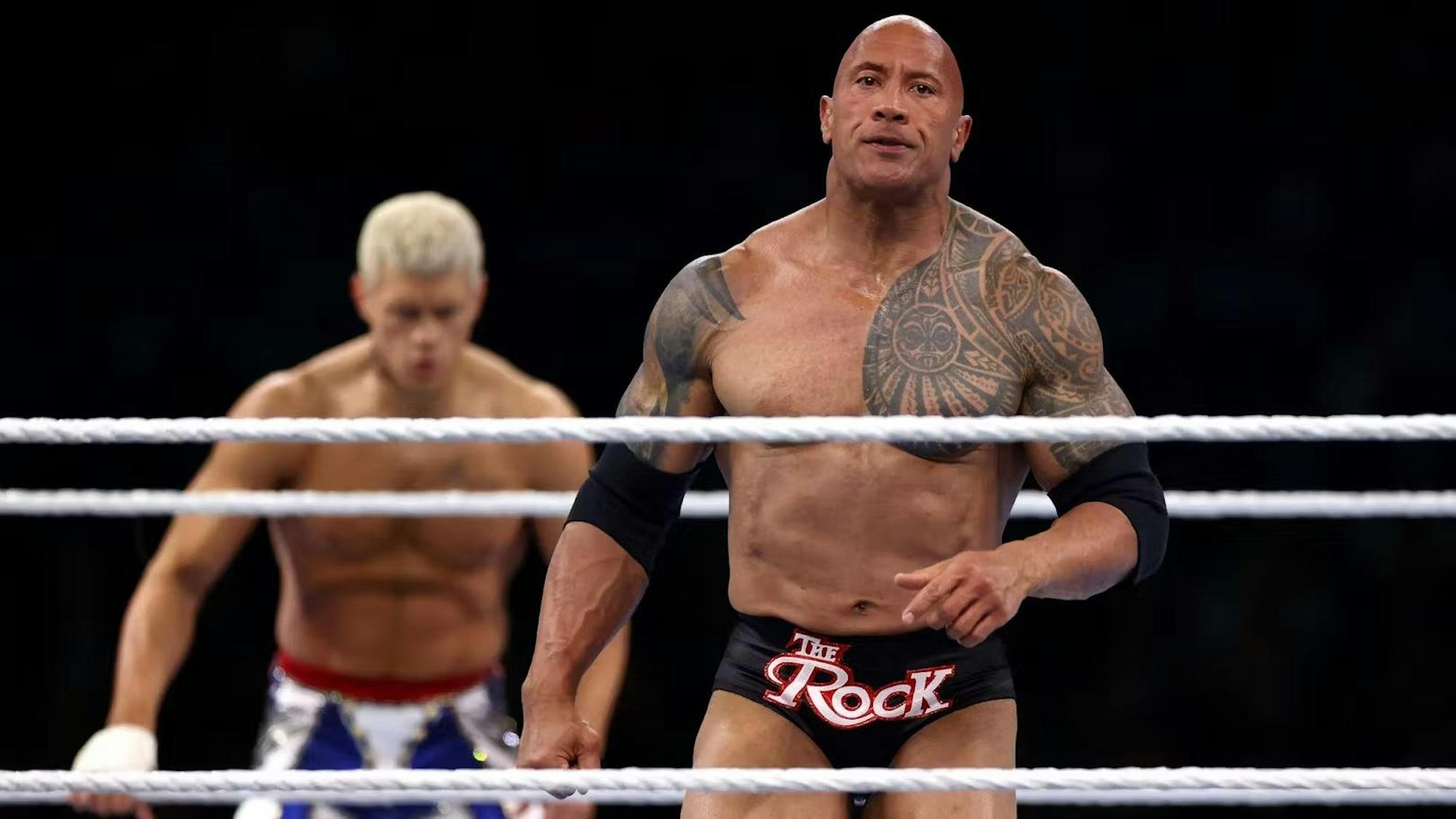
In the late 1900s, America began to champion a new type of gladiator — one that traded togas for spandex and amphitheaters for arenas. Still, their fights were primal and captivated the masses, earning them their daily bread. Perhaps one of the most beloved fighters of this generation is Dwayne “The Rock” Johnson, who debuted as a wrestler in the World Wrestling Federation, now the WWE, in 1996, and has since become one of Hollywood’s biggest stars.
But in “The Smashing Machine,” an understated yet affecting sports biopic from director Benny Safdie — one that this Saturday, won him the Silver Lion prize for best director at the Venice International Film Festival — Johnson imagines himself as an entirely different type of fighter. Safdie’s first solo feature tells the story of Mark Kerr, a star of mixed martial arts before the sport became a multi-billion dollar industry.
The opening introduces Kerr’s character at the genesis of his fighting career. Over grainy faux-celluloid footage of Kerr viciously beating his opponent in his first professional fight, a voiceover describes the unparalleled “high” of beating an opponent in the cage. Despite these animalistic qualities, Johnson’s character is unexpectedly soft-spoken. From interactions with his girlfriend Dawn (Emily Blunt), best friend and training partner Mark Coleman (Ryan Bader, an MMA fighter here making an impressively authentic acting debut) and even an elderly woman in a doctor’s waiting room, it is clear that outside the ring, Kerr is the antithesis of violence and brutality. Johnson plays the role to near-perfection; he is intense and sentimental in an unexpected showcase of emotional range for an actor previously viewed only as a box-office magnet.
Nonetheless, challenges to Kerr’s kind-hearted personality begin to arise as the plot gets underway. Early in the second act, substance abuse issues begin to disrupt Kerr’s comfortable life in suburban Arizona. Though he attempts to keep this affliction private by lying to pharmacy staff and carefully hiding needles from Dawn in the bathroom, this world can only be held together for so long.
It is this, the natural conflict between personal tranquility and professional savagery, that drives much of Safdie’s story. Though this framework is effective in creating drama, it can make the film’s emotional eruptions feel inconsistent. This is particularly the case for Kerr’s tension-filled relationship with Dawn. Though she is a naturally erratic character — certain late moments suggest she might be bipolar — her self-contradiction leaves crucial thematic moments feeling unmerited. The script largely neglects to explore Dawn’s character, and thus Blunt’s performance is left lacking credibility.
Yet pacing is far from an issue in the film. True to the form of some of his preceding features, Safdie, a genuine auteur, handled the editing himself. Though the film falters at times in weighing its events, the story flows with ease — thanks in part to a soundtrack spanning from Springsteen to Elvis’ cover of “My Way.”
It may only have one “Rocky”-esque training sequence, but “The Smashing Machine” is still unmistakably a film about fighting. Although the film’s fight scenes lack the brilliant staging of “Raging Bull” (1980) or the gritty realism of “The Fighter” (2010), Safdie’s controlled and precise style does enough to keep the viewer engaged. Additionally notable here is the strong work of the film’s sound department; every takedown is thunderous, and when Kerr takes brutal knees to the head it’s almost unbearable.
Throughout the film, Safdie carries a distinct visual continuity both inside and outside the cage. There is the warm, semi-antiquated color palette typical of similar recent A24 vehicles, such as“The Iron Claw” (2023) or “Mid90s” (2018), as well as handheld camerawork that attempts — mostly successfully — to lend the story intimacy. The film’s final scene, a cross-cut sequence following Kerr and Coleman, is perhaps its strongest, both visually and thematically.
Make no mistake: It is Johnson’s performance that elevates this work above an average sports biopic. The role calls for a delicate balance of tenderness and feral intensity, and Johnson disappears into it with triumph. Whether Johnson will end up with a trophy for his work is yet to be determined, but he’s clearly in contention. It’s strange to say that an actor who has already garnered billions of dollars in the worldwide box office is announcing himself to the world, but Johnson seems poised to redefine his career in Hollywood.
And Johnson is not the only contributor looking for a fresh start. For Safdie, the film is an announcement that he is fully capable of creating an engaging piece without his other half. Ultimately, “The Smashing Machine” is a testament to reinvention, both for the film’s characters and those who bring them to life. It is not a perfect film, but it wholeheartedly succeeds in touching an audience with a fresh yet familiar story.
“The Smashing Machine” premiered at the Venice International Film Festival. It is set to be released in the United States via A24 Films on Oct. 3, 2025.