Tufts’ Department of Psychology hosted an event on Saturday in Cohen Auditorium to celebrate the career and achievements of Professor Sam Sommers, who passed away on March 16. Sommers’ colleagues, students and children spoke at the event, sharing memories and tributes in his honor.
The event opened with a prelude musical performance titled “Guitar Time,” named after what Sommers called the tradition of playing music with his family and friends. The performance featured Sommers’ daughter Abby Sommers, his brother Ben Sommers, his college roommate and friend Michael Norton and fellow Tufts psychology professors Nate Ward and Lisa Shin.
Following the performance, University Chaplain Elyse Nelson Winger, University President Sunil Kumar and Dean of the School of Arts and Sciences Bárbara Brizuela delivered opening statements.
“I remember those first days as a Tufts community, in shock in the wake of Sam’s sudden and shattering death,” Winger said. “We knew a time would come to be together to celebrate Sam’s light and life with us at Tufts. Today is that day.”
Brizuela highlighted how students were deeply impacted by Sommers, consistently praising his teaching, humor and dedication. She read from several course evaluations that reflected this sentiment.
“Professor Sommers is by far the best professor I had this semester. He is an engaging and intelligent professor, and I imagine he is a great person,” Brizuela read aloud from one student’s course evaluation.
“They were very right,” she added.
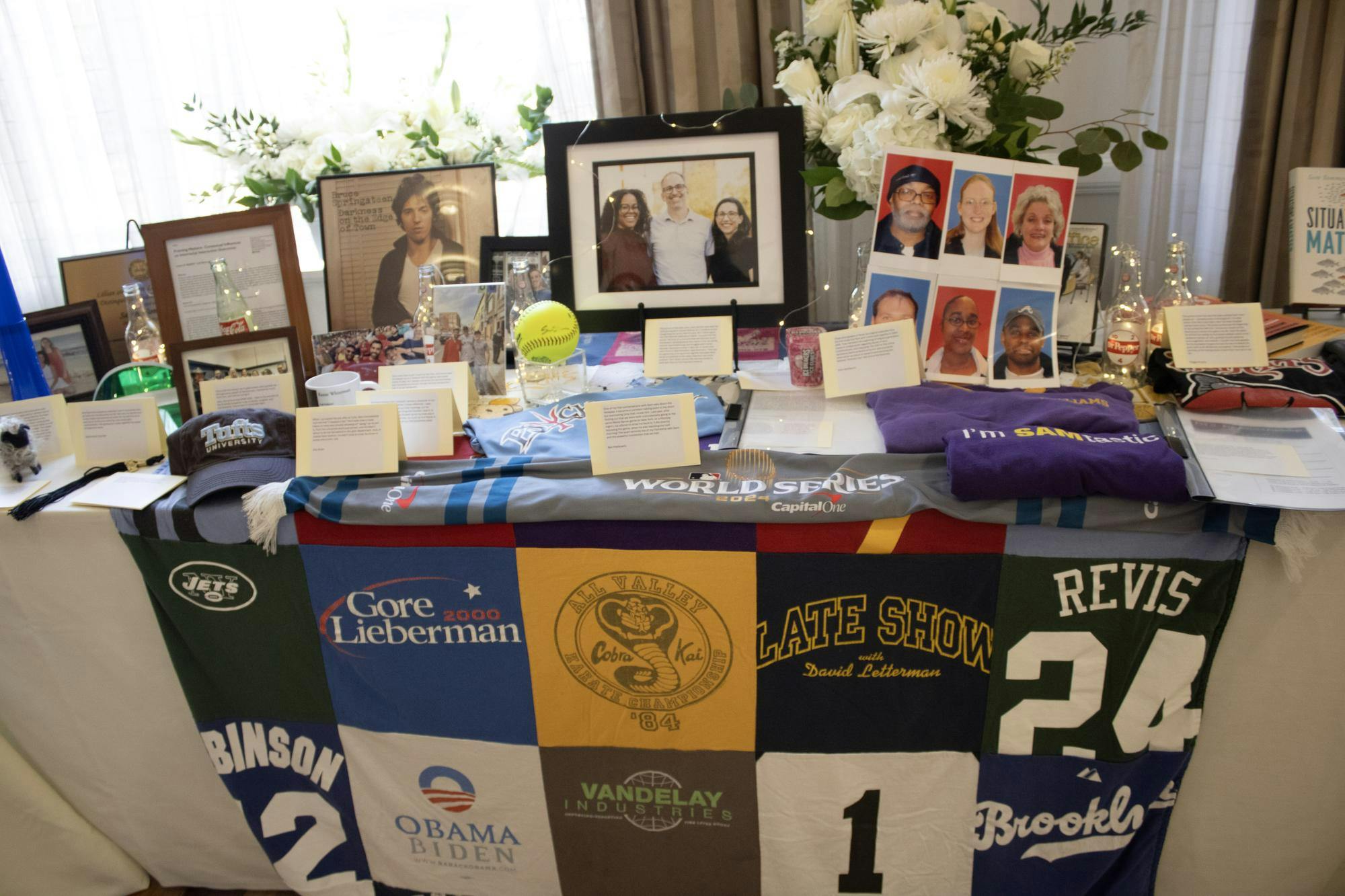
Heather Urry, a professor in the Department of Psychology, then introduced a “memory table,” a heartfelt collection of objects contributed by students, friends and colleagues that each represented a connection to the late professor.
Gifts ranged from Sam Sommers’ old syllabus for “Experimental Psychology,” given by Professor Phuong Dinh, who was inspired by Sommers’ instruction of the class as a student and later went on to become its instructor, to a 2024 World Series scarf from his former undergraduate student Ben Markowitz.
“The purpose of the memory table is to help tell Sam’s story at Tufts, making visible the intangible in many ways that he connected to his friends, colleagues and students,” Urry said. “We hope to celebrate and communicate Sam’s humor, the depth of his influence at Tufts and how much Sam loved this place.”
Following the presentation of the memory table, Sommers’ former colleagues Shin, Keith Maddox and Jessica Remedios made remarks.
Shin, who worked with Sommers for 22 years and regularly co-taught “Introduction to Psychology” with him, spoke of her admiration for his character.
“Sam’s personality was one of a kind, the unique combination of compassion, selflessness and fun,” Shin said. “He certainly treated his colleagues, friends and students like family, which is why this room is filled today and why there are hundreds more watching online right now.”
Maddox, wearing a Hawaiian shirt featuring Sommers’ face that was gifted to him by Sommers, spoke about their playful relationship as well as Sommers’ commitment to standing up against injustice. He compared their partnership to the buddy cop duo of Murtaugh and Riggs from the movie “Lethal Weapon.”
“Sam, like Riggs, was indeed a lethal weapon to injustice,” Maddox said, “But instead of a gun, a badge and his fists, he used a pen, a podium and his wits. If it concerned a challenge to diversity, equity, inclusion or justice, Sam was there, speaking for those without a voice.”
Sommers’ former students spoke next, including former graduate students Simon Howard and Mi’Lexus Milton, current graduate student Akil Atkins and Sommers’ former undergraduate advisee Evan Hayban.
“One of the main reasons I pursued a career in academia, to be a professor, is wanting to be the professor I never had. And I saw that in Sam Sommers,” Howard said. “His students adored him, not because he went easy on them, but because he treated them with respect, human[ity] and genuine care.”
Hayban described how Sommers supported him through struggles at Tufts during his first year.
“I expected to be scolded over my poor grades and my awful attendance, but instead I was greeted by the biggest smile I’d ever seen,” Hayban recalled of his first advisory meeting with Sommers. “And despite everything I was going through, I couldn’t help but smile back.”
Sommers’ daughters, Sophie and Abby, spoke before the closing remarks, sharing memories and stories about their father.
“I think we can all agree that there is nothing more reassuring during a crisis than a conversation with Sam Sommers, and I miss that so much,” Abby said.
Sophie shared memories of her father coaching her in basketball as a child, never giving up on her even when she did not make the team she hoped for. She also recalled how he drove all the way to campus to take her out for ice cream during her sophomore year.
“That’s exactly the kind of dad he was. Sure, he wanted me to have whatever I wanted always, but I also think he just wanted any chance to hang out with me, and even as the cool, independent college student that I was, I never passed up the opportunity,” Sophie said.