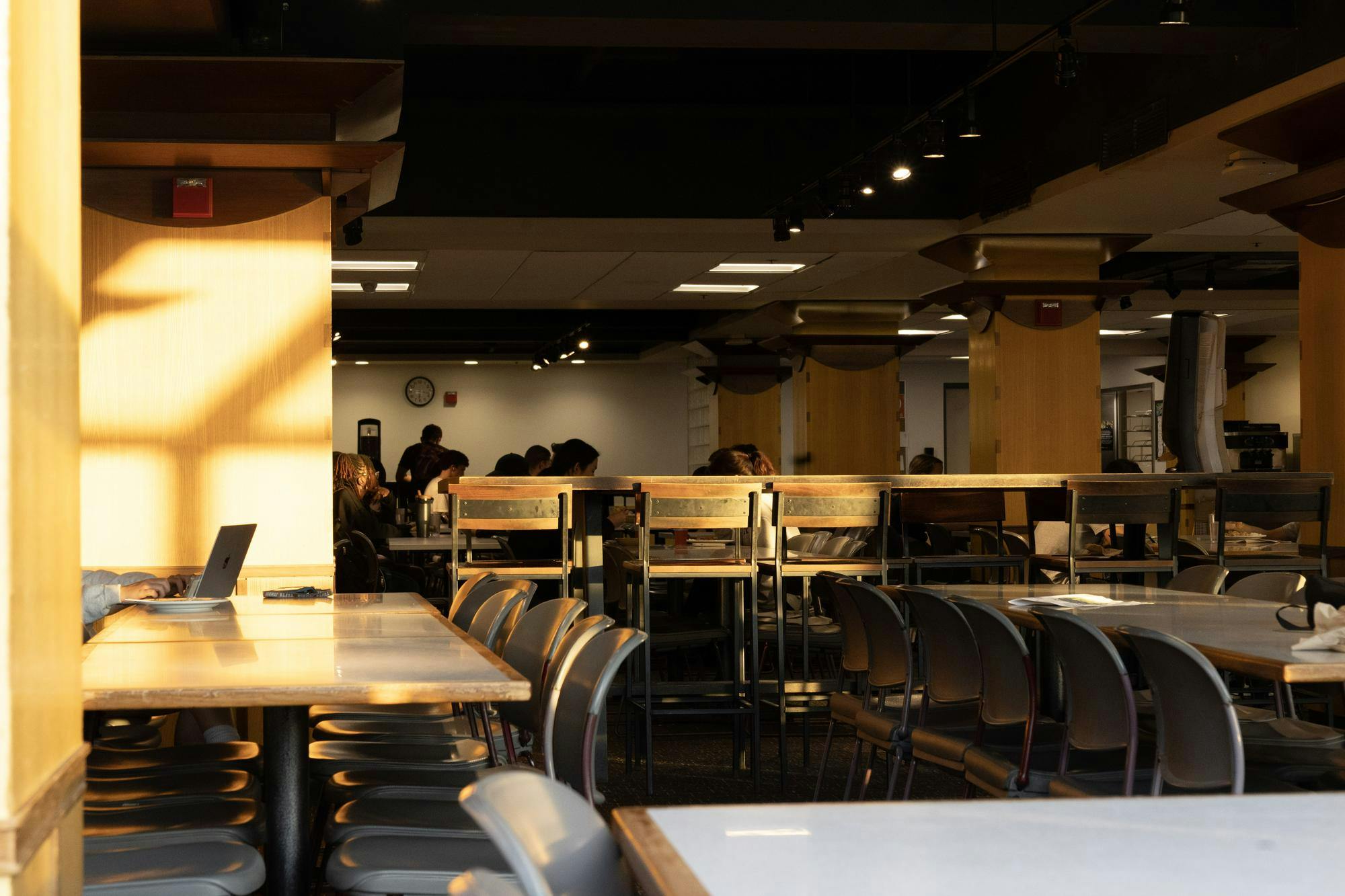
The Tufts undergraduate meal plans include six options, spanning from the “Full Plan” of 400 swipes all the way down to a 40-swipe plan. For first-years, the 400-swipe plan is required, while sophomores have the added option of a 220-swipe meal plan. Juniors and seniors are offered additional 160-, 100-, 80- and 40-swipe plan options.
As far as costs go, plans with more meal swipes have a lower per-swipe cost than plans with fewer swipes. This follows the principle of volume discounting, where sellers entice customers to buy in bulk with smaller unit prices.
However, upon closer scrutiny of the per-swipe cost in each plan, there is an alarming discovery: The costs per swipe — excluding the 400-swipe plan — are higher than the redeemable value of a swipe at Tufts Dining locations across all meal periods.
Below is a visual breakdown.


GRAPHICS BY ELLA SANDERS
When assessing the unit price of swipes in each plan, the data shows an overwhelming jump from $11.13 to $18.33 per meal swipe when moving from the 400-swipe to the 220-swipe plan. As the swipes per plan decrease, the price per swipe increases, with the 40-swipe plan priced at $19.35 per swipe. Notably, the increase in price per swipe occurs at a lower rate between the 220- and 40-swipe plans compared to the initial jump from 400 to 220 swipes.
Next, comparing these unit costs per swipe to the value of swipes at each meal period reveals a discrepancy: In no meal period does the cost of a swipe exceed $18.33, the price per swipe in the 220-meal plan. For instance, if one were to buy only dinners at $16.59 each, they are losing $1.74 per meal on the 220-swipe plan. Extending this logic to the 160-, 100-, 80- and 40-swipe plans, the monetary loss increases further.
Only students in the 400-swipe plan avoid losing money on lunch, dinner and late-night meal swipes. Only at breakfast, priced at $8.84, represents a $2.29 loss per swipe — though this is technically offset by the savings per meal when using lunch and dinner swipes.
Therefore, for juniors and seniors who are not required to purchase a meal plan, it seems that unless you are committed to the 400-swipe plan and consistently eating on campus, you would be better off paying with JumboCash or card at Tufts Dining locations.
For sophomores forced into the 220-swipe plan, the best way to maximize value is to use as many swipes as possible on dinners, followed by lunches and Commons Late Night.
Joon Guzman, a sophomore who worked at Hodgdon Food-on-the-Run last year, is currently on the 400-swipe meal plan.
“The pricing ladder felt a little bit predatory in a way — I don’t know if that’s too strong of a word,” Guzman said. “I would have done 220 if the pricing was more scaled to the value of the meal swipe, but it’s not, so I ended up going for 400 even though I didn’t really want to. I feel like that’s the same for a lot of sophomores too.”
Last semester, Guzman used about 270 swipes, bringing his average cost per swipe to $16.49 (based on 2025–26 meal plan values). He saved roughly $0.10 for every dinner swipe but lost $1.40 on each lunch swipe. He estimated his meal swipe breakdown: 40% for dinners and 60% for lunches, with negligible breakfast swipes as he did not usually swipe in during those times.
“The workers definitely care about the students … I just know that [Tufts Dining workers] also disagree with how the meal swipe progression has happened over these past few years,” he said.
The Daily reached out to the Tufts Dining team but received no comment.
George Blount, a lecturer at the Derby Entrepreneurship Center, is a financial therapist and behavioral economist who helps people understand their emotional relationship with money. His class, TGI111: Developing Financial Literacy, has expanded from 12 students to over 30 students with a wait list. Much of his work focuses on financial decision making, explaining that people see beyond dollars and cents and look towards factors like convenience and automation.
“How do we define value? Value is something that, when we talk about reduced prices or savings, [is] very, very quantitative, but value is [also] qualitative,” Blount said. “[Value is] determined by every single individual, and it’s determined by their lived experiences.”
He uses geography as an example. If a student comes from a manufacturing economy like India or parts of China, they are going to be able to determine value a little bit better because that’s how money is allocated in those economies. In comparison, economies like those of the United States, the United Kingdom and the United Arab Emirates are more discretionary, with people often willing to pay more for a better experience.
“In an overall budgeting sense, the meal plan allows you to have your meals taken care of at a cost that you are aware of, and it gives you the facility with your swipe to be able to go and do that without it affecting your overall budget,” Blount said.
“It’s a tradeoff, especially when you’re in college and you have so many things on your mind. Do you actually take value or add some additional premium to things that allow you to not think as much? A meal plan could do that,” he added.
“I think it’s more just like the security of knowing you can just get food whenever you want, not having to worry about it,” Guzman agreed.
Following this line of thought, for those that live on campus and may only have access to communal dorm kitchens, it may make sense to purchase a meal plan even if it is not the best financial deal.
Blount explained that meal plans are more than just food — they provide a service and an experience. Students are paying for prepared meals in a clean environment with staff support.
Blount often tells his students they must know their self-worth before they grow their net worth. In other words, for those weighing whether to buy a Tufts Dining meal plan, they must look inwards to understand what tradeoffs they are willing to make.
So maybe it is not about math after all. As the question of saving a few dollars and some change grows into much larger financial decisions, students may find self-reflection to be the best bench marker when assessing the value of their decisions.