In these times of turbulent change in our government, our communities and our homes, why does it continue to matter so fervently what is seen in our institutions? Why is it important for these familiar institutions to evolve now?
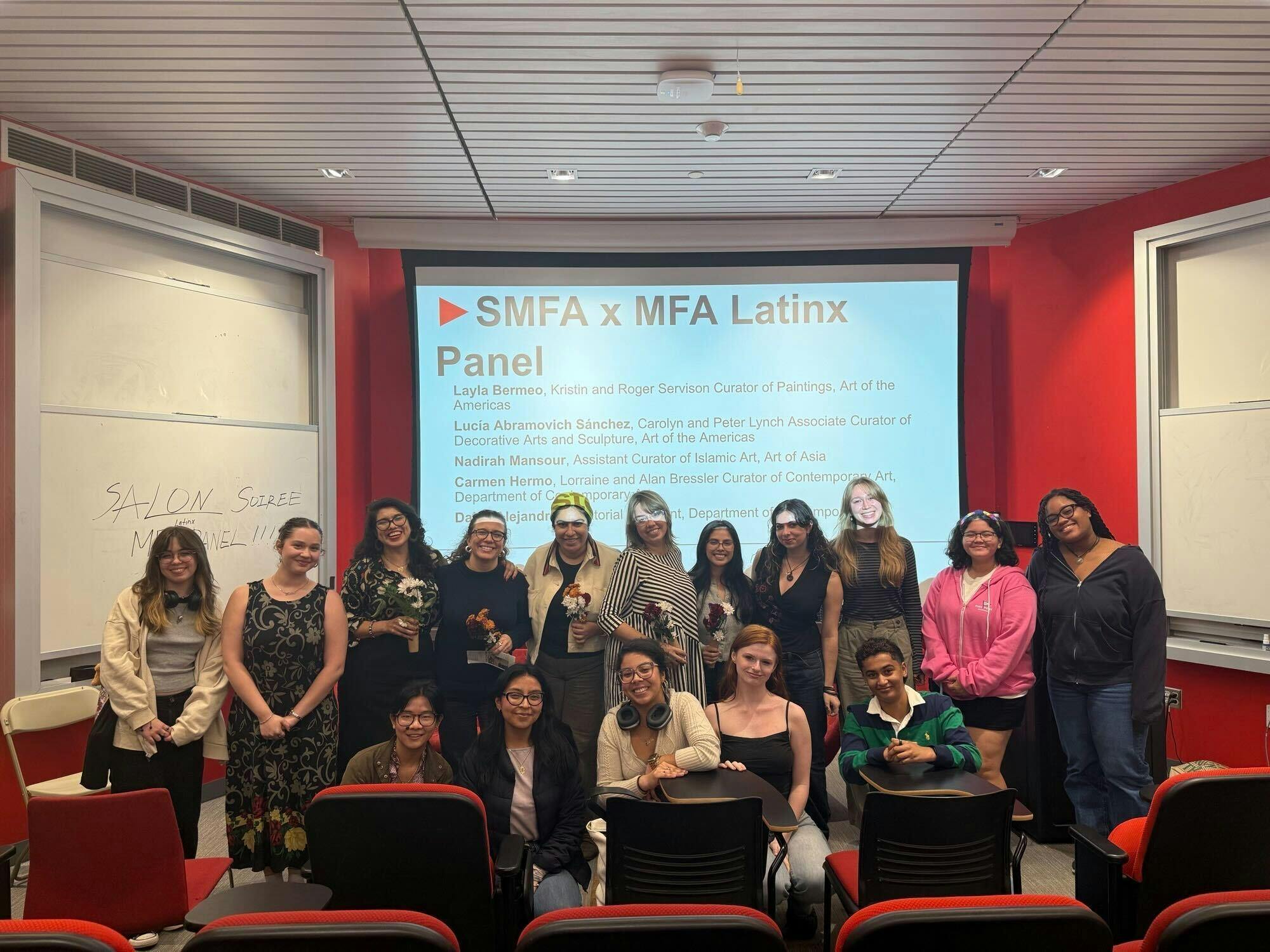
Tufts University’s art historical and curatorial collective Salon Soirée, alongside the Tufts Association of Latin American Students, welcomed five curatorial staff from the Museum of Fine Arts Boston on Wednesday evening: Layla Bermeo, Lucía Abramovich Sánchez, Carmen Hermo, Nadirah Mansour and Daisy Alejandre. While these women work in different galleries at the museum, they have all had very similar ‘origin stories’ that led to their current positions.
Making one’s own path and striving for proper and complex representation were common themes each of the panelists echoed throughout the talk, which was facilitated by Tufts junior and Salon Soirée member Katalina Mitchell.
Bermeo spoke extensively about how her own education, and how the access to knowledge she had growing up influenced her to find a way to connect with young people in particular. She shared that she had never heard of the word “curator” until late in her undergraduate career, and thus she wanted to make art and information about it accessible through programs such as the “Curatorial Study Hall,” which invites high school students to work on a project that will go into the museum. The MFA is important to both her and her colleague Sánchez because of the specific parameters of the “Art of the Americas” section. When someone says “Art of the Americas,” it does not specify “Art of the U.S.” — therefore it includes art across North and South America, including work by Indigenous communities. Going to the Art of the Americas section today would not reflect that sentiment. However, this is something the panelists are working to remedy so the museum properly represents everyone who may fit into the category of ‘American’ artist, a task made slightly easier by the fact that the MFA already has a space installed for that purpose.
The questions of: “Who works in a museum?” and, “Who gets to make decisions about what’s on view?” continue to inform Bermeo’s work today, highlighting the need for diverse voices in the workplace — not just in terms of ethnicity, but also age, upbringing and religion. Mansour raised this point as she answered the second question for the panelists, regarding how each of their individual experiences and identities contributed to their career trajectories. Coming from a multicultural background and having lived in several countries, including Mexico and now the U.S., Mansour intends to show the multidimensionality of Islamic art beyond the narrow understanding the general public often has of it today. She described Islamic art as not strictly devotional; rather, it looks at Muslim empires that have existed throughout history and how they have connected to global cultures. Without realizing it, many people may have preconceived notions about what the word “Islam” signifies, according to Mansour. She aims to use the MFA’s collection to craft a more complex view of Islamic art.
The panelists also addressed what the standard look of museum staff is at an institution like the MFA. Like many other fields, the museum is dominated by white men. While they tend to hold a majority of leadership positions, it is actually white women who dominate the curatorial field across the U.S. Hermo acknowledged that as a white woman, she has “thrived in museums.” She described her role as that of an “accomplice” to the complicated narratives evoked by art, working as a liaison between artists — since she works primarily with contemporary living artists — and the institution. When she worked at the Brooklyn Museum in New York, she was responsible for the show “Nobody Promised You Tomorrow: Art 50 Years After Stonewall.” She invited several people of color and, of course, artists of varying sexualities to work on the project both behind the scenes and to be featured in the show. As many of the artists featured were young, they were able to craft stories about how queerness and gender expression are still being attacked today, and how there is still work that needs to be done in these communities and in our society.
To answer the questions I posed at the beginning of this article: The art museum holds a unique position as a pillar of the established understanding of what is of value to us. To be put on the wall of the MFA, an artwork must have aesthetic value, be richly detailed and hold cultural relevance. So then, what does it mean if in this day and age we walk into an area titled “Art of the Americas” and see predominantly works by white, male artists from the U.S., made 20, 50 or 100 years ago? The MFA curators who visited Tufts on Wednesday illuminated the importance of properly representing all kinds of art, as this is vital to connecting people through the medium and building an understanding of the cultures of our world.