
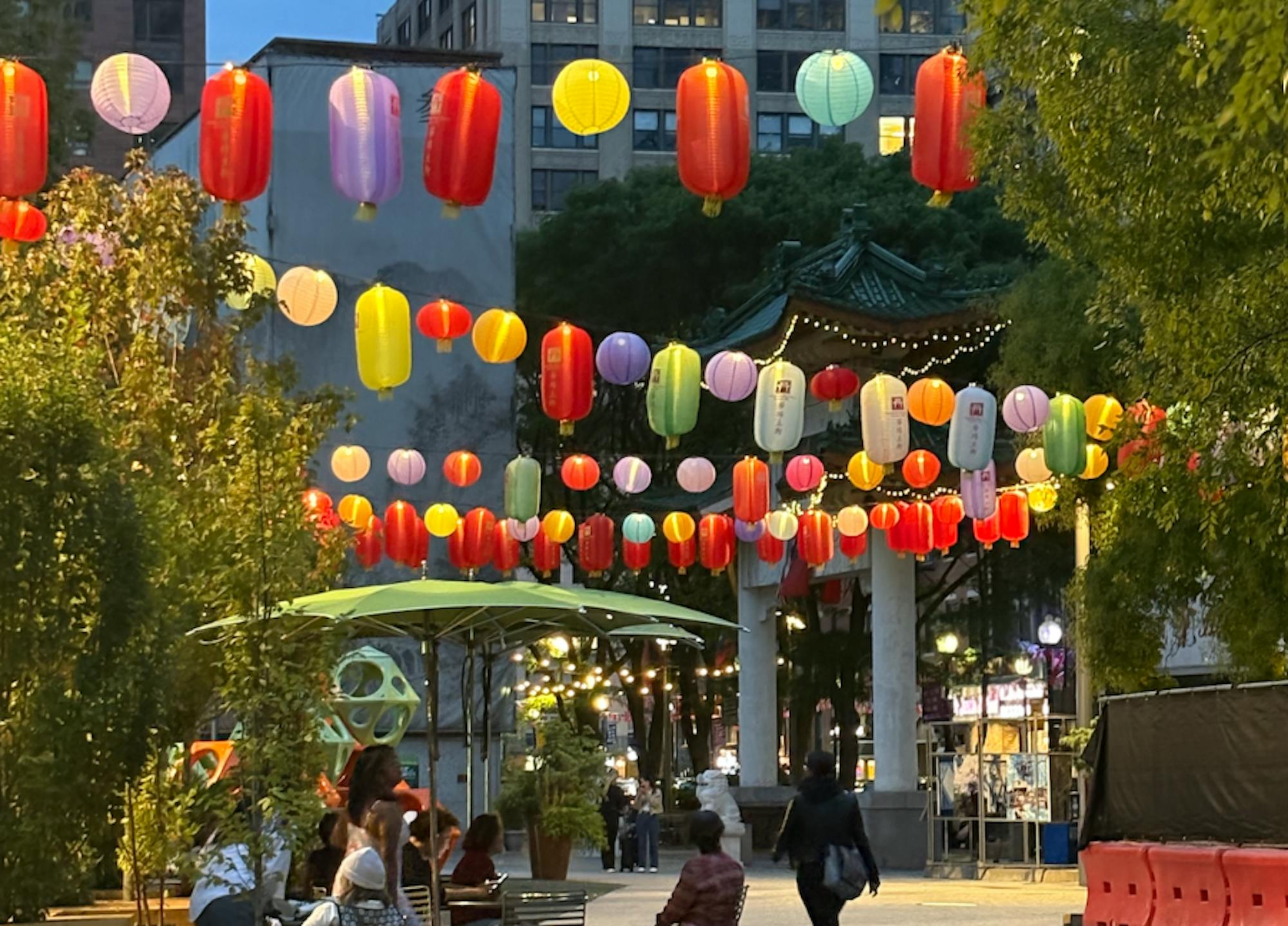
Boston’s Chinatown district will provide you with fresh groceries, soapy facials, rows of restaurants designated by their bright signs and sidewalks lit up by red lanterns. As the last major Asian enclave in the New England region, Chinatown also provides a home for many Asian Americans who desire an intimate community.
Beneath the exterior of bright lights and friendly faces, however, you’ll find a much more nuanced picture. Many residents are struggling to make ends meet amid rising prices and the influx of commercial real estate.
“We’re afraid that 10 years down the line, we don’t know what’s gonna become of Chinatown,” Debbie Ho, director of nonprofit Chinatown Mainstreet and lifelong resident of the district, said.
Ho, who interacts with business owners and residents throughout the neighborhood, echoes the common sentiments of fear and discomfort surrounding the ongoing changes to the area’s historic identity.
While the neighborhood has traditionally offered affordable housing for a variety of cultural demographics — including Jewish, Italian and Syrian workers — it is becoming increasingly harder for residents to make a living here. Chinatown faces an abundance of challenges today, including overcrowding, gentrification and housing shortages.
The Tufts Health Sciences campus — located in the heart of Chinatown — has been making an effort to help preserve the area and provide relief for its residents. While their initiatives have been met with support from many in the neighborhood, others cite Tufts as one of the root causes of some of the district’s issues.
Tufts’ expansion into Chinatown began in 1949, when the university purchased and renovated former garment factories at 120 and 136 Harrison Ave. in downtown Boston for its new graduate school location. Today, the center of Chinatown houses four graduate programs: the School of Medicine, the Friedman School of Nutrition Science and Policy, the School of Dental Medicine and the Graduate School of Biomedical Sciences.
In the late 20th century, the New England Medical Center, a forerunner to Tufts Medical Center, planned to buy and construct a parking garage on a small plot of land in Chinatown called Parcel C. In response to this plan, Chinatown residents took to the streets, organizing a campaign protesting against the urbanization of their neighborhood. As a result of community protests, the proposed parking garage was rejected by the Boston Redevelopment Authority, resulting in a decisive victory for Chinatown residents in their fight against institutional expansionism.
Decades later, controversy still remains, with some professors and students criticizing the university in the Daily for their role in advancing gentrification through building dorms and expanding medical facilities in the region.
Nonetheless, Tufts has seemingly been responsive to feedback from the community, and they maintain a wide variety of programs to advance needs in Chinatown.
Jennifer Greer-Morrissey, program manager of Tisch College’s civic life programs at the Health Sciences campus, explained that Tufts initiatives are divided into two main categories: those driven by students and those driven by faculty.
The main facility-led program, Addressing Disparities in Asian Populations through Translational Research, hopes to use community-based research to improve the physical and mental health disparities of Asian American populations.
In addition to research, faculty in the program encourage students to get involved in the neighborhood. ADAPT has inspired a first-year course at the Tufts University School of Medicine, where students are able to learn about community partners and collaborate on health topics identified by the community itself.
Students studying gentrification at the Tufts program created a list of restaurants that led the school to reconsider its annual Cherish Chinatown Restaurant Challenge. This program encouraged local dining by offering raffle tickets for each purchase at a restaurant in the area.
“They created a guide to locally owned restaurants, because what they were finding was that some of these bigger chains are buying up space,” Greer-Morrissey said. “[These chains are] still bringing money to the community and so on, but it’s really driving up rent costs for these smaller, locally owned businesses.”
The students’ research highlighted the complications of the issue, inspiring Tufts to consider reexamining the program and potentially make their own guide in the future.
In regards to gentrification, Ho believes that it is a complex issue.
“It’s gonna happen no matter what neighborhood you’re in … [and it’s] how we become diverse,” she said. “We’re hoping that [these] folks will come in and buy and eat locally.”
Tufts’ other main program is the Chinatown Wellness Initiative. Students are able to get involved with a variety of volunteering opportunities in Chinatown. Through the Music and Medicine Collaborative, students perform for local communities. In Jumbo’s Kitchen, medical students teach key nutritional concepts to children. Other popular programs include tutoring at the Josiah Quincy Upper School and volunteering at the Asian Task Force Against Domestic Violence’s family shelter.
In regards to student involvement, Greer-Morrissey credits Tufts for attracting students with an interest in civic engagement.
“Students have said, ‘This is why I was excited to come to Tufts – because I won’t just be learning [biochemistry] and how the lungs work, but I’m really going to be engaged in a community,’” Greer-Morrissey said.
Student co-chairs of community service at the School of Dental Medicine, Rana Sultan and Jamyla Elquiero Palomar, corroborated this point.
“People [are] just very eager to help,” Sultan said.
Tufts often partners with organizations that also have a more hands-on role in the community. For one of their largest initiatives, Chinatown Clean Up, Tufts partners with Chinatown Mainstreet for a yearly day of cleaning.
According to Palomar, at such events residents tend to be grateful for the help.
“People from the community walk up to us and thank us [for] things that we think are just pretty small, like picking up some trash or … planting some plants at a school,” Palomar said.
Ultimately, Greer-Morrisey believes that Tufts has a responsibility to help with preserving the area.
“I think there is an awareness that we take up a lot of space in the very small historical neighborhood, and that we want to be good neighbors,” she said.
Ho says she is thankful for Tufts initiatives, while admitting they are constricted by cultural differences, making their efforts to assist — though well-meaning — not always fully effective.
“They try their best to assist and to help create programs but … it’s hard to work with a community [given] language barriers,” Ho said. “It’s just hard to educate people with different ideas.”
One of the issues that the community faces, which remains unaddressed, is the housing crisis — Ho describing it as the one of the main issues faced by residents.
“Although there has been expansions throughout the years, I still see that we are still densely populated. It’s like we’re pushed into one box,” Ho said.
The construction of high-end housing — as well as changing government qualifications for work— makes an expensive bid for many residents, who struggle to properly support and take care of their families after rent and taxes.
“I’d like to see more expansion for Chinatown to include the part of that South End corridor that they’re wanting to develop,” Ho said. “We need more retail, Chinese stores, restaurants … [and] there isn’t a really good senior center here.”
While there is lots of work to be done to understand how to best give back to Chinatown, Tufts students are encouraged to engage in the multitude of community programs in place today.
The sixth annual Chinatown Community Cleanup Day — one of Tufts most popular programs — will take place in two weeks, on Oct. 25 from 9:30 a.m. to 12:30 p.m.
“We hope that everybody will join in and help with the community cleanup,” Ho said.



