
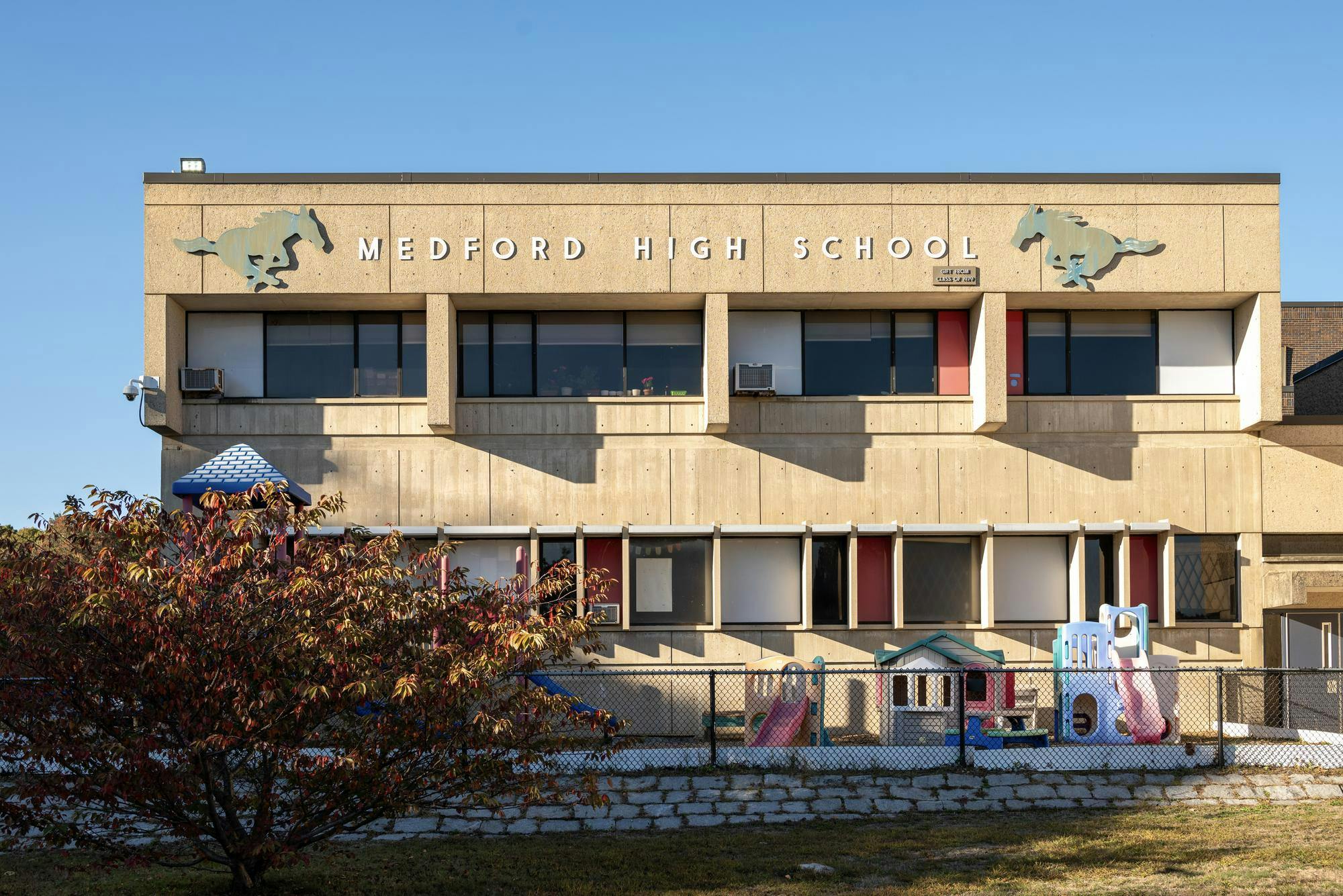
The Medford School Committee approved the first reading of a new policy, “Use of Generative AI in Medford Public Schools,” on Sept. 22. Though the policy still must pass a second reading before it is formally adopted, the committee voted to include it in the school handbooks, offering guidance on how teachers and students can choose to responsibly use artificial intelligence while the committee takes time to adopt the policy.
Erika Reinfeld, the school committee member who proposed the resolution, said her goal was to establish consistent guidelines for AI use across the district.
“The goal of the guidelines was to create a framework and a context in which groups of teachers could make their own determination of what technology supported their educational goals in that grade level and subject area, across the board,” Reinfeld explained.
Reinfeld said the process began with a district-wide survey sent to assess opinions on AI in education. According to Reinfeld, the survey received about 120 responses.
“There was certainly a contingent of ‘This should be nowhere near education,’” Reinfeld said. “But overwhelmingly, the response was, ‘This is here, and we have to teach people how to work with it [and] understand it.’”
Following the survey, Reinfeld formed an AI task force with several educators and staff to create resources that help teachers make informed decisions about AI use. The task force referenced the Massachusetts Department of Elementary and Secondary Education’s guidance, focusing on areas such as data privacy, ethical use and bias reduction.
To ensure compliance with privacy laws, the policy states that only vetted AI tools will be approved for classroom use.
“The district is a member of the Massachusetts Data Privacy Alliance,” Molly Laden, the director of library, media and technology for Medford Public Schools, said. “[The data privacy agreement] essentially states that they meet these student data privacy agreements, which is that they don’t collect data, they don’t market [data].”
Despite these safeguards, Medford School Committee member John Intoppa raised concerns about the ethical implications of AI in education.
“It’s just plagiarism in my opinion,” he said. “When you cite generative AI, you cite the machine learning model, and you don’t cite the sources that it pulled from, so it seems like a shortcut.”
In reaction to these concerns, Laden emphasized that the proposed policy allows teachers to decide whether to include AI in their curriculum, using district-provided guidelines and an approved list of platforms.
“Teachers are responsible for making sure expectations are clear, what’s allowed and what’s not,” Laden said. “That’s true for anything that they have students do — they should be specific in direction: ‘Yes, you can use [AI] for this, but you cannot use it for this.’”
Intoppa also voiced concern about AI in creative subjects like art.
“There’s no ethical way to use it in art design unless [students] are creating their own machine learning model and putting in their own data,” Intoppa said.
Reinfeld agreed that AI’s usefulness will vary depending on the subject.
“To [committee] member Intoppa’s point, I cannot see a scenario in which an art teacher is going to say, ‘Yes, AI tools are great.’ He’s right — that is theft,” Reinfeld said.
She added that teachers will have full discretion over whether or not to use AI.
“I think it comes down to trusting teachers,” Reinfeld said. “[This policy is] making sure all the pieces are in place so that they can make those decisions in a responsible way.”
The proposed policy also emphasizes responsible and ethical use of AI tools by both students and teachers. Laden said that addressing bias and misinformation remains a challenge.
“The issues of bias and critical thinking are huge, and we’re saying we need to make sure that information that’s generated through AI is checked for accuracy and bias and misinformation and potentially negative content. How that should be checked? I don’t know,” Laden said. “We know AI checkers are not that reliable. … We want to promote critical thinking.”
While debate continues about the role of AI in schools, Reinfeld said she hopes the policy will help students and teachers use the technology productively.
“I think AI is often compared to the microwave,” Reinfeld said. “Everyone said the microwave was going to ruin cooking. And it did ruin some things. But we still have chefs. We would really like students to be empowered to make the meals that they need, and the teachers to help them do that.”
The school committee and AI task force plan to continue meeting with students and parents in focus groups before presenting a final version of the policy in the coming months.



