
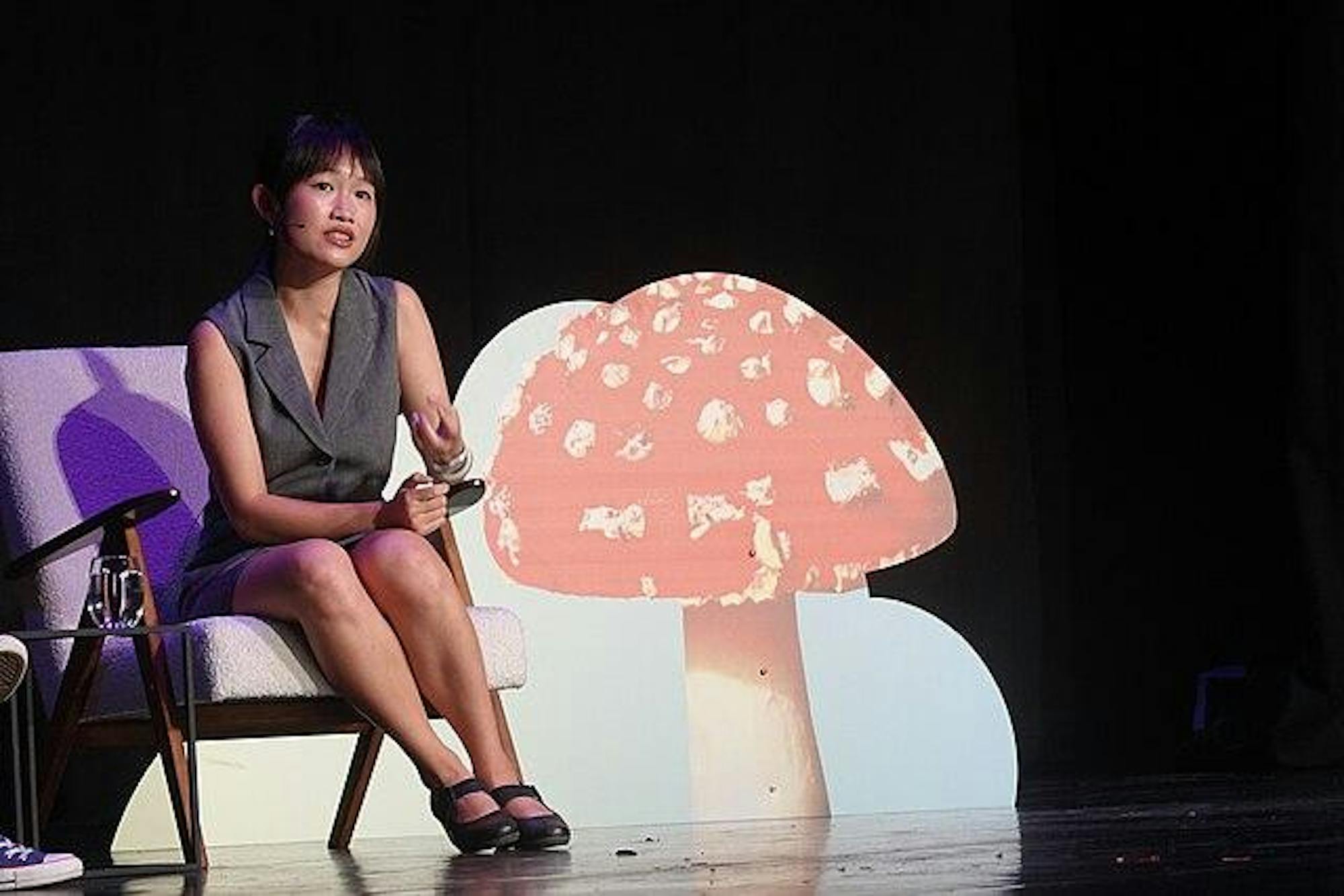
R.F. Kuang has never shied away from ambitious storytelling. From the imperial critique of “Babel” to the literary satire of “Yellowface,” her novels combine social insight with an inventive narrative. In “Katabasis,” she turns her attention to a new and rather audacious terrain: academia itself, imagined as a literal underworld. The result is a darkly funny, rather unsettling meditation on ambition, power and the cost of striving for academic recognition.
Kuang, who is pursuing a Ph.D. herself, infuses the novel with her lived experience as a graduate student. The work feels organic, lending every grievance and critique an air of authenticity.
At the story's center is Alice, a Ph.D. student at Cambridge who, in magick (yes, it is spelled that way) gone awry, accidentally kills her mentor, Professor Jacob Grimes. Determined to secure her academic future — and haunted by guilt — she descends into the underworld to retrieve him. Joining her is Peter, a fellow student whose effortless brilliance stands in stark contrast to Alice’s desperate work ethic. Their journey through the Eight Courts of Hell is vivid, with each circle mirroring a darker side of academia: impossible workloads, abuse and relentless comparison to peers.
At times, Alice is a difficult character to read. She judges Peter’s effortless brilliance, acts selfishly and consistently makes questionable decisions. On paper, she should be deeply unlikable — yet, Kuang presents these flaws unapologetically, rendering Alice compelling even as she infuriates the reader. As you peel back each layer of her prickly exterior, Kuang reveals an exhausted woman (she is in her early 20s) who wants more but is too tired to try.
Peter, too, is no flat foil. Kuang explores the downside of his brilliance, his insecurities and his twisted relationship with Grimes. Together, they illuminate the central tension of academia: the pursuit of recognition often comes at the cost of warped ethics (or a lack thereof).
That said, “Katabasis” is not perfect. The narrative is bloated — no text needs to exceed 500 pages — and the concepts are severely overexplained. Kuang seems not to trust the reader to follow the philosophical and mathematical theories she introduces; after a while, it is difficult not to skim. Furthermore, though Alice is a compelling character, her cruelty can be hard to swallow. Kuang requires the reader's trust in her warped ideas. If you grant it, the narrative is easily digestible — however, if you are unable to follow Alice, you may struggle to make it past the early chapters.
A true highlight — and something to be expected if you have read some of Kuang’s other works — is her prose. Each sentence feels purposeful and sharp, balancing wit with a light sense of humor. For a novel built on such a grim premise, the writing remains light and readily absorbable. In its the more intense moments, such as Alice’s contemplation of the Lethe — the mythical river that erases memory — Kuang conveys both exhaustion and the desire to escape. Despite the fantastical premise, Kuang captures the larger theme of academia’s faults in a journey that feels viscerally real.
As a whole, “Katabasis” offers a sharp critique of academica as Kuang suggests, is a form of hell: punishing, hierarchical and gendered, rewarding brilliance without acknowledging the resilience behind it. Alice’s idolization of Grimes mirrors the pressures many women face to admire and emulate figures who abuse their power. Meanwhile, Peter’s inherent genius reflects society’s obsession with talent over work ethic. The novel explores the cost of ambition and illustrates how success in an institutional system often requires you to compromise everything about yourself.
“Katabasis” succeeds because it balances fantasy with insight. The descent into hell is both entertaining and unsettling, offering a tale that is both thought-provoking and engaging. Her ability to create characters who are both compelling and deeply flawed, along with a world that feels realistic, is her greatest strength. For all its excesses, “Katabasis” proves Kuang’s willingness to risk too much rather than settle for too little.



