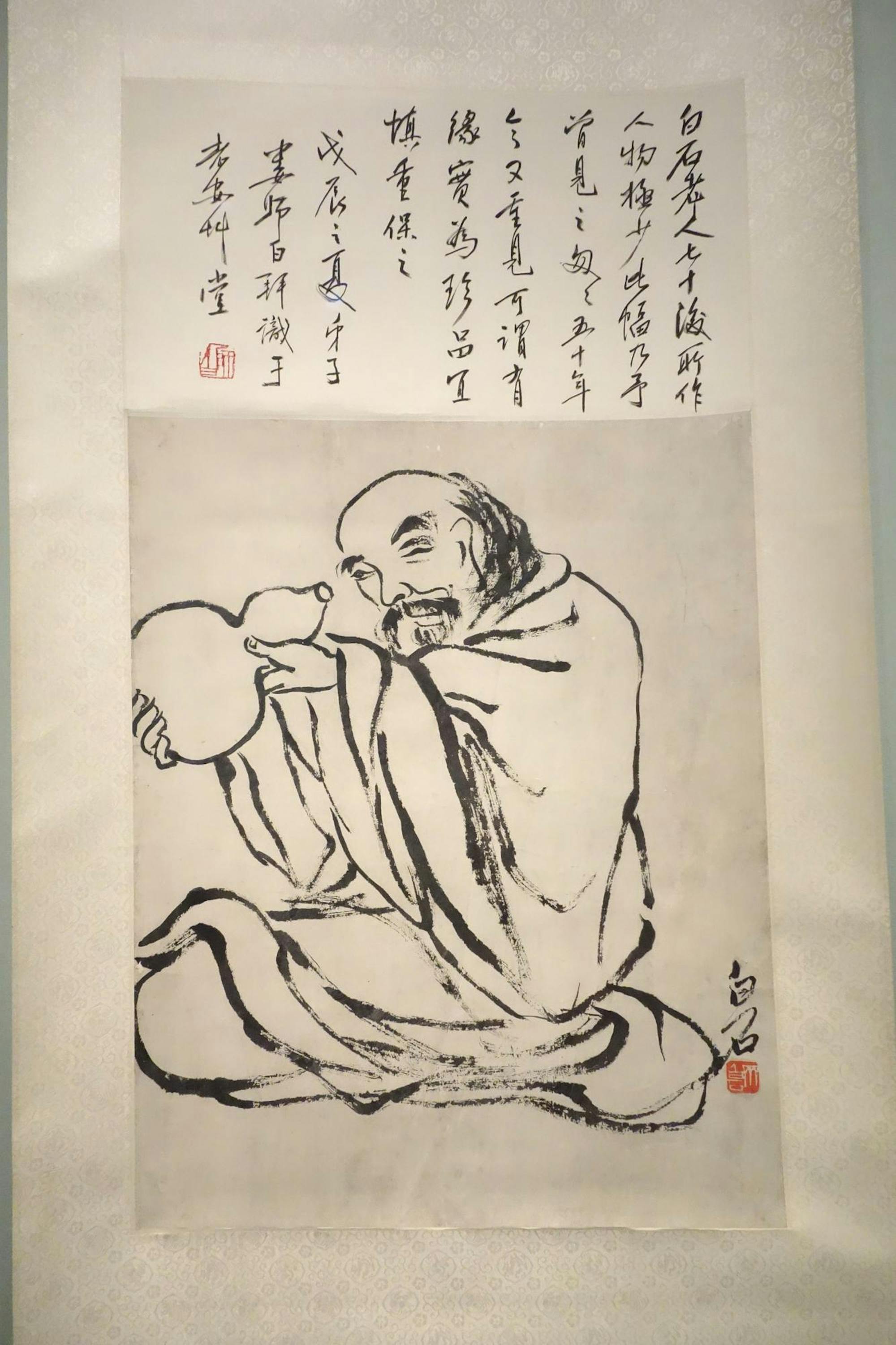
Situated among the Boston MFA’s proud Asian collection is a dimly lit exhibition hall whose inconspicuous presence belies the crowds of visitors frequenting its displays. To protect the fragility of the Xuan paper and silk scrolls, as well as to ensure the ink doesn’t fade, each work is spotlighted under a single warm light. However, these soft beige and brown illuminations do not dull the vibrancy of Qi’s colors nor detract from the eccentricity of his brushstrokes.
To celebrate the 160th anniversary of Qi’s birth, the MFA acquired loans from the Beijing Fine Art Academy to promote this modern Chinese artist’s genius to a Western audience. The show’s modest size of around 40 pieces — including calligraphy, paintings and sketches — implies a careful curatorial process, presenting a broad view of Qi’s expertise across various genres, not only his famed shrimp art pieces. Visitors were also welcome to admire Baishi’s landscapes, amusing figures and depictions of various flora and fauna.
Born into a lower-class family in Xiangtan, Hunan, Qi didn’t receive formal painting training as a child like many of his elite contemporaries. Instead, he began his artistic journey working as a woodworker in his rural home, carving delicate flowers and figures for the elite class. At 20, by chance he encountered the “Manual of the Mustard Seed Garden” (介子园画谱). Fascinated, Qi borrowed the manual for a year, tracing and imitating its various plants both out of passion and to add variety to his woodwork. His diligence was rewarded at 27 when his talent was discovered by Hu Xinyuan, a locally respected artist and writer. After training under Hu, Qi lived several stable years as a local artist, painting Chinese mythological figures for the spiritual and religious needs of the rural community. Qi found it easier to transition from woodcarving to painting as his economic status elevated.
In 1902, at age 38, Qi set off on an eight-year trip through China, painting as he went. Through these travels, Qi greatly improved his landscape artworks, and once he settled down in Beijing, he refined them into a collection under the titled “Borrowing Mountains from Nature” (借山写生). These titles exemplify Qi’s belief that the splendor of mountains can only be borrowed through art. Out of the 22 surviving pieces from this collection in the Academy, eight were displayed at the MFA. Through abundant negative space depicting water and sky, we can glimpse a very raw, early stage of what became Qi’s signature “freehand” (写意).
Once in Beijing, Qi found his art lacking the polish of those trained professionally, though his seal-carved stamps were highly praised and provided a steady income. In 1920, he had the good fortune of being received by Chen Shizeng, a highly acclaimed artist who persuaded Qi to renovate his style. This shift matured into Qi’s “freehand,” akin to the Western “gesture lines,” which depicts the emotion and movement of a subject in contrast to “contour lines,” which focus mainly on the shape and outline of forms. Springing from Daoist and Confucian values, Qi’s “freehand” also combined rural authenticity, his personal humor and philosophical ideals. When these refinements were exhibited by Chen in Japan in 1922, the works earned high critical praise, launching Qi into prominence.
It is impossible to mention Qi’s artworks without leaving a section dedicated to his masterful depiction of shrimp. To paint these creatures, Qi kept shrimp in a tank at home, closely observing them for years. Other artists tended to use the changing washes of the ink to depict the feeling of water; as a characteristic of “freehand,” Qi’s shrimps are painted with empty space as the background. Even though there are no strokes dedicated to water itself, viewers are able to capture and perceive the motion of water through the varying concentrations of ink throughout the shrimp’s body and the direction of its whiskers. Visitors to the MFA can admire this technique in two hanging silk scrolls, along with a display documenting his process.
These techniques are also visible in the scrolls and paintings of Chen’s that depict various creatures such as mice, crabs and fish. Similarly, though the backgrounds are bare, viewers can better grasp the vitality and emotions of Qi through the abundance of negative space present. Often accompanying such works are Qi’s own poems that reveal his humorous takes on life, such as his portrait of the mythological figure Zhong Kui (钟馗), the fierce protector of civilians against demons. Qi renders Zhong Kui with a playfulness that contrasts his fearsome appearance, creating a refreshing, almost comical portrayal of the deity, one more amusing to common viewers.
Qi was an artist of a new political and social era, one that prioritized the needs of commoners over the traditionally powerful elite. It is hard to ignore the significant role that Qi’s rural upbringing held in his social success for the new nation, but his willingness to embrace his identity as a grassroots artist expanded traditional Chinese art’s reach to include the common people. His paintings of various countryside elements, such as insects and rural religious figures, displayed his modesty and authenticity that remained fresh in the remnants of war. Though his artistic expertise was the subject of heated debate among traditional art scholars during this time, Qi’s art bridged the gap between elitist tradition and a modern, evolving nation.