Editor's Note: Katie Spiropoulos is a former deputy news editor of the Daily. Spiropoulos was not involved in the writing or editing of this article.
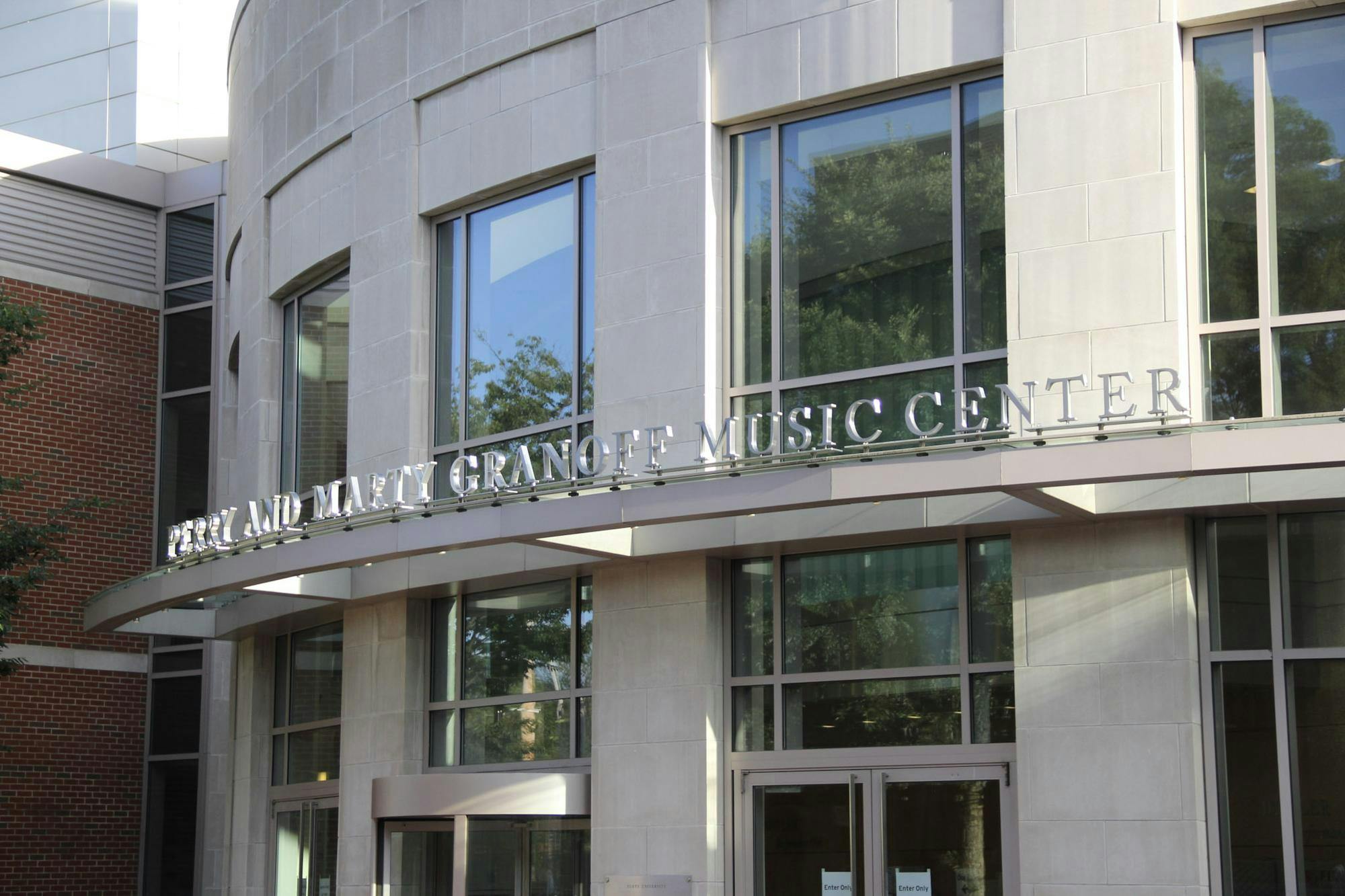
Ben Platt opened his intimate “An Evening with Ben Platt” show in the Granoff Music Center on Oct. 11 with a cover of Billy Joel’s “Vienna,” seemingly singing directly to the place that he was inhabiting — a college campus full of students always in need of a reminder that there is more to life than their upcoming midterm.
For many students at Tufts, the music and theater departments and programming are spaces that provide an accessible ‘Vienna’ right on campus — a place to create and perform among a close-knit community of wonderful people. Senior August Kittleson, president of Tufts’ theater program — Pen, Paint and Pretzels (commonly referred to as 3Ps) — found a community in Tufts theater from the first play he ever did.
“Basically my entire friend group is in the theater scene, and that’s been developing since [my first] year,” Kittleson said. “Theater inherently is a collaborative, collective event. … You [don’t] do it in isolation. You do it with so many others, especially as an actor.”
3Ps, founded in 1910, is Tufts’ oldest student club on campus. The club produces four completely student-run plays per year: one workshop and one mainstage in both the fall and spring semesters. The main stage productions are done in a bigger venue and with a bigger budget, while the workshops are spaces where students can showcase their own self-written work or experiment with directing a play for the first time. 3Ps also hosts weekly community meetings for anybody interested in joining the theater community at Tufts.
“We kind of embody the spirit of a theater camp in how free-spirited we are,” Kittleson said. “And truly, every production is completely different. We have this general frame for how every production should go, but the choices that are made, the styles, the plays themselves are all selected by the community.”
Similarly, Torn Ticket II produces a variety of workshops and main stages every year. There are five Torn Ticket II shows every year, including an orientation show for incoming first-years that the organization prepares for over the summer, as well as one mainstage and workshop per semester. Their fall workshop is the 24-hour musical, a musical that is cast, directed, organized, rehearsed and performed in only 24 hours.
As the 3Ps is organized, the shows put on by Torn Ticket II are chosen democratically. These democratic functions of the theater groups at Tufts help foster their reputations as community-oriented spaces that are open to all experience levels and interests.
“Theater at Tufts is just so miscellaneous,” Kittleson said. “One semester you’re doing a department [production], another semester you’re doing 3Ps, another semester you’re doing Torn Ticket [II] … or you’re doing some other performance opportunity in a class here. It’s kind of all around, really.”
The Tufts’ theater, dance and performance studies department shows are the highest commitment of the different theater offerings — these shows are put on by the university, with a large budget, a large audience and a wealth of faculty connections and support. The university’s current department show is titled “Natasha, Pierre and the Great Comet of 1812,” a play inspired by certain parts of Leo Tolstoy’s “War and Peace.”
In an exciting turn of events, the cast of this play was invited to sing a song with Platt to conclude his visit to Tufts, a moment which meant a lot to Torn Ticket II president and “Great Comet” cast member and senior Katie Spiropoulos.
“I had a double reaction,” Spiropoulos said. “I found out [Platt] was coming, and then like, three or four days later … [the cast] found out that we would be performing with him. So that was a double thing of, like, ‘What do you mean? I’m gonna be in the same room as Ben Platt? Oh, I’m gonna be on the stage with Ben Platt.’”
TDPS is different from traditional theater conservancy programs. A conservancy program is an immersive program that focuses on developing actors to be immediately ready to enter the professional world after graduation from their respective programs. Tufts, on the other hand, offers students interested in studying TDPS a Bachelor of Arts program, which follows the same trajectory as all other majors through Tufts’ School of Arts and Sciences. While a BA program offers a less fully immersive environment for aspiring actors, Tufts’ departments still provide students with connections and opportunities for enrichment.
“I think people sometimes underestimate how many performance opportunities, like with Ben Platt, but also just like networking and exposure, that Tufts and our music and theater department have,” Spiropoulos said. “That is something in Torn Ticket [II] that we really try and advertise to our community members who maybe start out with student theater and think, ‘Oh, I don’t want to take classes. I don’t want to be a major; therefore, I can’t be involved.’ But … anybody can audition for the department shows, and you get a whole world of opportunities that you might never encounter somewhere else.”
Kittleson similarly credits Tufts as providing him with a wealth of opportunities related to his theatrical aspirations.
“We not only have access to Broadway-level stars that come — I know a couple of years ago, Maria Friedman came, who is also a Broadway star and director, and she sang just like Ben Platt,” Kittleson said. “But also it speaks to the amazing facilities we have here. And although we could always have more funding, the funding we do have, both in the department and even as student theater, is amazing compared to other schools that don’t have as much access to these things as we do.”
These sentiments are echoed by faculty in these creative departments as well.
“Ever since the music building opened, the Department of Music, and Tufts in general, has been fortunate that the Granoffs have wished to sponsor someone of Ben Platt's pedigree to perform in these special, one-night-only events,” Jeffrey Rawitsch, the Granoff Music Center manager, wrote in a statement to the Daily. “For our students to be able to witness [these performers’] artistry would be reward enough. But, in the instances where they have been invited to sing with the performer and pick their brains about what life is like in the professional music and/or theater world, it has led to some of the greatest memories and learning that any budding musician or actor could hope to have.”
Tufts is a place where people from different backgrounds can come together and bond over their unique and quirky interests, often ones that defy stereotypes and expectations. The fact that the Platt showing was held at the same time as the Homecoming football game meant that students were streaming into the theater all decked out in their browns and blues — an image that speaks to the diversity of interests at the university and the gathering power of music and theater.
“To fully lean into the cheesiness, theater at Tufts has been everything to me. It’s where I got so many of my closest friends. … I know that I would not be the person that I am today [without it],” Spiropoulos said. “Everybody talks about Tufts in general, like, it’s about the people. But that is especially true in the theater community. They’re the most accepting, kind, excited, passionate people I’ve ever met.”