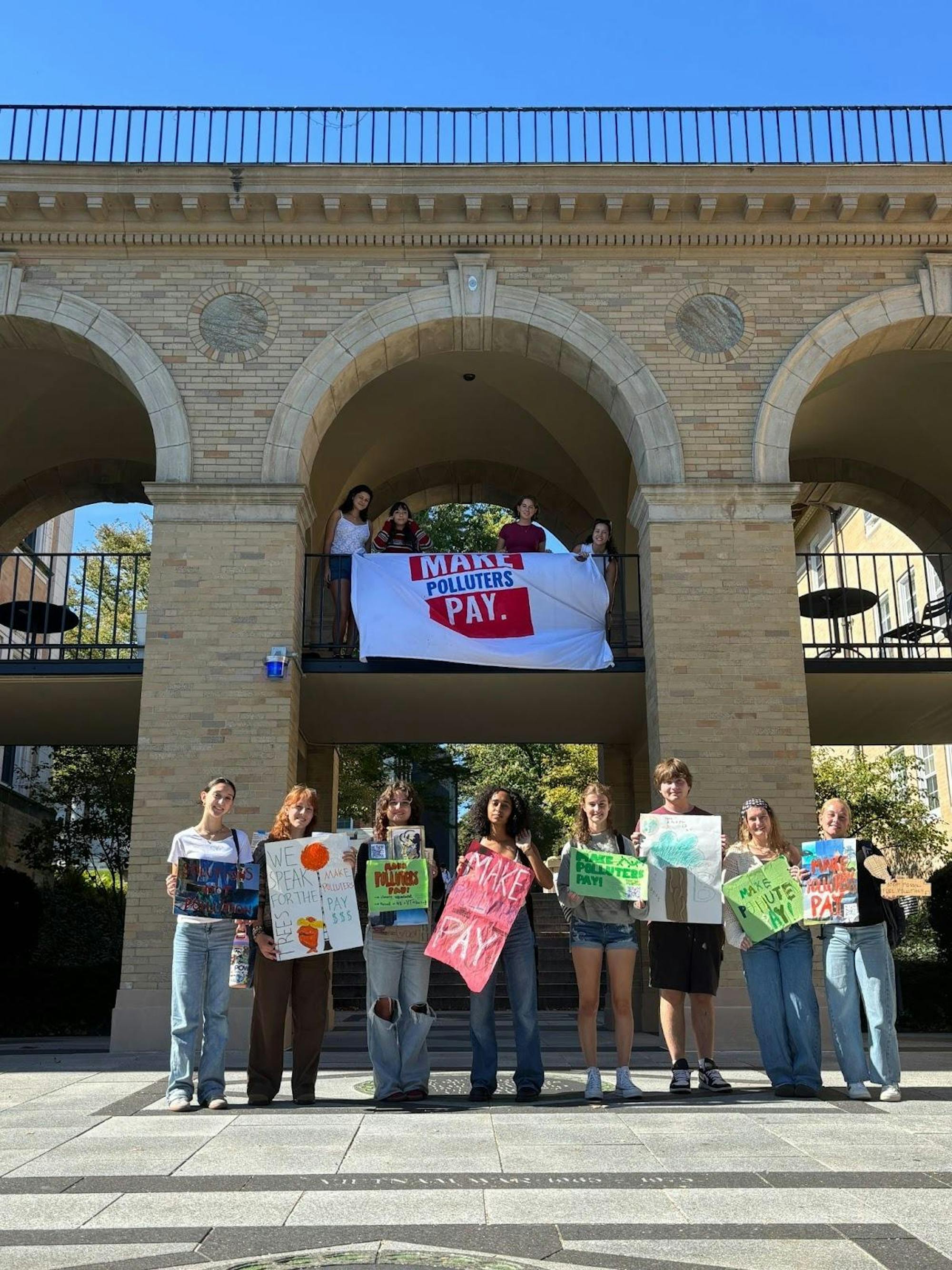
Tufts Climate Action hosted a banner drop in support of Make Polluters Pay on Oct. 3. The campaign aims to raise public and legislative support for climate superfund bills.
Organized with student groups Sunrise Smith, Sunrise UMass and Sunrise Harvard, the banner drop was preceded by the gathering of around 25 signatures and a march across the academic quad. TCA’s signatures contributed to around a total 7,500 signatures that were delivered to Massachusetts’s Environment and Natural Resources Committee and Gov. Maura Healey at a rally at the State House on Tuesday.
The Massachusetts branch of the Make Polluters Pay campaign is driven in part by 350 Mass, an organization run by the Somerville based nonprofit Better Future Project. Massachusetts will start a vote on a bill entitled “An Act establishing a climate change superfund” on Nov. 1. The bill is supported through collaboration between local and out-of-state allies, including New York and Vermont, who have already passed superfund bills.
As opposed to carbon pricing, which allows fossil fuel producers to raise prices to compensate for the tax, climate superfunds are a one time payment from profits already made, preventing companies from transferring the cost to consumers.
According to Olivia Amitay, Communications Manager at nonprofit Fossil Free Media, the superfund is modeled after the federal Comprehensive Environmental Response Compensation and Liability Act, which requires chemical companies to clean hazardous waste sites. In Massachusetts, the Better Future Project expects the superfund to generate billions of dollars over 25 years, 40% of which will directly benefit environmental justice communities.
TCA president sophomore Audrey Hufnagel wanted the organization to get involved with the Make Polluters Pay Campaign because she believed Tufts students’ ability to organize and bring people together would help put pressure on fossil fuel companies.
“Redistributing funds is this concrete way to address some of the climate impacts that we’re currently seeing around the state, around the world,” she said.
Hufnagel worked with 350 Maine, now Maine Climate Action Now, in high school, and contacted 350 Mass while serving as TCA vice president last semester.
“It's amazing to be able to show student power across the state, and to have that kind of activist network,” she said.
Sophomore Julia Vela, who joined TCA in hopes to help her community under the Trump administration, participated in the protest and felt safe being surrounded by her peers.
“I think sometimes the idea of doing a protest on Tufts campus, where everybody knows everybody, it feels a little vulnerable,” Vela said. “I’m glad I did it, because now I'm not afraid of it. … I just want to be more of an advocate towards the issues I care about, including climate justice.”
Dan Zackin (LA ‘21), former TCA member, is the legislative manager of 350 Mass is working on passing a bill that addresses the climate concerns of this protest.
“Right now, taxpayers are on the hook for 100% of the costs, and this bill is about making sure that these companies pay their fair share for damages,” Zackin said.
While not everyone can attend a midday rally, Zackin claimed that “73% of voters in Massachusetts support a one time fee on the fossil fuel industry.” The petition delivery is a way to demonstrate this widespread support.
First introduced in 2023, the superfund bill stalled in the legislature. The bill was reintroduced this year with new and returning sponsors. This year’s vote will be the first time a recorded tally will be taken on the bill.
“Unfortunately, the mentality in our state house is that bills rarely go through the first session they're introduced,” he said.
This session, Zackin feels more optimistic about the bill’s chances of making it through initial voting, but is worried about whether the State House’s ways and means committee would pass it.
“They have a lot to share about what implementation looks like and what they are available for,” he said.
Zackin emphasized how the one-time bill may turn out to be more cost-effective in the long run.
“When you look at the cost that we're currently paying for climate damages, including $39 million for just one extreme storm, the flooding in Western Mass two years ago, it’s actually not that much. And when you compare it to the annual profit that any one of these massive, massive fossil fuel extractors is making, it is an extremely fair and reasonable demand for restitution,” Zackin said.
Hufnagel hopes to keep TCA involved in the Make Polluters Pay Campaign and the youth coalition.
“Having that kind of infrastructure and network of young people who care about justice and who care about things like climate change, but also other systemic issues, that’s super important and powerful.”