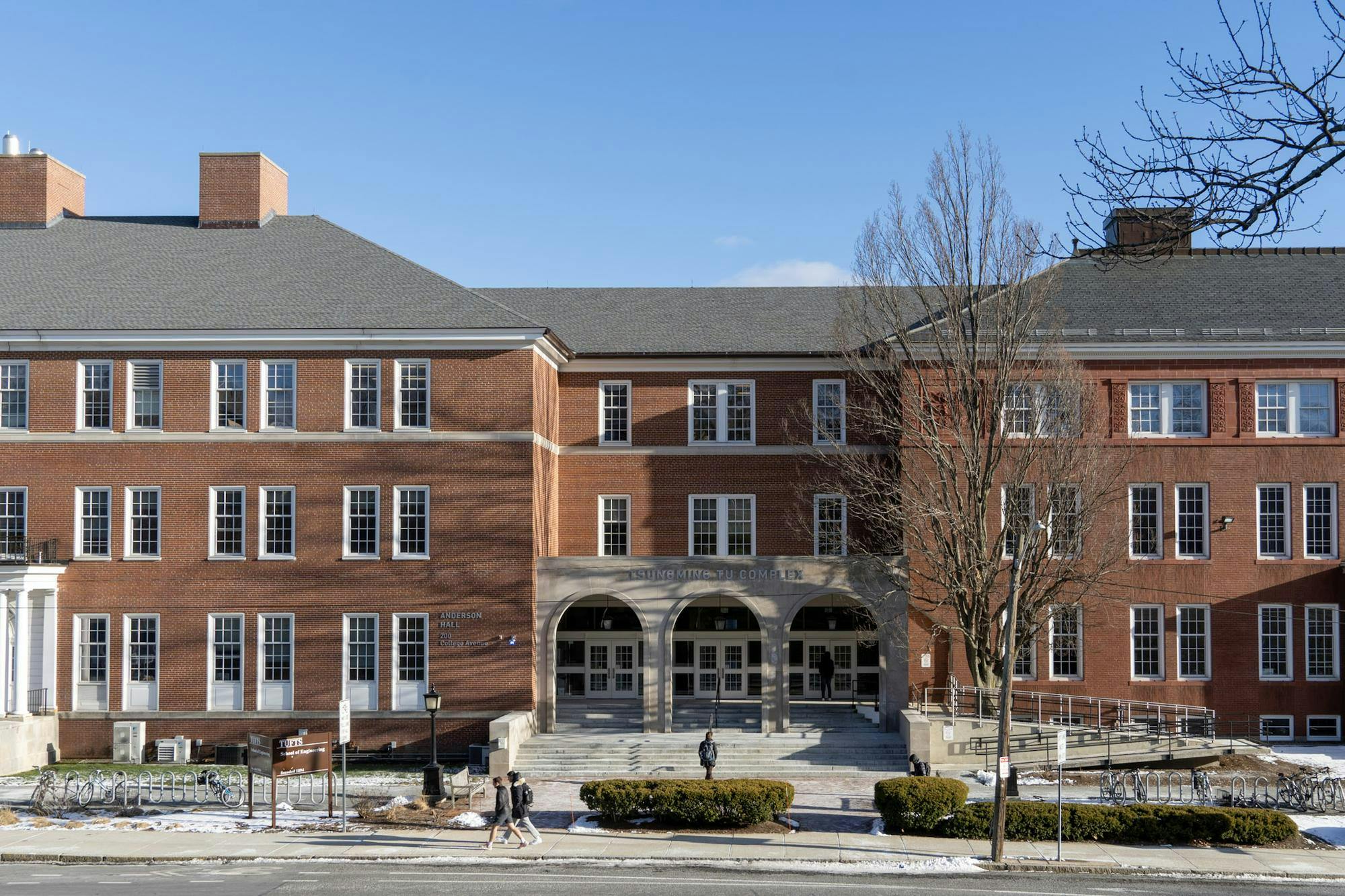
The class of 2026 at Tufts School of Engineering is 49% women. Yet, the department faculty is only approximately 35% women. The distribution of faculty rank reveals an even greater divide, with each increase in professorial position leading to a decrease in the percentage of women faculty. Approximately 45% of Tufts SOE assistant professors are women, a percentage that drops to approximately 25% for associate professors and 23% full-time professors. This begs the question: Why are female-identifying professors underrepresented in the Tufts SOE?
One possible explanation is that women simply haven’t had enough time to ‘catch up’ to their male counterparts in higher academia. The first woman to graduate from Tufts SOE was Charlotte Taylor, who received her diploma in 1943, 78 years after Tufts first introduced a three-year degree program in civil engineering in 1865. The first woman SOE faculty member, Edith Linwood Bush, joined the faculty in 1922, 24 years after the SOE was officially established as a distinct school within the University. The gender gap in the makeup of today’s faculty could therefore be a consequence of men’s head start in Tufts’ engineering.
Even if the gender gap in faculty could in part be explained by the head start given to male academics, this explanation fails to capture the full picture. In a 2018 Pew Research Study, 39% of U.S. adults attributed the lack of women in STEM fields to a cultural issue in which women are not encouraged to pursue STEM subjects at an early age. A 2023 paper by UCLA Anderson’s Sherry Jueyu Wu and Xiamen University’s Xiqian Cai, “Adding Up Peer Beliefs: Experimental and Field Evidence on the Effects of Peer Influence on Math Performance,” explores the impact of the belief that ‘boys are innately better than girls at math’ on middle school children’s mathematics performance. They found that exposure to this belief resulted in a decrease in math performance for girls, and an increase for boys. This suggests an exposure to gendered beliefs around STEM subjects at a young age could have direct impacts on girls, developing a perceived inherent inferiority in comprehending science, technology, engineering and math subjects. This results in decreased performance in such subjects. This all works to discourage girls from further pursuing STEM in higher academia.
Furthermore, women disproportionately report having experienced workplace discrimination in STEM jobs. According to a 2017 Pew Research study, 50% of women in STEM surveyed reported experiencing gender discrimination at work, in stark contrast to 19% of surveyed men. This could also, in part, explain the drop in percentage of women faculty from assistant to associate to full-time professor in the Tufts SOE. Women assistant professors may experience gender discrimination throughout their careers and thus could be discouraged from furthering their careers in higher academia. This potentially explains why there is a sharper drop in the percentage of women faculty between assistant professor and associate professor, compared to associate professor to full-time professor. Assistant professors who may have experienced gender discrimination and who became associate professors may be less likely to be deterred from becoming full-time professors due to gender discrimination.
Although women faculty are underrepresented in the Tufts SOE, the SOE is generally superior in its gender equity compared to its counterparts. According to a 2006 paper introduced at the Cornell Higher Education Research Institute, the Tufts SOE has an above-average record nationally of employing and educating women, and women faculty retention. The paper credits this to the school’s commitment to bringing gender representation to upper-level positions and providing programs and recruitment to target women in STEM. Indeed, the percentages of women assistant, associate and full-time professors have improved since this paper was written — at the time of publishing, 36% of assistant professors, 17% of associate professors, and 18% of full-time professors identified as female. These increases in percentages may suggest that the support the Tufts SOE is providing to women faculty members is helping remediate lost time and the underlying cultural issue surrounding women in STEM. However, the paper credits a large part of this better-than-average gender representation in Tufts SOE to its close integration with the School of Arts and Sciences, suggesting there may still be some fundamental flaws within the culture of the Tufts SOE that discourage women faculty growth.
Ultimately, many of the factors influencing the lack of women in STEM are out of an individual’s control. At Tufts, there are many ways for women engineers to find community through programs like the Society of Women Engineers, involvement in a female professor’s lab and programs like Girls In Stem. However, to address the underlying issue, both men and women should challenge their biases by supporting women’s presence in STEM spaces.