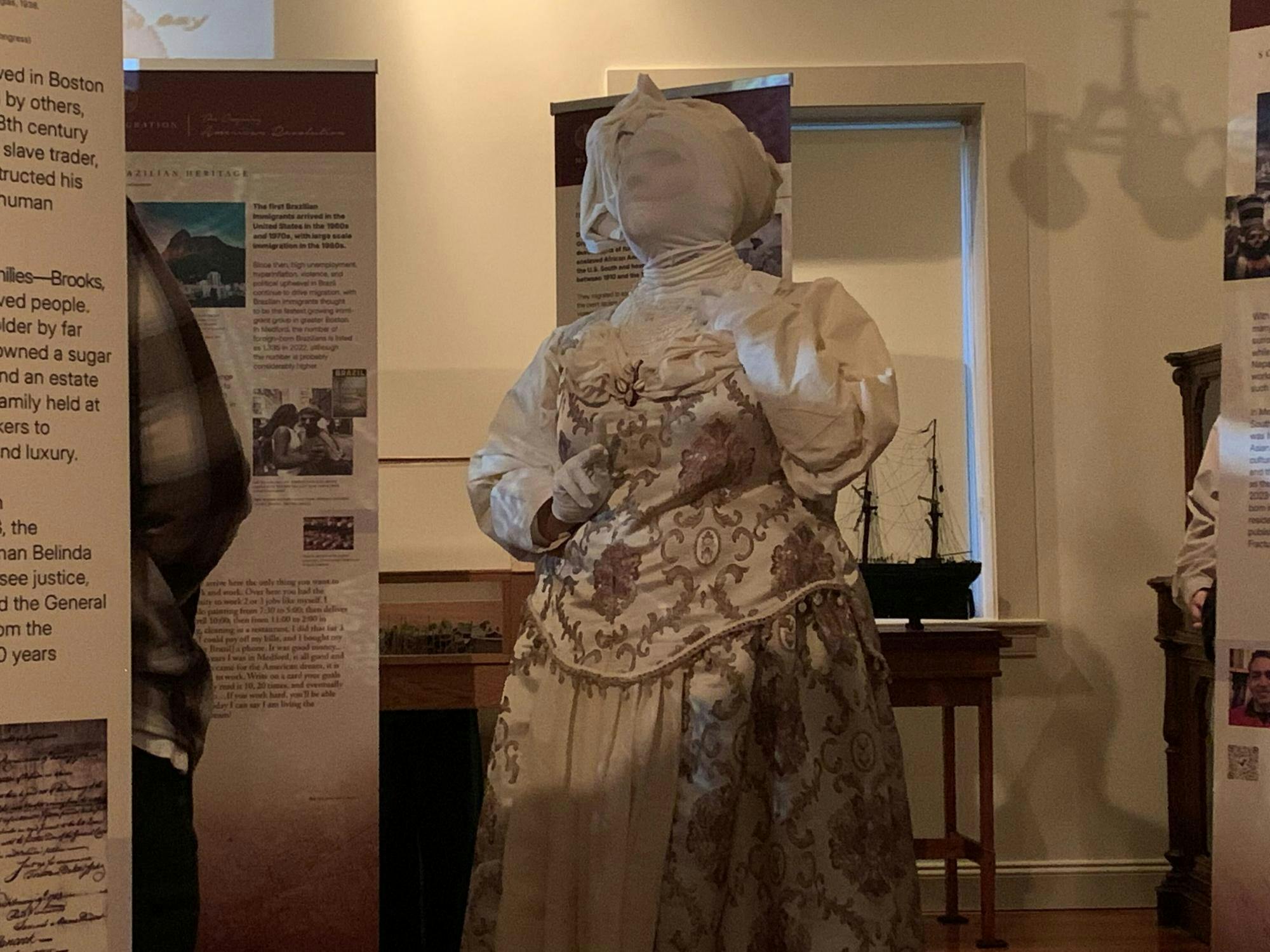
Sitting in a mildly cramped, dimly lit room, I, along with several other guests from the Medford area, waited with bated breath for School of the Museum of Fine Arts alum Bianca Broxton’s performance. A hush quickly spread throughout the room as Broxton entered dressed in a floor-length gown, white stockings, a white veil covering her face and a white headwrap on her head.
The obfuscation of her features represented the lost records of countless enslaved people, not only across the nation, but particularly here in Medford.
Throughout the performance, Broxton played a looping tape which recited the names of women and girls, all of whom, as she revealed, had been enslaved in Medford: “Kate, Mira, Nan, Nancy, Nancy, Nanny, Negro Girl, Negro Woman, Phebe, Present, Prine, Priscilla …” and so on. The repetition was almost hypnotic, forcing me into a meditative state. Broxton said she wanted audience members to hear these names again and again so that “when we’re done, [these names] come with [us].” Starting in the far-right corner of the room, Broxton moved between audience members during the recitations, stopping in front of each guest — a direct confrontation. When she paused, she would pose and gesture fancifully, evoking the portrait traditions of wealthy white people of the time. Sometimes she gestured delicately with her hands; other times she stood proud with her hands on her hips. When she came to me, she was practically standing on top of me. I felt uncomfortable with this personal confrontation in the full room — my chest tightened, and I had to stop myself from looking at anything but her. The veil over her face was pulled taut, and the impression of her eyes was enough to make me feel the full weight of her gaze.
The Medford Historical Society & Museum’s ongoing exhibition “The Ongoing American Revolution” reflects on how the core values of the Revolution continue to resonate in the modern era, particularly for immigrants.
The first non-European immigrants to what would become the United States were, though unwillingly, Africans. Forced aboard slave ships and across the Atlantic, many lost their lives, their connections to their homes and their sense of self. Belinda Sutton was one such enslaved woman who worked for Medford’s Royall family on their estate. The Royalls made their fortune trading rum, sugar and enslaved people. In Massachusetts, they became one of the wealthiest families in the colonies, and their home still stands today as a museum. The Royalls fled to England following the outbreak of the American Revolution, and Sutton was emancipated. When slavery ended in Massachusetts in 1783, she petitioned the Massachusetts General Court to be granted a pension from the proceeds of the Royalls’ estate and was granted it as reparation for her over 50 years of unpaid servitude. Many of you might have seen the Royall House and Slave Quarters in passing; it’s only a five-minute walk from campus. But how many have ever stepped inside?
Broxton grew up in Medford, often walking past the Royall House without much awareness of what it actually was — a museum and memorial of the practice of slavery in Massachusetts. She shared that she discovered Sutton’s story at the age of 28 and, learning her story, she wanted to create a piece that would pay homage to her. She decided that the best way to do this was to physically embody her. If you visit the Medford Historical Society & Museum while the exhibition is still up, you will see a panel that includes details on Sutton and, vitally, how she is visually remembered: as a simple silhouette of a woman in a headwrap. This explains Broxton’s decision to conceal her features.
“The Ongoing American Revolution” exhibit asks, “How do core values of the American Revolution — people’s determination to reject oppression and hardship and courageously head into uncharted territory — echo today in the stories of recent and current migrants to Medford?” Broxton’s performance offers an answer: a full-bodied honoring of Sutton, marking her deep significance to Medford’s history. Broxton brings life to a figure who was stolen from Africa at the age of 12 and later took agency over her life by becoming one of the first people in America to receive reparations for slavery. As the United States approaches the 250th anniversary of its founding, Broxton’s performance compels us to ask: What can we stand to learn from the voices of our past — and how should we implement that learning going forward?