
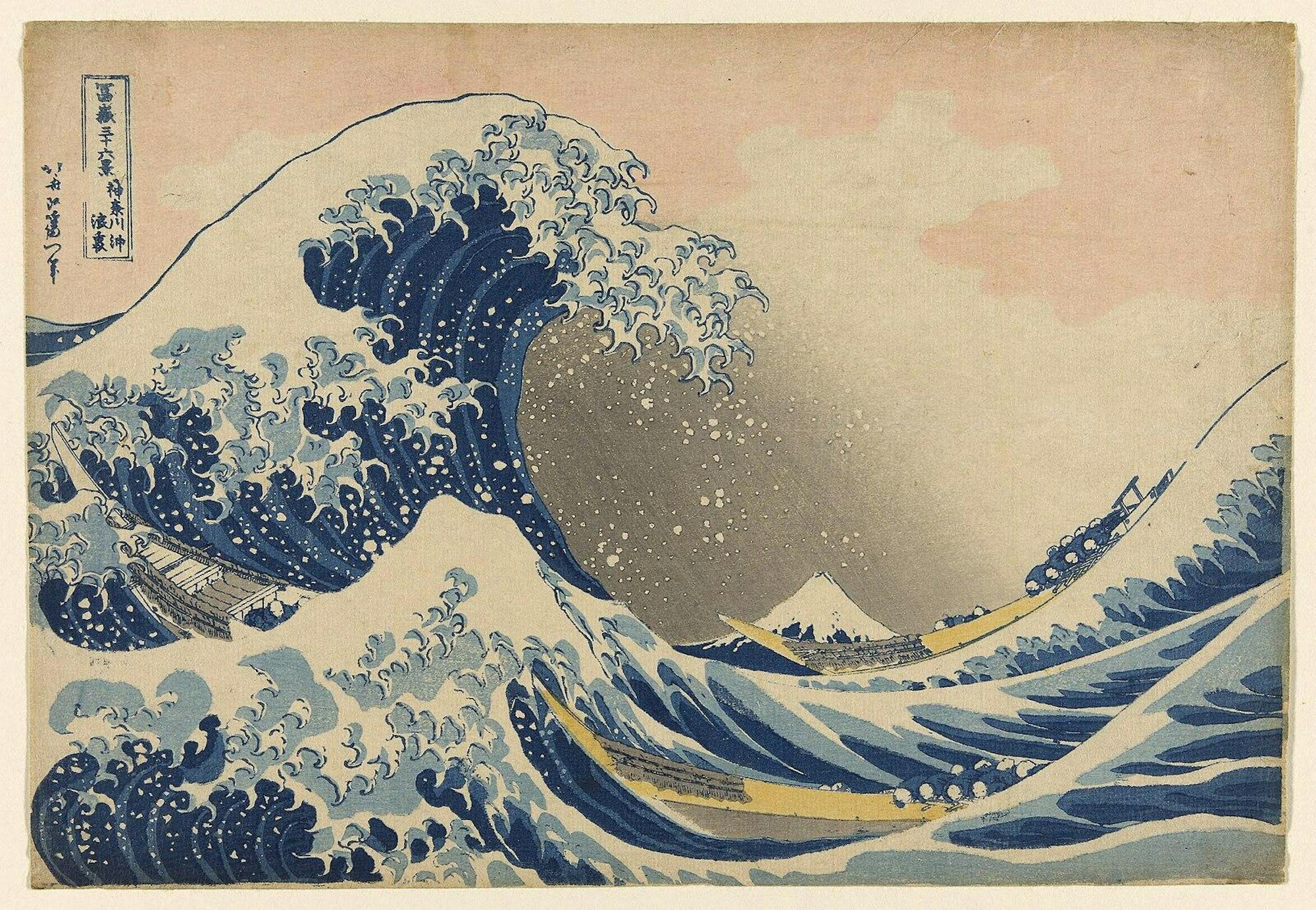
In the last column, we explored how Hokusai’s “The Great Wave” incorporated Western techniques and came to symbolize artistic exchange between East and West. In this article, we will examine how the print evolved into a global phenomenon, becoming the foremost cultural motif of Japan and East Asia.
When “The Great Wave” was published as part ofHokusai’s “Thirty-Six Views of Mount Fuji,” it stood out for its imaginative composition and striking visuals. Its use of foreign “aizuri-e” (blue printed picture) and European perspective helped the domestic audience reimagine Mount Fuji. Visually, the towering wave — a natural force that both protects and isolates the Japanese archipelago from outside influences — appears to overpower the sacred and eternal Mount Fuji. To the Japanese audience, this served as a stark reminder of the potential threats brought by foreign powers and encouraged reflection on national identity.
Even before “The Great Wave” entered Western art discourse, Hokusai had already established a reputation as the foremost representative of Japanese aesthetics. The accessibility of the print medium, paired with the assistance of expanding international commerce, created momentum for the global influence of his prints. His manga were widely acknowledged and praised by prominent critics such as Phillippe Burty for “rivaling Watteau in their grace, Daumier in their energy, the fantastic terror of Goya and the spirited animation of Delacroix.” At the same time, British had also developed a taxonomic approach to Japanese prints that reduced their cultural complexity and presented a clear definition for the Western world to digest and mobilize. Even apart from its creator, the waves and the sea were already a powerful visual motif: fluid and all-encompassing. In the West, they were seen as symbols of globalization and revolution. These interpretive currents laid the foundation for “The Great Wave” to become a global phenomenon.
Over the years, the world witnessed the mutual appropriation of Hokusai’s wave. British architect Thomas Cutler reworked Hokusai’s waves for his book “Models of Modern Combs and Pipes,” reframing it within British ornamental design. Danish designer Arnold Krog incorporated the waves into porcelain plates for Denmark’s Royal Copenhagen Manufacture, translating the print into a refreshing Oriental taste for European customers. These Western interpretations, in turn, made their way back to Japan: domestic Japanese kilns began mass-producing wave-decorated porcelain for the international market. The waves were elevated from woodblock prints into the trendy porcelain medium that supported reproduction. In France, critic Edmond de Goncourt renamed Hokusai’s waves as “La vague,” granting the image a new European identity. Russian illustrator Ivan Bilibin built his personal style around incorporating Hokusai’s style into his illustrations of Russian folklore. Composer Claude Debussy chose Hokusai’s “The Great Wave” as the poster design for his impressionist composition “La mer.” These are just a few examples of how the Western world gave “The Great Wave” a global voice.
As the motif spread, its entrance into the United States made public recognition take off. The dominance of American political power post-World War II and Japan’s reemergence as an economic superpower assisted in the fight against Communism. Prominent art dealers passed along ‘The Great Wave’ in auctions, elevating its monetary value and prestige to the point where solo exhibitions were held to showcase it. Nobel Prize-winning author Pearl Buck selected the print to portray the beauty of Japan that exists in her work, “The Big Wave.” This piece distracted the public from Japan’s rebuilding and coincided with the improvement of Japan’s public image amid American occupation. As media outlets singled out “The Great Wave,” the Japanese government embraced this imagery to reestablish Japan’s identity in a more positive light.
Hokusai’s powerful print “The Great Wave off Kanagawa” is a masterful work. The establishment of its modern status, though, cannot be divorced from the cultural exchange that can be attributed to globalization.



