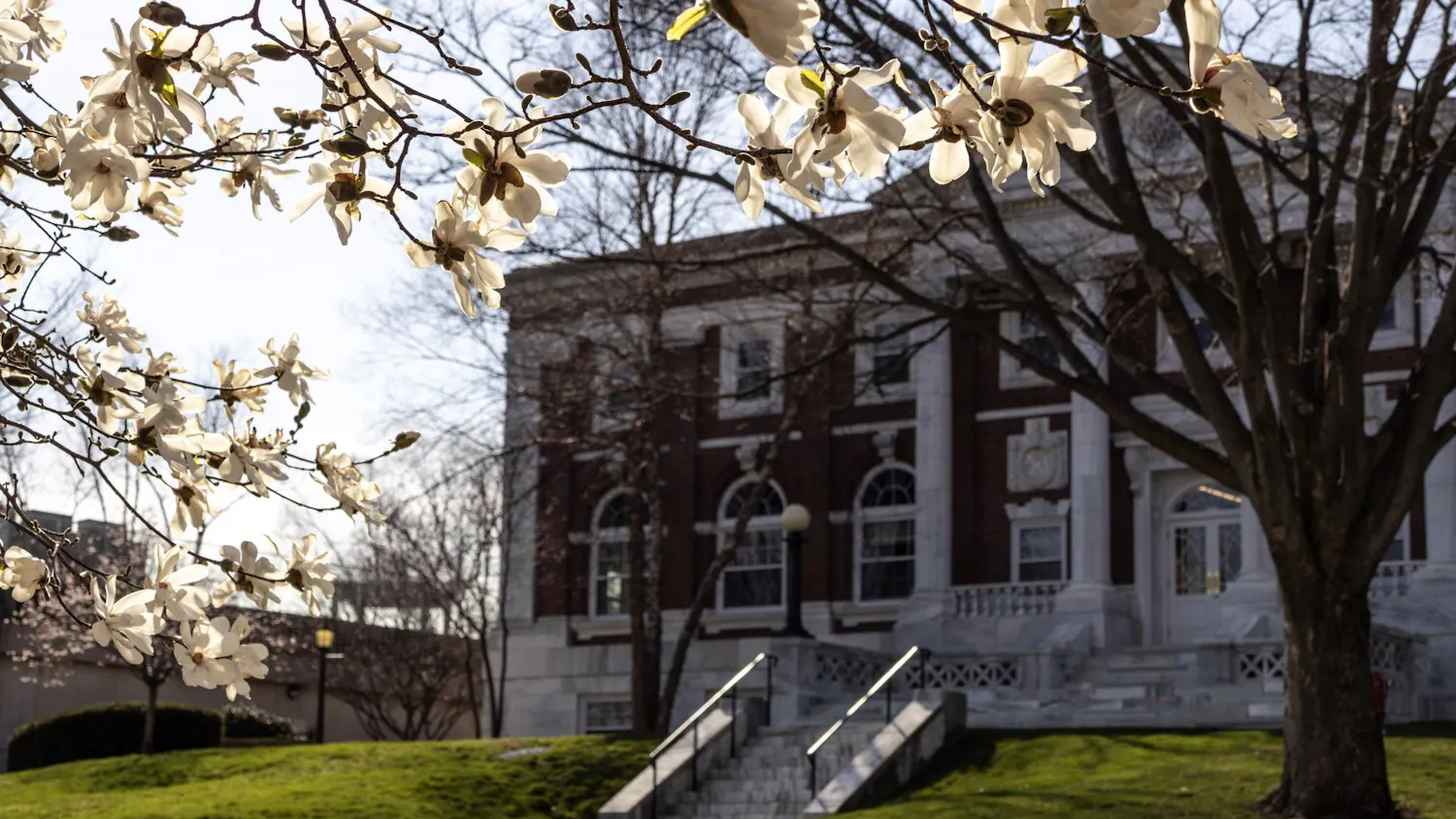
Sitting next to the lush greens of President’s Lawn is Tisch Library, a building we all know and love that serves as a center of academic learning and scholastic research at Tufts. Students utilize the library for a wide range of purposes, which include creating in the Digital Design Studio, meeting group members in Tower Cafe and finishing a last-minute homework assignment in one of the reading rooms.
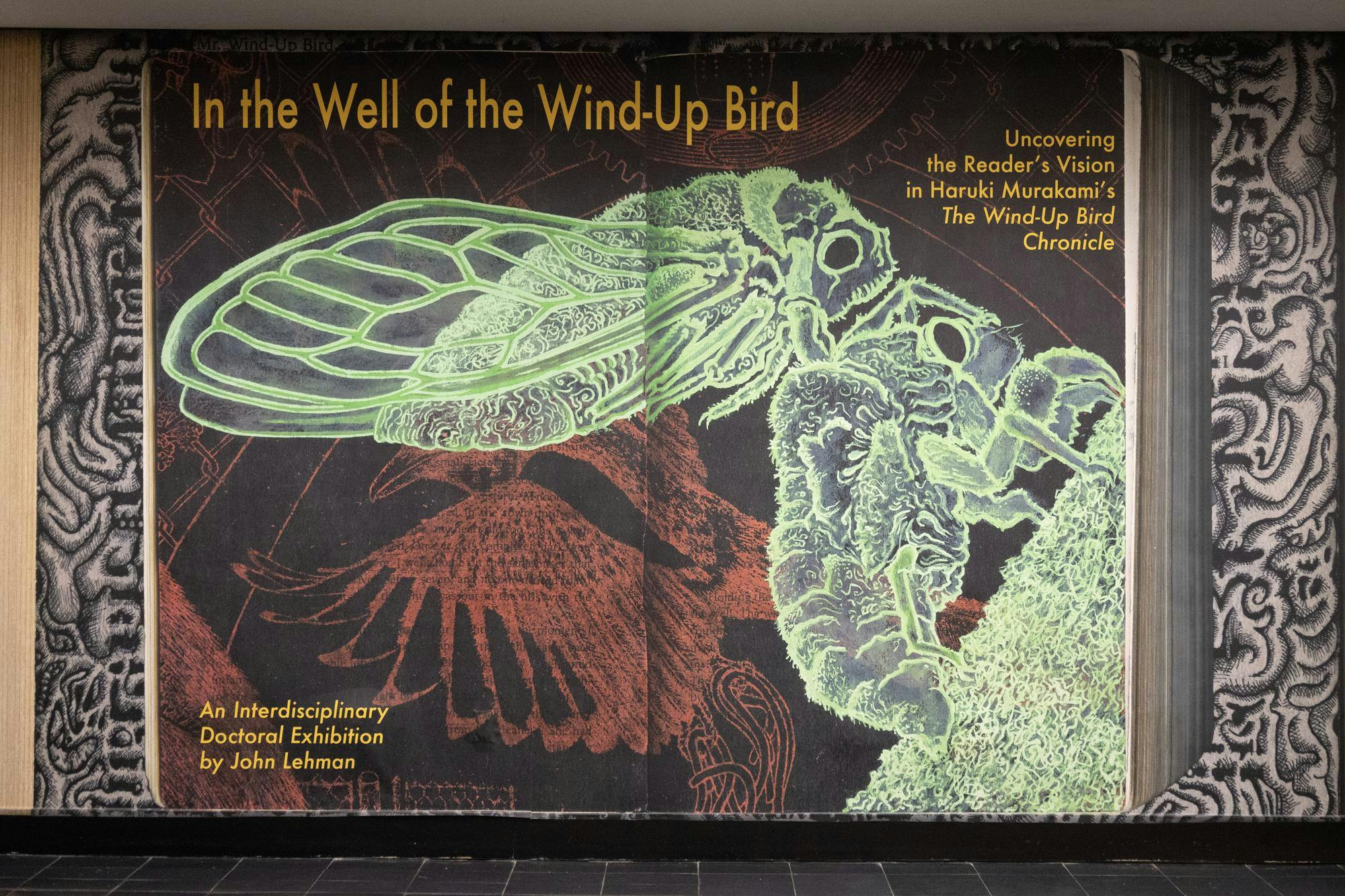
For Tufts Ph.D. candidate John Lehman, the library — with its actively engaged community — is the perfect interpretive space for his dissertation, “In the Well of the Wind-Up Bird.”
As one strolls past the Hirsh Reading Room, it’s hard not to be caught in the vibrant colors of Lehman’s delicately created illustrations. The exhibition visualizes all 607 pages of Haruki Murakami’s — a former writer-in-residence at Tufts — novel, “The Wind-Up Bird Chronicle.” Lehman first conceived the idea of combining literary experience with artistic expression while teaching in high school.
“I started making these strange and intricate drawings as a means to sort of cope with the daily grind, as it were,” Lehman said. “They were very intricate and gesturing towards medieval manuscript style imagery, and I was always thinking about how literature and visual art can commingle and support one another.”
To explore these ideas further, Lehman applied for a post-baccalaureate and, later, an Master in Fine Arts at the School of the Museum of Fine Arts at Tufts University. Afterwards, he applied to the Interdisciplinary Doctoral program at Tufts. Through the facilities SMFA provided, Lehman was introduced to etching and woodcutting, and he developed his love for printmaking. These passions — combined with his interdisciplinary studies in the international literary and visual studies department, the Japanese department, the English department and the film and media studies department — set the foundations for his dissertation’s successful and moving execution.
“What is amazing is that he really became creative in response to his reading,” Hosea Hirata, the director of the ILVS department, said. “Usually, our reading is really aligned with what the text is saying, but [Lehman’s] work is far freer than the usual tracing of the text.”
“So I would rather think that the work [Lehman] did was an additional dimension that he created, and that’s his world. His world is responding to [the] miraculous world in a very personal way,” Hirata said.
Lehman decided to hold “In the Well of the Wind-Up Bird” in the Tisch Library instead of a gallery since it is a democratic reading space.
“Because I am making these visual interventions in the text. That means that anyone who’s coming and looking at this work or looking at my work in any other venue, they’re capable of making their own interventions in my work so that the reading process can continue,” Lehman said.
This is also the reasoning behind Lehman’s use of the Hirsh Reading Room, where he has set up markers and prints on one of the tables to invite people to interact and create over his own works.
Another reason Lehman chose the library space was Tisch Library’s role as an interdisciplinary hub of the university. His work can engage with a wide variety of audiences across disciplines and encourage creative tension between audiences. His personal studies across departments contributed to the high accessibility of his works.
“I’m part of an interdisciplinary doctoral program, so interdisciplinarity is important to my thinking. Cross-pollination over what I consider … boundaries between disciplines,” Lehman said. “Folks in the art history department should be able to talk to people in ecology … and we can benefit from one another’s different readings of reality or of various texts that we engage [with].”
As Lehman worked on developing his exhibition, he actively engaged with the Tisch Library staff, notably Special Collections. Special Collections, situated on the first floor of the library, holds a vast collection of precious manuscripts, topographical equipment and much more. Some books from the Collection are featured in Lehman’s exhibition.
“We want people to have the experience of working with those materials,” Dorothy Meaney, director of Tisch Library, said.
Lehman first started taking inspiration and making art from the rare book collections before finalizing his proposal. Afterwards, he worked closely with librarians in Special Collections and their facilities to develop the majority of his prints.
“We’ve always seen a potential for people — for artists — to make new art from ours, to remix imagery in our collection,” Christopher Barbour, head of the Special Collections, said. “We have many illustrated books, many beautifully bound books, which in themselves have designs on them, and this was an opportunity to see what that would be like — to see an artist who made new art based on imagery in our early printed books.”
Lehman’s exhibition also mirrors Special Collections’ similar mission of encouraging interdisciplinary learning.
“We work with classes in political theory, in the history of science and medicine, history of witchcraft and magic. We have hosted English classes. … We work with SMFA professors teaching typography, graphic arts and visual and material studies. We’ve worked with professors in romance language [and] in religion. … There is a place for everything,” Barbour said.
Special Collections, apart from closely collaborating with faculty and students in the curation of Tisch exhibitions over the years, also showcases its proud pieces in exhibitions of its own, often grouped by kind or by a common theme. A most recent exhibition, “From A (Athanasius) to Z (Zarlino): Changes in Printing Technologies and their Impact on Music Notation (12th-19th c.)” is a collaboration with the Lilly Music Library that displays precious music manuscripts.
“This is a way that we work with the instructors and students and in the curriculum not only to inform the work they’re doing, but the work they do informs the work we do,” Barbour said. “I understand a lot more about printmaking processes because of the collaboration with SMFA faculty and students.”
Overall, Tisch Library Exhibitions are precious learning opportunities that showcase scholarship happening at Tufts. Meaney adds that these spaces are available for anyone and any department and are one of the ways the library engages with students and professors.
“There are all kinds of things that we have going on, and we want students to find the things that give them the learning experiences and expose them to all kinds of knowledge across all of the disciplines, depending on what they’re looking for,” Meaney said.
Lehman’s exhibit, therefore, is not just a beautiful work of art but the epitome of a long-standing interdisciplinary tradition that Tisch promotes. Members of the Tufts community are able to view Lehman’s work in the lobby of Tisch until Dec. 2; alternatively, you can view a virtual rendition of the exhibit via Lehman’s website.