
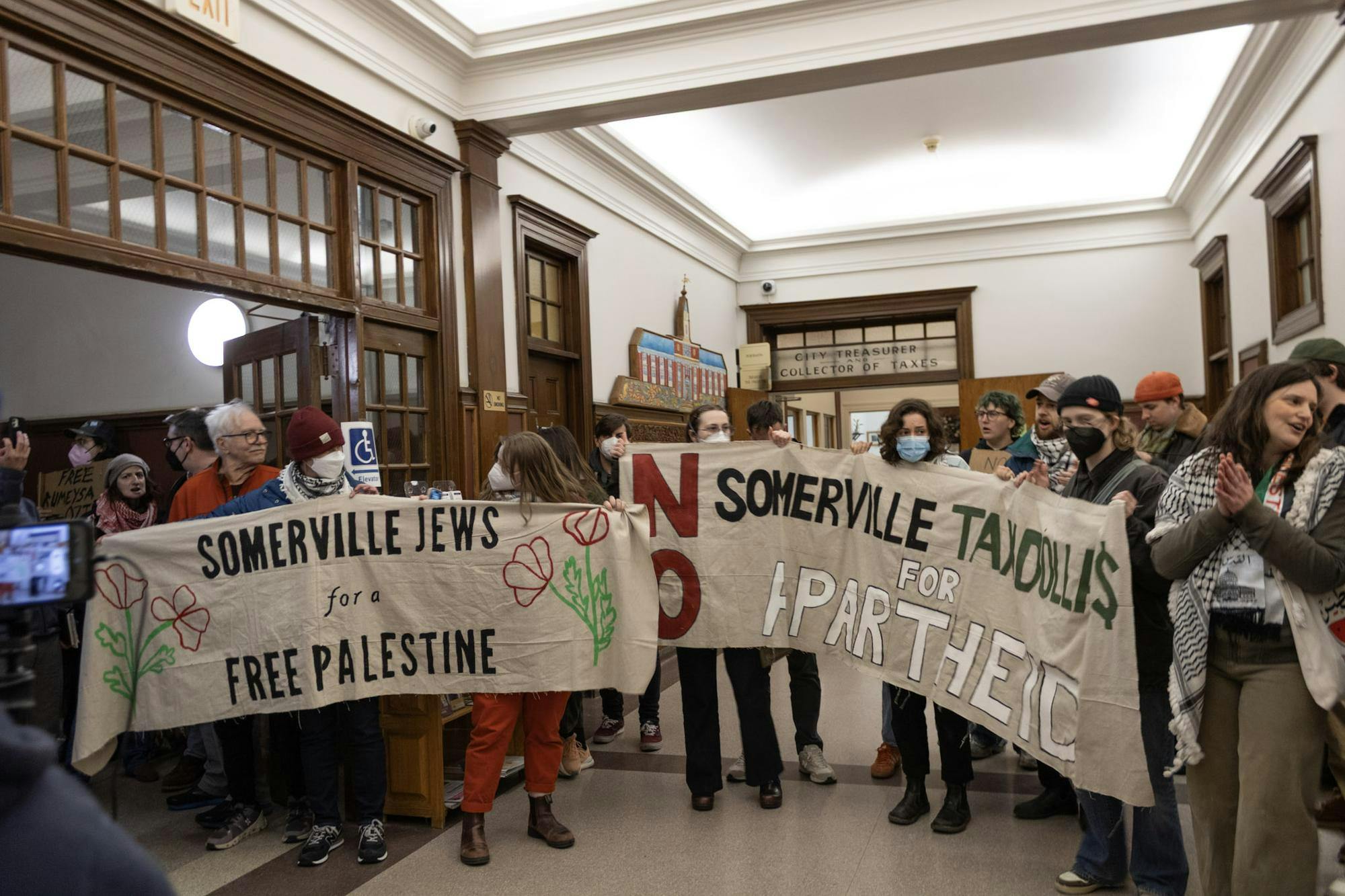
The Somerville Election Commission voted on Oct. 6 to certify more than 8,000 voter signatures in support of a nonbinding advisory ballot measure asking whether the city should end business with companies linked to Israel, clearing the way for the question to appear on the November ballot.
The decision followed a lengthy public hearing before the city’s Election Commission, where commissioners heard testimony from residents, elected officials and representatives arguing for and against certification. The measure, known as Question 3, will allow Somerville voters to weigh in on whether city leaders should, according to the city’s website, “end all current city business and prohibit future city investments and contracts with companies as long as such companies engage in business that sustains Israel’s apartheid, genocide, and illegal occupation of Palestine.”
The ballot question is nonbinding.
The Election Commission’s approval of Question 3 follows months of organizing by Somerville for Palestine, whose members and volunteers gathered 8,013 certified signatures to qualify the measure for the ballot — exceeding the 10% threshold of all registered city voters required by state law. Somerville for Palestine is a grassroots organization “united in [its] steadfast advocacy for Palestinian liberation,” according to its Instagram page.
The Oct. 6 hearing was centered on a challenge filed by members of Somerville United Against Discrimination, a group of Jewish residents of Somerville and allies who oppose Question 3. SUAD sought to disqualify thousands of voter signatures, arguing that they were collected outside the legally permitted time frame.
A representative for SUAD also testified at the meeting that the question’s wording was “vague” and “filled with discrimination.”
“This specific question will cause harm to our residents … because it is incorrect, it is false and it is filled with antisemitic tropes,” she said. “It specifically states that Israel is doing apartheid, genocide and illegal occupation of Palestine. These are all false statements.”
Elections Commission Chair Nicholas Salerno said the verified signatures surpassed the necessary benchmark. “We have not received objections alleging fraud or forgery of any particular signatures,” he said.
Advocates for the measure, including Tufts graduate student Lucy Tumavicus (A’22), treasurer of the Somerville Boycott Question for Palestine Committee, pushed back on claims that Question 3 is discriminatory.
“This question does not discriminate against any particular person, group or protected class recognized in state or federal law. The language of the question was drafted specifically to apply to companies on the basis of their actions, not their identity, not their origins, not their beliefs,” Tumavicus said.
She also emphasized canvassers’ and volunteers’ adherence to regulations, laws and the importance of proper civic process in the collection of signatures for Question 3.
“This ballot campaign has been, at every step of the way, a grassroots effort of Somerville community members exercising their right to the civic process, taking measures to be diligent in following all applicable laws and guidance,” Tumavicus said. “The fact that this question brings forth differing opinions is precisely the reason that it must appear on the ballot so that the voters of Somerville … can make their voice heard on this issue.”
State Sen. Patricia Jehlen offered testimony in support of allowing voters to decide on the ballot question themselves.
“The ballot question does not discriminate against Jewish and Israeli business owners. The ballot question only advises the city government not to engage in business with or invest in companies that engage in business that sustains Israel’s apartheid, genocide and illegal occupation of Palestine,” Jehlen said.
Several Somerville city councilors — including Councilor-at-Large and mayoral candidate Willie Burnley Jr., Councilor-at-Large Wilfred Mbah and Councilors J.T. Scott and Naima Sait — also offered testimonials in support of moving the question forward.
Burnley Jr., a signatory of the petition, said he was “deeply grateful” for the Election Commission’s decision to approve the question for the ballot and looked forward to voting for it.
“It would have been a severe miscarriage of justice and a disruption to the democratic process if a relatively small amount of individuals and institutions … were able to drown out the voices of over 11,000 signatories,” Burnley Jr. said. “If voters are unable to decide whether our city will remain complicit in genocidal acts, then our democracy itself will be degraded.”
For many supporters, the Election Commission’s decision stood as an affirmation of the city’s democratic process.
“I won’t deny that not everyone agrees with us, as you can plainly see, but that’s the function of democracy. We should all have the right to vote on where our tax dollars are spent, because what’s undeniable is that Somerville cares about this issue,” Annika Schaefer, a resident who coordinates the Jewish caucus of Somerville for Palestine, wrote in an affidavit.
Following confirmation of Question 3’s place on the ballot, SUAD members are continuing to urge people to vote ‘no’ on Tuesday.
“The people that do not support this question are entitled to their opinion and their right to express it, which they may do by voting ‘no’ on this question. What they cannot do is police others’ language, suppress others’ right to be heard,” Turmivicus said. “Somerville wants the opportunity to vote on this, and the signatures are there to prove it.”



