
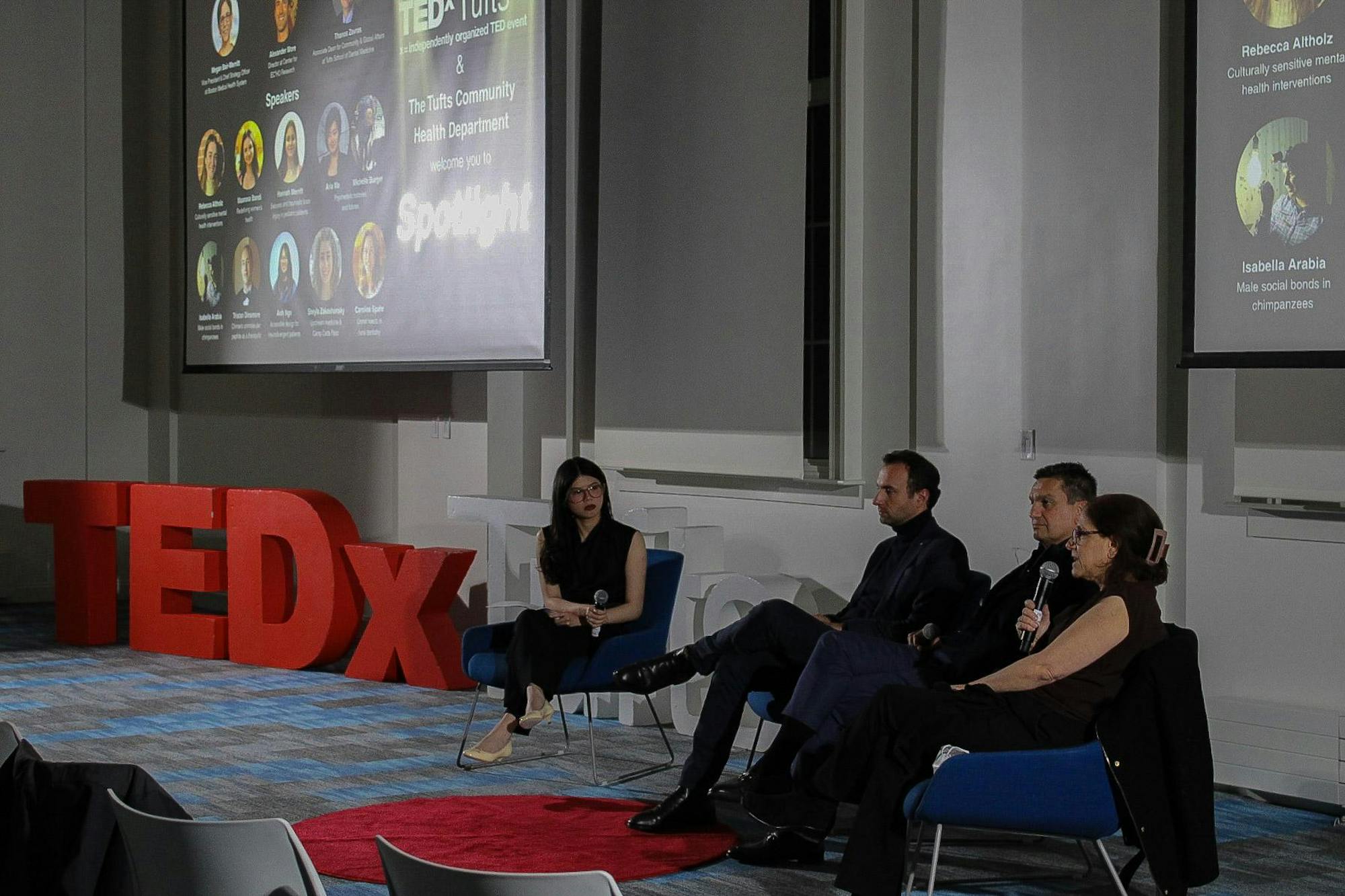
TEDxTufts, in collaboration with the Tufts Department of Community Health, hosted its first-ever Spotlight event on Sunday. The new format, which the organizer hopes to make annual, featured brief lectures by 10 students followed by a panel discussion with three community health experts.
Nick Dohr, a co-executive director of TEDxTufts, explained that the shorter Spotlight structure was designed to make the event more conversational and digestible to attendees. It aimed to provide a platform for more speakers to share research on topics they care about — even for those without prior public speaking experience.
“[TED Talks] can feel a little bit intimidating to people who don’t have public speaking experience,” Alexandra Rachmat, a co-executive organizer, said. “One of the things we hear is that people can often be nervous to apply, put themselves out there or even get on that stage. And so what we wanted to do was lower that barrier to entry to the world of public speaking.”
The event opened with a talk by Aria Ma, a fifth-year dual-degree student studying biopsychology and studio art, and Michelle Burger, a senior studying anthropology. They focused on the positive uses of psychedelics and how colonization and the War on Drugs contributed to the erasure of a long history of psychedelic use as a form of spirituality in various Indigenous communities.
“We’re seeing more and more possibilities that these substances offer to treat conditions that Western society is not necessarily ready to treat,” Burger said. “We’re finding evidence that they may be helpful for PTSD, for treatment-resistant depression, for chronic pain and for autoimmune diseases.”
Anh Ngo, a senior majoring in child studies and human development, followed with a speech addressing the lack of understanding of neurodivergent patients in healthcare. She shared her own experience advising healthcare practitioners to be aware of the different ways in which patients with autism experience pain.
The program then shifted into the sciences with Tufts alumnus Tristan Dinsmore (AG’25), who discussed emerging work on chemical peptides used to induce weight loss. Rebecca Altholz, a senior studying clinical psychology and community health, spoke about her research trip to Rwanda and the value of promoting honest mental health dialogue in communities. Isabella Arabia, a 4+1 master’s student studying biology in the primate lab of Associate Professor Zarin Machanda, spoke about the similarities between chimpanzee and human social structures.
Other talks continued the evening’s focus on healthcare inequity. Senior Caroline Spahr reflected on how growing up in a rural community shaped her understanding of barriers to medical access, and on the solution she hopes to pursue as she enters dentistry.
Junior Maanasa Bandi addressed the longstanding underrepresentation of non-cisgender, non-white and non-male bodies in biomedical research — and the resulting disparities in how pain is recognized and treated.
“An immigrant woman sits in an exam room struggling to find the right words to express her symptoms, but her accent is mistaken for confusion, and her pain goes undiagnosed and untreated,” Bandi said. “These are just some of the things that I’ve seen while working with some of the women in my community.”
Hannah Merritt, a sophomore studying biology and chemistry, presented her work at the Brain Trauma Lab at Massachusetts General Hospital, where she studied a common misconception about pediatric brain trauma.
“Early traumatic seizures are a symptom of brain injury in the immature brain, not a cause,” Merritt remarked. “However, the way we are treating them does cause harm.”
Sheyla Zakashansky, a senior studying biology and environmental studies, closed the lecture portion of the event, sharing her experience working at Camp Cada Paso, a summer program in New York with a large Puerto Rican population. She stressed the importance of community engagement in raising children to be passionate about local and global change.
“[The campers] got to present their findings that they had learned over the course of the four weeks of camp, and then they got to advocate for what they believe needed to be done,” Zakashanksy said. “The kids became agents of their own change.”
The event concluded with a panel of public health experts — Alexander More, Megan Bair-Merritt and Athanasios Zavras — who highlighted the economic struggles of conducting modern-day healthcare and environmental research.
TEDxTufts organizers said they hope the Spotlight event will help promote the club and encourage stronger attendance for their 12th annual talk in the spring.
“I think this is just a great way to keep energy for the topic and to bring new ideas and perspectives to these really complex and challenging problems that we face,” Elizabeth Marfeo, associate professor and chair of the community health department, said.



