
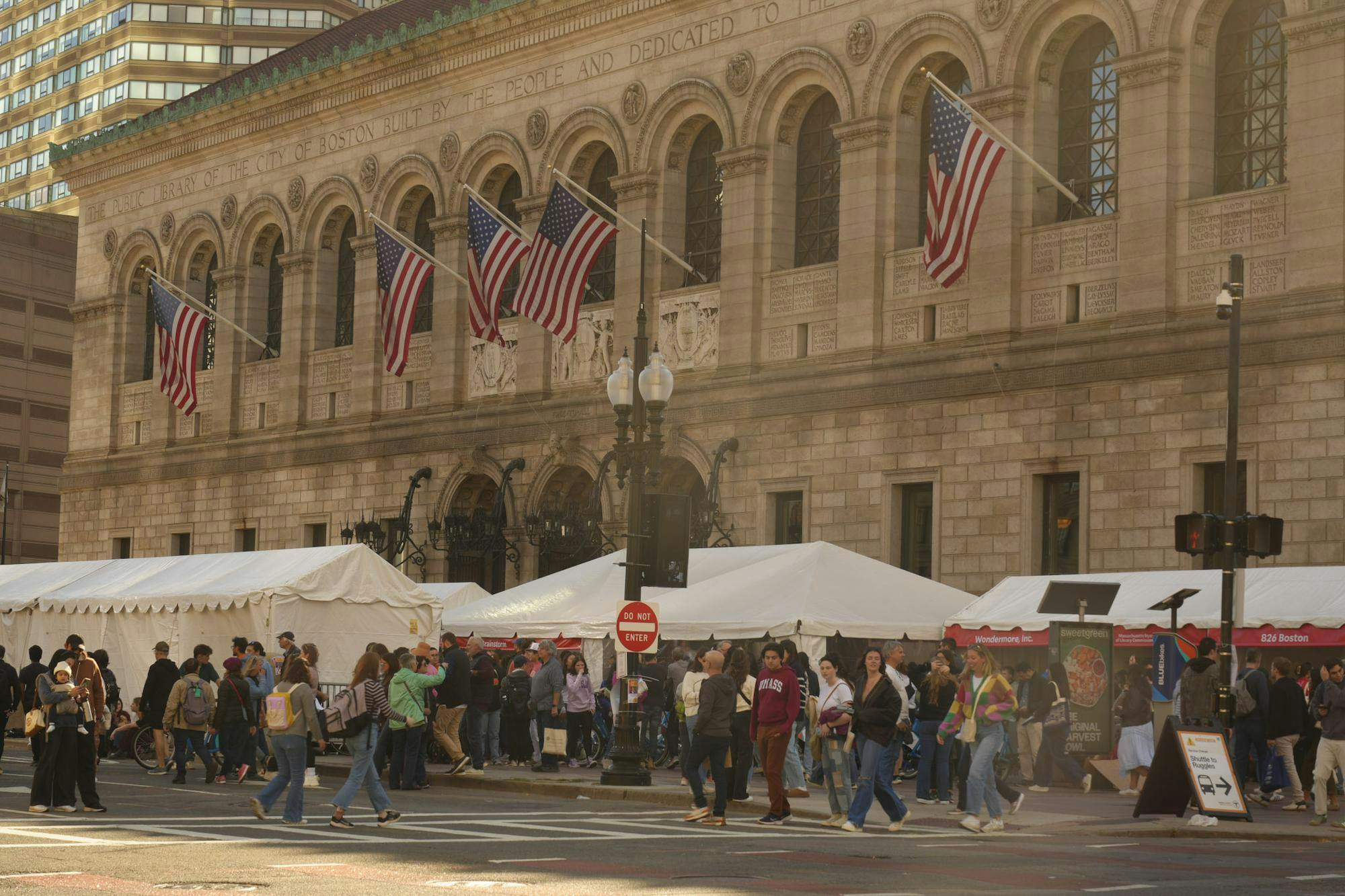
One Saturday every October, Tufts students can hop on the Green Line and, after 30 minutes, arrive at New England’s largest literary festival. The Boston Book Festival, located in the bustling Copley Square, is one of Boston’s biggest events of the year, drawing upwards of 25,000 attendees annually. The event hosts hundreds of authors, moderators and vendors to celebrate the city’s vibrant literary community. This year’s festival was held on Oct. 25 and saw more than 200 authors and moderators in over 70 sessions, including keynote speakers such as Geraldine Brooks, Patricia Cornwall, Kiran Desai, Maureen Dowd and Hafsah Faizal.
While this fall marked the festival’s 17th year, several clubs at Tufts have just recently begun organizing trips to the festival to promote student attendance and community. Sophomore Rhys Flynn, one of the social media managers for the Tufts Book Club, attended the festival with the club for the second year in a row.
“[The Tufts Book Club is] a space for Tufts students to all go to the [Boston Book Festival] and not feel alone. It can feel a little intense if you don’t have any people you know,” he said. “We really enjoyed it last year, and it was such a fun moment of camaraderie for all of us … and I think we had the same experience this second time.”
Senior Madison Heckman, the treasurer of Tufts’ creative writing club Parnassus, attended with a group of Parnassus members in the club’s second year organizing a trip to the festival. The group attended two workshops: “Unbound: From Workshop to Book Deal,” a panel-style discussion among memoirists moderated by Alysia Abbott, and “Weaving Your Story: How Silly Ideas Can Become Compelling Narrative,” a creative writing workshop led by authors Aube Rey Lescure and Maria Pinto.
In this workshop, attendees were inspired to craft engaging stories from obscure premises. Heckman noted the variety of ways in which attendees expressed their creativity and found inspiration throughout the event.
“[People would find] some random computer article, or go on YouTube and find a video … and develop it,” she said. “[One attendee] managed to make [a story] about ‘Star Wars,’ even though it did not start out [being] about ‘Star Wars.’”
In addition to the panels and workshops that were scattered throughout the Copley neighborhood, the festival also hosted a street fair in front of the Boston Public Library with over 30 vendors, including booksellers and local literary organizations. One booth that stood out to Heckman was Zip Code Poetry put on by Mass Poetry, a nonprofit organization that supports poetry communities across Massachusetts. In this activity, participants wrote a poem inspired by their zip code.
“For every number in the zip code, it’s that amount of words [in that line]. So you make a poem about your hometown, or that kind of thing,” Heckman said.
Participants then hung their poems on a clothesline between the booths, decorating the street fair with colorful papers of original poems.
During the festival, Flynn spent the majority of his time at the street fair, looking at books while talking with vendors and other attendees. A highlight for him was the Pop-Up Poetry booth by the Boston Typewriter Orchestra, a percussion ensemble that utilizes typewriters as instruments. At this booth, attendees received free personalized poems based on topics they provided.
“You walk up to them with an idea, with something you want expressed in poem … and then they write you a poem based on these ideas,” Flynn said. “So they end up creating this really beautiful piece of literature that’s very specific to you, written by someone else right in front of you.”
Flynn, who visited nearly every booth at the festival, also expressed the importance of the diversity of literature represented.
“I’m glad that there [are booths] there for all this literature for you to immerse yourself in, because you may not have access to it at a Barnes & Noble,” he said. “[At the festival], they’re trying to sell books, but also trying to help you explore the full range of the literary spectrum.”
Heckman had the opportunity to engage with books she may not otherwise have known about or gravitated towards. At the “Weaving Your Story” workshop, one of the books she purchased was Pinto’s “Fearless, Sleepless, Deathless,” a nonfiction narrative centered around fungi and the ways in which it connects the natural and human worlds.
This topic of stories born from niche topics was the focus of an event in which Pinto was a panelist, along with longtime journalist Sam Quinones and visual artist Makoto Fujimara. The event, entitled “The Transformative Power of Going Deep: Tubas, Fungi, Beauty,” explored the ways in which transformative stories can be born from deep immersion into a specific topic.
Quinones’ latest book, “The Perfect Tuba: Forging Fulfillment From the Bass Horn, Band, and Hard Work,” was published this past fall and explores the history and cultural significance of the tuba. Quinones, who has been a journalist for the past 38 years and wrote four other narrative nonfiction books centered around Mexico and the opioid epidemic, was initially unaware of the extent to which “The Perfect Tuba” would connect to his previous work.
“It’s that deep immersion in a topic that lets you understand [and] see the deeper connections,” he said. “Why would a book about tubas, tuba players and band directors be an excellent sequel to two books about OxyContin and heroin and fentanyl and methamphetamine? … [‘The Perfect Tuba’] was about [saying] how you actually defeat addiction or prevent addiction is by hard work, [by] finding the thing that makes drugs almost laughable.”
While Quinones did not set out to write a book about the tuba, it continuously surged as an unexpected theme while researching for his previous two books.
“I just got enamored with tuba players. In part because I knew nothing about them, and also because everyone that I talked to seemed to do it not for any plan of becoming rich and famous … but instead, because [they] just loved doing it,” he said.
Quinones found that in communities that were greatly affected by the opioid epidemic, the tuba provided a positive outlet for vulnerable youth.
“What they end up feeling is their own worth, their own abilities come forward, and that is the best when you find that through something that’s not connected to drugs,” he said. “It becomes the best defense against drug addiction you could possibly imagine.”
For Quinones, one of the most memorable aspects of the festival was the quartet of tuba players that performed outside of the venue to promote his event, consisting of Boston Symphony Orchestra tuba player Mike Roylance and three of his students.
Quinones also emphasized the importance of creativity and initiative when it comes to book promotion.
“You need to take joy from book promotion, and that means all kinds of creative stuff,” he said. “I used to promote punk rock concerts when I was in college, many years ago. And punk rock was all about you [doing] it yourself. … Book promotion and freelance book writing is not that different. Very punk rock.”
This aspect of creative freedom and expression at the festival was also a point of appreciation for Heckman.
“There’s this belief that people read less [now], and I don’t know if that’s true or not, but I think it’s nice that there are people who enjoy reading or writing enough to go to an event like this,” she said. “I like how it does promote creativity, and also a lot of the authors are kind of smaller … [so] I’m exposed to authors I’ve never heard of.”
Quinones, who has attended many different book festivals throughout the years promoting his various works, noted the positive energy radiating from such events.
“People who go to book festivals seem happier,” he said. “They’re surrounded by something simple … [and by] good stories … [so] maybe that’s [why].”
The Boston Book Festival continued to be a hit this year, drawing in crowds from all across New England for the sole purpose of celebrating literature. The festival already has plans to continue the annual tradition, with next year’s festival date slotted for Oct. 17.
For Flynn, one of the most significant aspects of the festival is its ability to encourage camaraderie and community among more understated members of the community.
“The festival provides a place for those people [who are] more reserved, or [those] who are interested in literature,” he said. “It’s a place for these people to share and learn about literature, and also a place for book clubs, like here at Tufts, to go visit and [to] partake in community activities that involve literature.”



