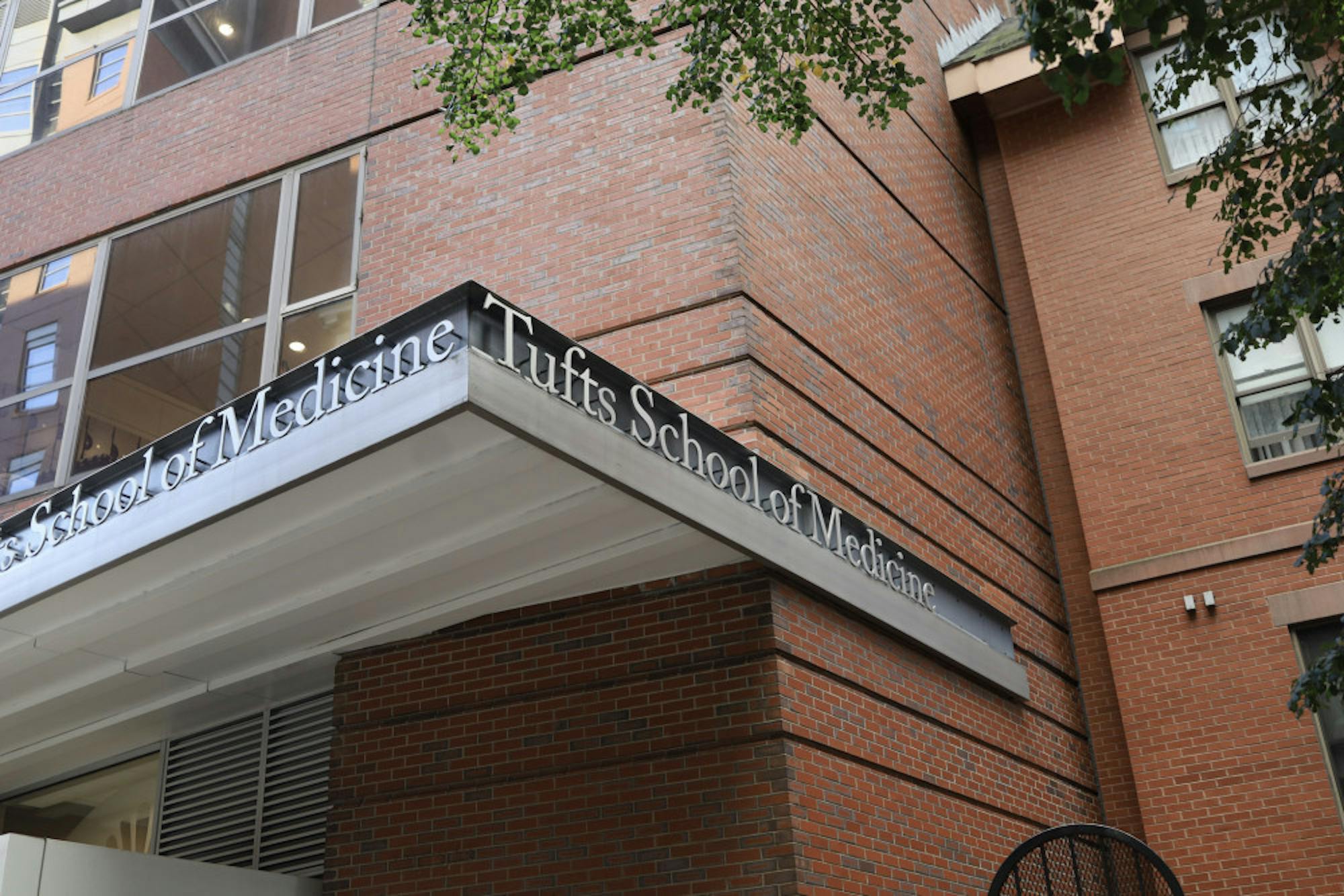
Chair of the Tufts Board of Trustees Jeffrey Moslow (A’86) and his wife, Linda Moslow, made a $4 million donation to establish a Women’s Health and Menopause Initiative at the university, aiming to promote a more holistic approach to medical care for women and advance the under researched field.
The initiative — a collaboration between the School of Medicine, the Friedman School of Nutrition Science and Policy and the Tufts Medicine health system — will fund new professorships in both the Medicine and Friedman Schools and create educational opportunities for students, faculty and external professionals.
For students, the initiative will support fellowships and scholarships in menopause medicine and embed women’s health education into curricula.
As part of the initiative, the university will also create a novel menopause outcomes registry, giving medical trainees the chance to participate in translational research that links laboratory discoveries to clinical care across the Tufts Medicine system.
Helen Boucher, the dean of the School of Medicine, explained that collaboration across the university will allow the creation of new curricula, research teams and clinical integration into ongoing research.
“The initiative’s academic menopause clinic will serve as a shared hub — where education, clinical practice, and research inform one another in real time and where students, fellows, scientists, and clinicians work side by side to advance evidence-based care,” Boucher wrote in a statement to the Daily.
Linda Moslow was first drawn to women’s health as an area in need of investment following her own journey with menopause and the lack of support she experienced.
“From a medical standpoint, there is really very little to no support of women’s health in the standard medical system. You have to advocate for yourself,” she said. “We can spend half to a third of our lives in menopause, and not having the medical support for half your life — it just can’t continue like this.”
Moslow added that standard medical insurance often does not cover the costs of accessing doctors who are familiar with women’s health issues. She said hearing from Medical School graduates that they were not educated on women’s health issues at Tufts because it was not part of the curriculum was “eye-opening.”
The donation is intended to leverage Tufts’ status as the only university in the country with a nutrition school. The initiative will contain a research component directly focused on the nutritional aspects of women’s health.
Christina Economos, the dean of the Friedman School, says that nutrition plays a significant role in the medical treatment of women.
“Obviously you need clinical care, and you need people who are trained in medicine and all of the other health professions to treat women, and that includes dietitians and other nutrition professionals,” Economos said. “So we want to develop a program which has clinical care for women that’s more holistic.”
Experts agree that women’s health has been heavily underresearched and underdeveloped. Economos added that menopause’s effects on nutrition-related changes, like glucose metabolism, muscle mass loss and cardiovascular health, are essential to study.
“For women during the perimenopause and menopause period, there really hasn’t been enough research done to optimize dietary intake,” Economos said. “There are a lot of changes that require different nutritional inputs in order to optimize health as one’s body is changing.”
The lack of research has consequences for medical treatment as well. Access to hormone replacement therapy, which can make up for lost estrogen during menopause, has been reduced significantly since a 2002 study found that the treatment can cause breast cancer, strokes and other health issues. The study’s focus on older, postmenopausal women led many to argue more recently that the results were skewed.
Moslow noted the lack of updated research on issues like hormone replacement therapy, saying it has limited women’s ability to seek critical care.
“We have hearts and bones and endocrine systems and muscular systems that all suffer with the loss of estrogen,” she said. “Women aren’t even educated to know that’s been the missing link.”
Jeffrey Moslow says that the initiative aligns with the university’s goals as a research institution and should serve as a model for other universities.
“This is an area where we think Tufts … could be uniquely positioned to not only build out our effort of women’s health across the entire life spectrum, but really have others leverage off of what we’re doing and try to have this, effectively, go viral,” he said.
Moslow added that the initiative is an opportunity to educate doctors outside of the Tufts system and to be a resource on the latest advancements in women’s health. Although women represent around half of the population, he says their gift will, “ironically, [serve] the underserved.”
“Women have not had the focus from the [Food and Drug Administration], doctors, or the medical system,” he wrote in a statement to the Daily. “Primarily it has been the needs of men.”
Linda Moslow said she hopes to eventually see classes on women’s health on the undergraduate level.
“I think it is so important for [young people] to begin to understand what lifestyle and how your life choices now affect your adulthood,” she said.