
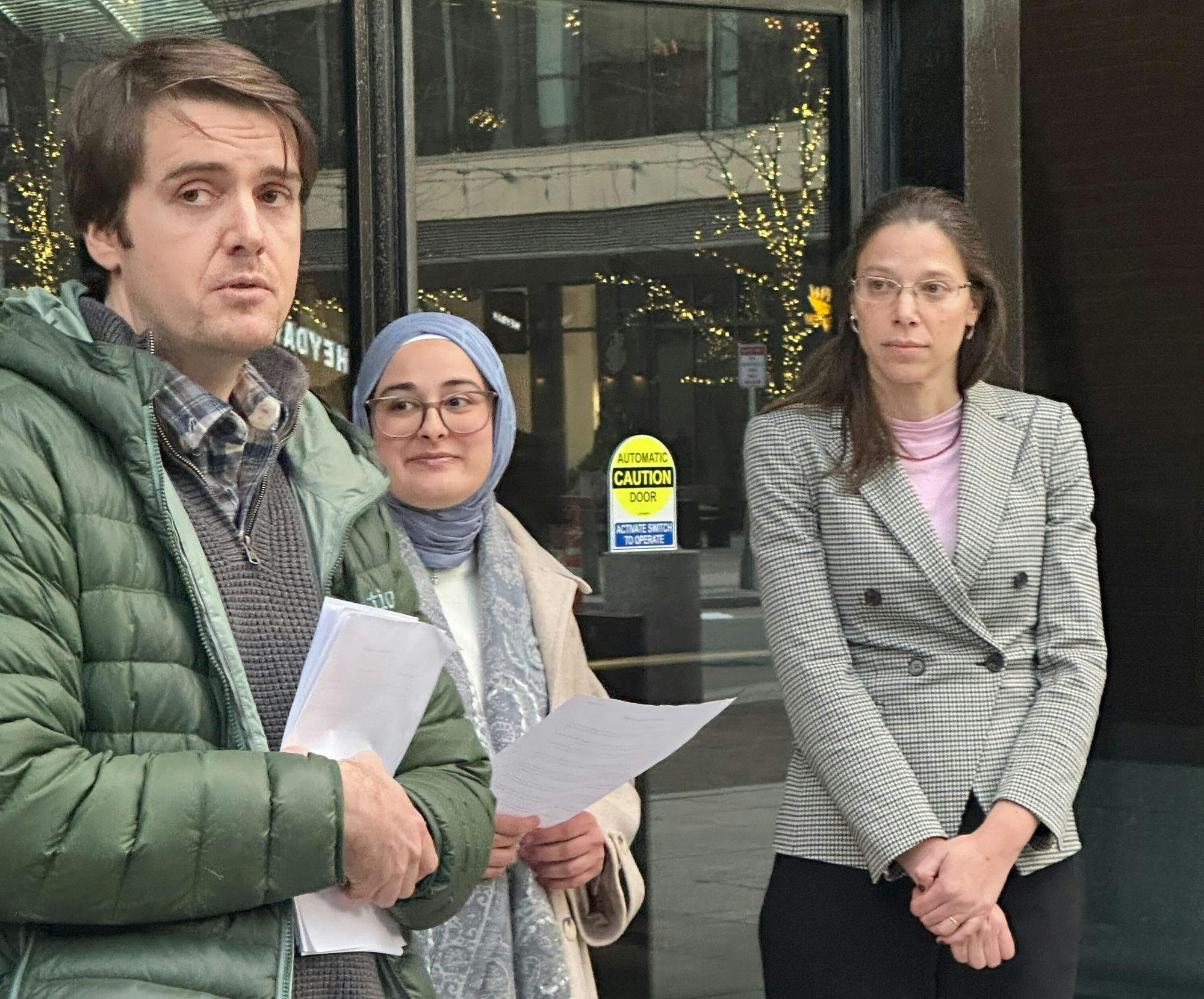
On Thursday, the United States District Court for the District of Massachusetts heard arguments on a motion for a preliminary injunction that seeks to require the government to reinstate Tufts graduate student Rümeysa Öztürk’s Student and Exchange Visitor Information System record. U.S. District Judge Denise J. Casper did not issue a ruling, but committed to making a prompt decision.
Öztürk’s F-1 student visa was revoked days before her arrest on March 25. Her SEVIS record, the file that monitors the legal status of non-citizens studying in the U.S., was terminated on the day of her arrest.
Terminating a student’s SEVIS status, unlike an F-1 visa, officially ends their lawful presence in the United States. Öztürk told reporters after the hearing that she has faced irreparable harm, including the loss of her current employment authorization, as a result of her SEVIS termination.
“For the first time, as a scholar and a woman, I’ve been denied my education,” she said. “Because of this, I could not contribute to a children’s podcast project or teach at my university.”
She also emphasized that the record was cancelled due to her co-authoring of an op-ed in the Daily “advocating for equal dignity and humanity for all,” and reaffirmed her solidarity with colleagues and students in Gaza, along with those around the world whose right to education is denied.
The termination of Öztürk’s SEVIS record by Immigrations and Customs Enforcement, her lawyers argued, has “prevented her full reintegration into academic life at Tufts following her release” from immigration detention in May.
“If her SEVIS record is not reactivated soon, she will lose the last opportunity she has in these final months of her graduate studies to obtain relevant work experience outside of her coursework and thesis,” her attorneys explained in their November memorandum for preliminary injunctive relief.
Öztürk’s counsel argues that her SEVIS record termination violates the Administrative Procedures Act, as the termination was not founded on regulations. Since Öztürk originally maintained her student status and did not meet other criteria for status termination by ICE, her lawyers argued the action was “arbitrary and capricious.”
“The records make clear that Ms. Öztürk was maintaining her status and continuing her course of study,” an October memo filed by Öztürk’s attorneys stated. “Nothing changed that could explain the termination of her SEVIS record on March 25 other than the government’s decision to target and punish her for her speech.”
This targeting of Öztürk’s speech, her counsel argues, is a violation of the First Amendment. They contend that Öztürk is likely to succeed on the merits of her First Amendment challenge to the SEVIS record termination, citing proceedings regarding her habeas corpus petition in the District of Vermont and the District of Massachusetts. Both courts have acknowledged the connection between Öztürk’s speech and the government’s decision to arrest her.
Assistant U.S. Attorney Mark Sauter argued in the hearing on behalf of the government that the District Court of Massachusetts lacked jurisdiction to review ICE’s termination of Öztürk’s SEVIS record, according to the Immigration and Nationality Act. The proper venue, Sauter claimed, would be federal immigration court, as the termination of Öztürk’s SEVIS record arose from removal actions taken against her.
Öztürk’s counsel argued that federal immigration court proceedings are restricted to questions of removability, which are not central to Öztürk’s request for preliminary injunctive relief. Instead, they said her request challenging the agency’s decision to terminate her SEVIS record concerns the administrative process.
They further argued that the government has not pointed out a mechanism through which Öztürk can seek a resolution through immigration court. The practical effect of taking the SEVIS claims to immigration court would be to “deprive her of any remedy at all,” according to the November memo.
The government also contended that even if the District Court had jurisdiction, the SEVIS termination was still lawful because ICE may terminate a student’s SEVIS record when the student’s visa has been revoked and the individual is therefore subject to removal.
“I think it’s fascinating to see that the Trump administration continues to try to funnel everything through the immigration courts, because they know that they have complete control, essentially, of what happens there,” Mahsa Khanbabai, Öztürk’s private counsel, told reporters.
This is a developing story. Check back here for an update on Judge Casper’s ruling.



