
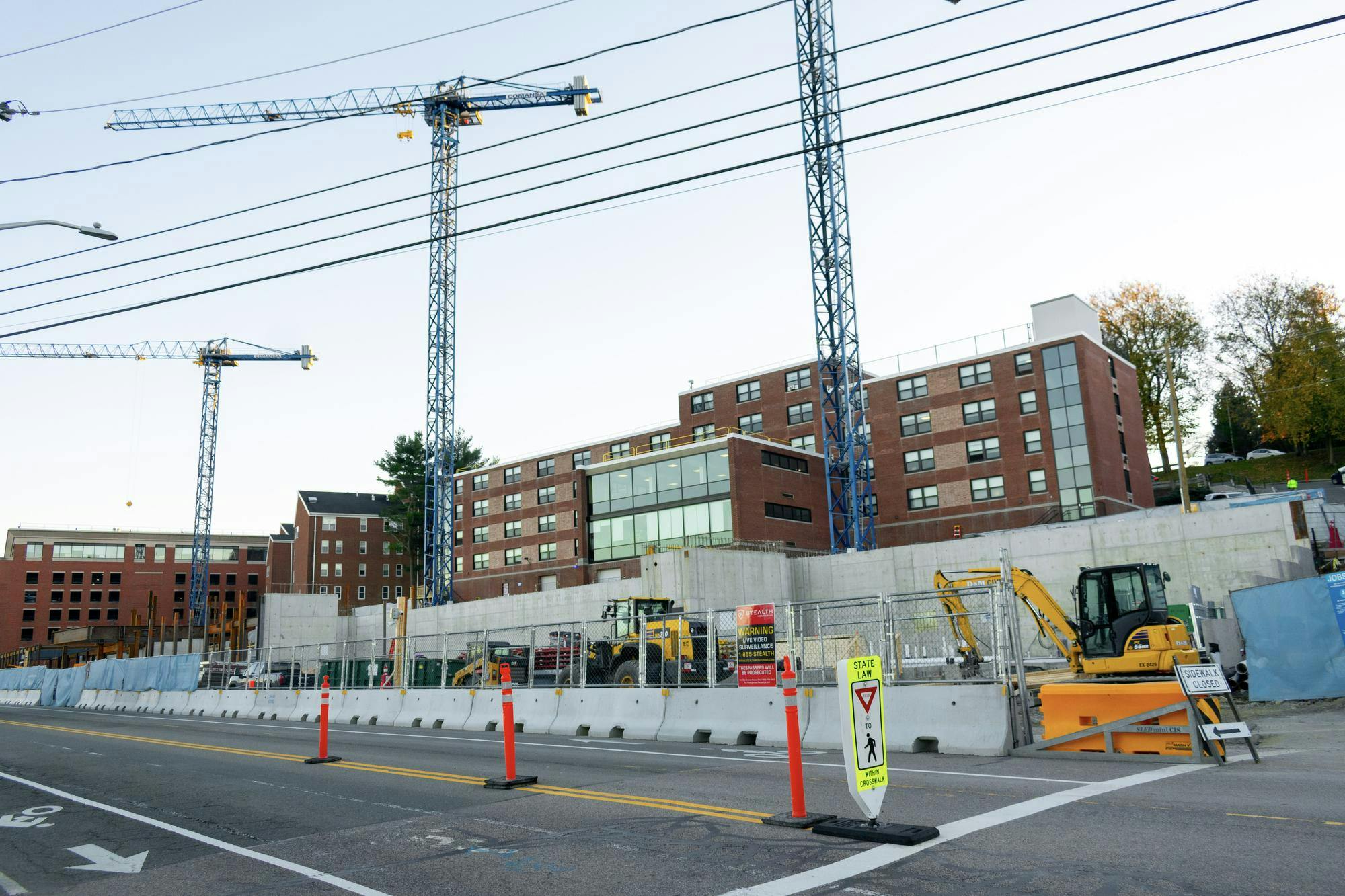
Tufts University will launch a comprehensive planning study of Boston Avenue in early 2026, aiming to address concerns about pedestrian safety, tree loss and the overall streetscape. The study, funded through Tufts’ community benefits package tied to the new Boston Avenue residence hall, is expected to take several months and conclude by September 2026.
Rocco DiRico, Tufts’ associate vice president of government and community relations and a member of the Medford Chamber of Commerce’s board of directors, wrote in a statement to the Daily that the goal is to rethink Boston Avenue’s design with the needs of both Tufts and Medford residents in mind.
“The goal of the study is to create a vision for Boston Avenue that is more accessible, safer, and greener,” DiRico wrote.
The study is expected to provide guidance for future improvement projects, and DiRico said Tufts plans to work closely with stakeholders in Medford throughout the process.
“As part of the Boston Avenue planning study, the university will engage with local business owners, the Medford Chamber of Commerce, and the city’s economic development department,” DiRico said.
Some residents emphasized the importance of transparent communication, particularly after frustration surrounding the development process for the new Boston Avenue residence hall.
“There were a lot of changes that happened in both the scale and scope of the building itself, and then the development partnership structure in terms of bringing a private developer — that happened really quickly, without a lot of communication. It was bad,” Laura Jasinski (LA’07, AG’14), a Medford Hillside resident, said. “Since that time, Tufts has had the opportunity to have more direct conversations with some residents that have yielded better results for everybody.”
Others felt communication from Tufts has not improved enough. Page Buldini, a member of the Medford Community Development Board, a member of the Medford Chamber of Commerce and the owner of Page Aesthetics Skincare on Boston Avenue, said she has generally felt informed of projects thus far but believes there is always room for growth.
“I think it’s a great opportunity for the community to have input,” Buldini said. “But I think we can always do a better job communicating.”
Jasinski stated that if the university continues to be transparent, the planning study could mutually benefit both Medford residents and the Tufts community.
“There can be a lot of mutually beneficial planning and development, particularly on the Boston Avenue corridor,” she said.
DiRico echoed this message, citing the street’s aging infrastructure as a persistent challenge affecting both communities.
“Students, faculty, staff, and neighbors have often expressed concerns regarding the current conditions on Boston Avenue,” DiRico wrote. “Concerns include the lack of trees, the condition of the sidewalk, and the lack of crosswalks and the overall capacity for pedestrians.”
While the Green Line extension has improved accessibility, Buldini said that increased traffic in the area highlights the need to preserve Boston Avenue as a walkable space.
“70% of my clients will actually come from outside of Medford, just because I [previously] worked [elsewhere], so the opportunity and accessibility of having the Green Line is wonderful,” Buldini said. “There is a surge of cars, [but] incentivizing ways that we can potentially have more bikes, more space, safer streets, good walkability — I think that’s always great.”
Tree loss along the Green Line remains a central issue for Hillside residents. The buffer once provided shade, noise protection and visual screening before being cut to make way for the Medford/Tufts station.
“The importance of tree canopy for climate resilience, for producing heat islands, [is] so important, and it really does make a difference in what you can hear and see across Boston Ave.,” Jasinski said.
Addressing these concerns, DiRico said the MBTA has granted Tufts permission to plant new trees along the rail right-of-way as part of the residence hall project.
Both Buldini and Jasinski stressed the importance of prioritizing locally-owned retail stores along Boston Avenue, including in the new commercial space under construction within the residence hall.
“As a member of the board for the Chamber of Commerce and as a business owner, the thought of having a local business go in there, not just a national chain, would be great,” Buldini said. “Having Tufts continue to engage with the Chamber is awesome and appreciated.”
Jasinski suggested replacing the now-empty Starbucks in the Joyce Cummings Center — which was frequented by Medford residents due to its proximity to the Green Line — with a local coffee shop.
“I would love to see another coffee shop or something there,” Jasinski said. “It would be great if it [were] locally owned instead of a chain.”
Jasinski also highlighted the importance of resident input moving forward.
“It’s important … to have those kinds of conversations about what different people want and what can work in the space from an economic standpoint,” Jasinski said. “I would definitely love to see more uses that benefit the neighborhood and the community.”



