Last weekend, Tufts men’s basketball played their most consequential pair of games yet. Entering a back-to-back against two formidable NESCAC opponents: No. 19 Wesleyan and No. 2 Trinity, Tufts brought with them a commanding 16-game win streak and an undefeated record in conference play.
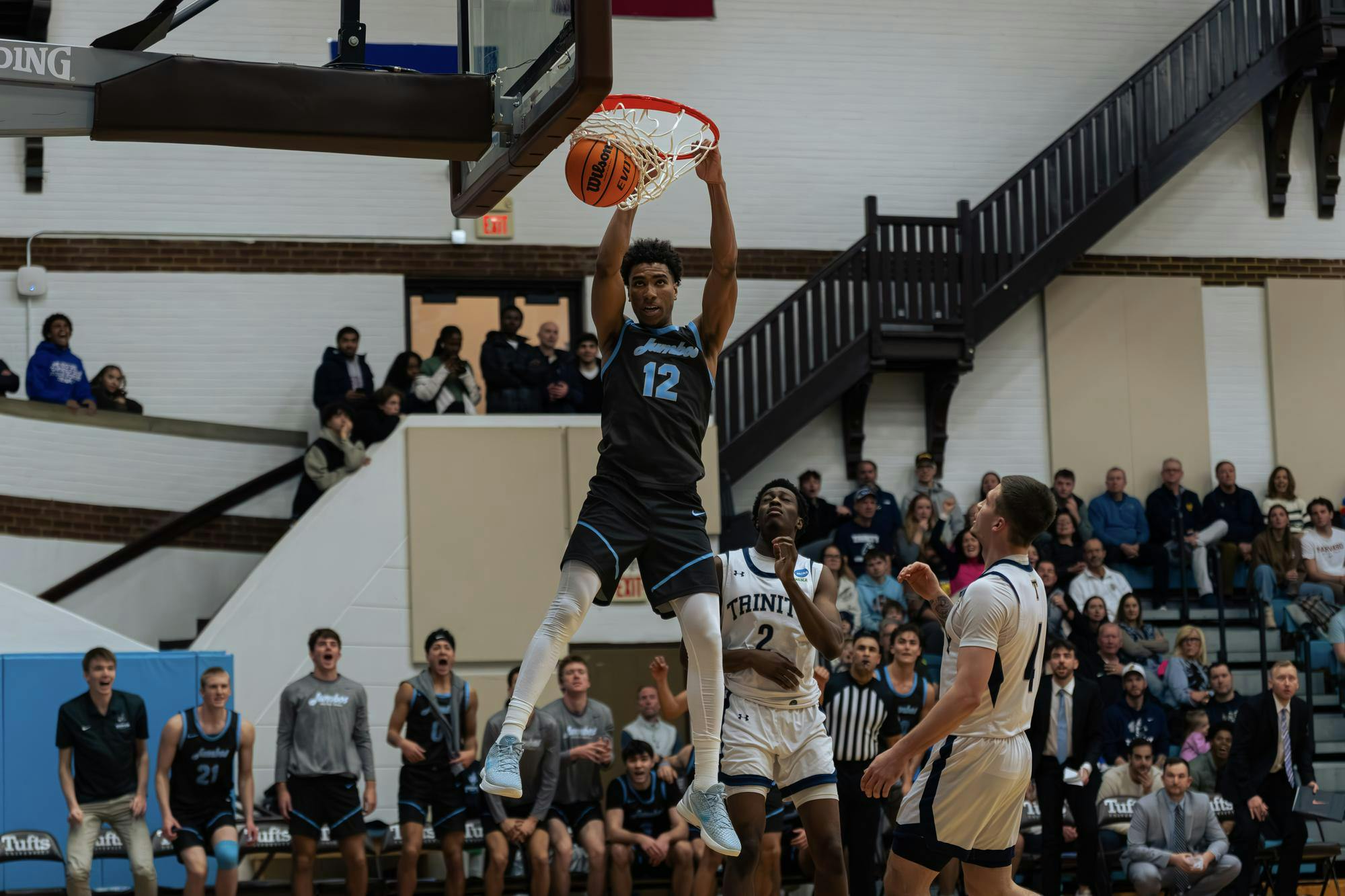
Tufts vs. Wesleyan on Friday night proved to be a grueling, sluggish affair. From the anthem and tip, both coaches opted for similar defensive schemes, shifting between a loose 3-2 zone and aggressive man-to-man coverages. Initially, Tufts maintained a narrow lead, shooting 6–15 from the 3-point range as a team in the first half. Senior guard James Morakis, who was honored for entering Tufts’ 1,000-point club before the game, quickly broke out of his shooting slump, and junior guard Zion Watt and junior guard Dylan Reilly lit up Wesleyan. After a thunderous dunk by Joshua Bernstein, senior center, to close the half, Tufts led Wesleyan 38–35.
The fans were entertained at halftime by a game of knockout consisting solely of Tufts faculty.
The second half was a different story for the Jumbos. The product of the crowded schemes was a game dictated by scrappiness and bruises — it was to be won or lost in the trenches. Despite the congestion, the Jumbos continued to manufacture offense in an unpretty, but inevitably effective, fashion. The team moved through its standard actions — pick-and-rolls, dribble hand-offs — slowly generating switches until senior forward Scott Gyimesi found a favorable matchup. The ball hit the post, Gyimesi bullied his defender out of position, repeatedly finishing with a deadly mechanical hook shot over his right shoulder. But Tufts slowly began to slip. Down the final stretch, Wesleyan guard Sam Pohlman and forward Oscar Edelman began to dissect the Tufts pick-and-roll coverage, continually converting advantages. The Jumbos went frigid from three in the second half, shooting 1–12.
Final score: 68–61, Wesleyan. Tufts suffered their first loss in 16 games.
A note on that 16-game win streak: That was the second longest winning streak in the program’s history, behind the 1949-50 Jumbos who won 17 games. While a streak builds confidence, it will always snap and how one responds is the true test. Last year, Tufts lost to Trinity twice — one a 45–81 trouncing, and another blow out in the NESCAC semifinals. Trinity went on to win the NESCAC again and is currently ranked No. 2 in the country.
A night of terrible sleep, and a chance at redemption the next day.
Saturday against Trinity was Senior Day. Before the matinee, Gyimesi, Morakis, Bernstein, senior guard Sidney Wooten and senior guard Theo Liu were honored. Unfortunately, the delightful buzz and the ceremony’s joyous residue instantaneously evaporated at the ball’s tip. Before coach Brandon Linton had an opportunity to call a timeout, the score was 11–0, Trinity. Unlike the Wesleyan matchup, the Trinity game was noticeably quicker. Versatile Trinity forward Tristan Davis menaced the paint and star wing Jarrel Okorougo abused Tufts in the mid-range. The lead ballooned to 17 and was trimmed to 13 at the half after bursts from Reilly and first-year guard Ricardo Nieves. Towards the end of the first half, Nieves attacked right off the dribble, and appeared to beat his man Davis. He flew towards the basket, but opted for a finish slightly too high on the glass, which was all Davis needed to eviscerate Nieves’ layup off the glass. That block punctuated a hopeless first half.
Trinity led 40–27 at the break.
In the second half, coach Linton changed his strategy: He swapped to smaller lineups, which revolved around sophomore forward Robbie Nyamwaya at center. These lineups helped the Jumbos stay afloat in the first half, but proved crucial in the second. As a spectator, it was clear that the team began to tactically understand Trinity. Superstition set in among the spectators. Magically, the momentum began to shift, and the team began to whir. Gyimesi pummeled to the low block, and made beautiful and quick reads against double and triple teams. The gears of offense turned from these advantages. Nyamwaya made several key reads off cuts, and held down the paint on defense. Watt and Reilly hit timely shots. Junior guard Jon Medley made an absolutely tough fading, contested deep 2-pointer to cut the lead to one. Nieves played clutch basketball, leading the team with an efficient 15. After a Gyimesi putback gave Tufts the lead, the team went on a 4–0 run to end the game. Trinity left shaking their heads.
The Jumbos bested the Bantams 68-62, outscoring them 41–22 in the second half.
This was the win that crystallized the team’s identity. Postgame, coach Linton praised his squad’s maturity. “[Against Wesleyan], we were in full control. We had a lot of boneheaded mistakes, both on the players’ end and the coaching staff’s end, that we all collectively said ... the only thing we can do is learn from it ... to see us have poise to execute, to play with IQ down the stretch of this game and learn from that, not doing it at home at a high level the night before,” he said.
“It wasn’t always pretty, it wasn’t always perfect, but we were playing with the proper level of fight, which was the most important thing at that time, trying to claw back … Robby [Nyamwaya] and Ricardo Nieves, those two just gave such a spark off the bench, a well-needed one as well. And the guys all fed off of that,” he added.
Gyimesi also spoke of the significance of this win. “This is a big win for us. It’s personal. These guys have had our number for the past few years, so it’s really good to prove to ourselves that we can beat them. Yeah, we can beat anyone,” he said.
Tufts is now tied for first with Wesleyan in the NESCAC standings.