
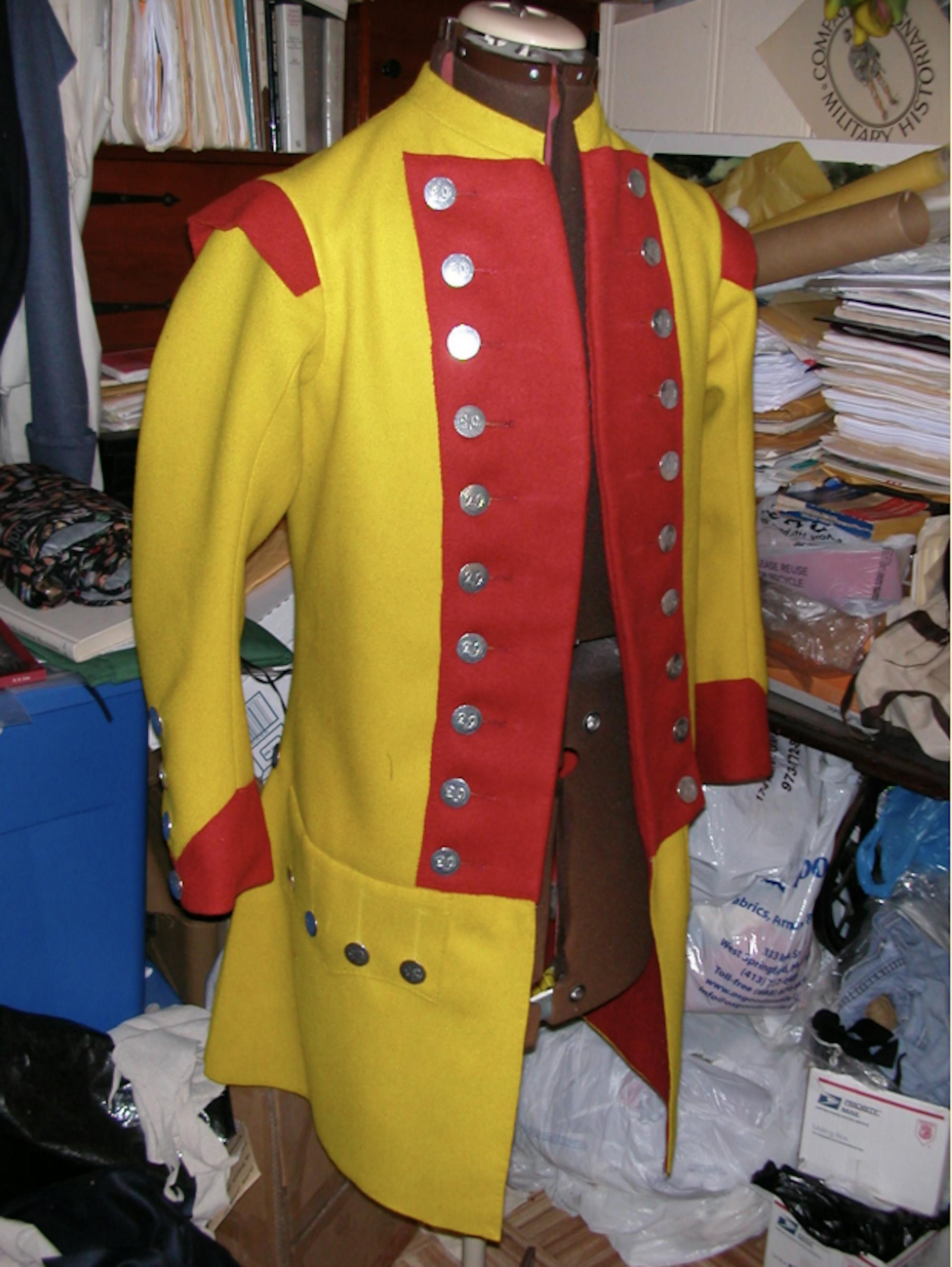
Henry Cooke (A’79, AG’84), founder of Historical Costume Services, discovered his passion for history while trying to bolster his college application. Cooke worked throughout high school to pay for college, which didn’t leave him much time for extracurriculars. Because of his interest in history, his school counselor suggested he join a newly-formed minuteman reenactment group.
As the son of a dressmaker, he always had a special knack for sewing, and soon found himself as the group’s costume maker.
“I got involved in living history as a reenactor in this minuteman group … and we needed clothing,” he said. “I don’t have a ton of money, but I know how to sew. So, I sewed for my buddies.”
Cooke continued reenacting as an undergrad at Tufts, where he changed majors from geology to history. He took a course on the American Revolution — coincidentally, during its bicentennial year — and was struck by the course’s principal text, “The Minutemen and Their World” by Robert Gross. The book’s focus on “ordinary people interacting with extraordinary events of their times” especially resonated with Cooke, who missed the Vietnam draft by one year.
“It had meaning to me. Still does. It still inspires me,” Cooke said.
After graduating from college, Cooke spent an additional four years at Tufts completing a master’s program in American social history.
“I was having way too much fun studying [and] doing research,” Cooke said.
Despite his education, Cooke struggled to find a job upon graduating.
“I was competing with people with Ph.D.s for entry-level jobs in the history field in museums,” Cooke said.
To make ends meet, he continued tailoring, and his extensive historical education aided his burgeoning career.
“I was making clothing and didn’t realize I was creating a career for myself,” Cooke said. “I could do everything. I could do research for people on what somebody wore at a certain point in time or what a uniform looked like for a particular regiment in the army, and that made me valuable, that gave me skill sets that other people didn’t have.”
His restoration work began by mending a Civil War-era uniform in the late ’80s. Today, he is responsible for the 1814 U.S. Navy Officer’s Uniforms for the USS Constitution and has worked for the Smithsonian and the Donald W. Reynolds Education Centre at Mount Vernon. For the Mount Vernon project, he collaborated with the sculpture studio, StudioEIS, along with a forensic anthropologist, a historian and sculptors from Madame Tussauds to produce “the most lifelike figures of [George] Washington ever created.”
Cooke also enjoys collaborating with other professional “history geeks.”
“We’re playing with the toys of history, and it’s so cool,” Cooke said. “They’re wonderful people to work with.”
Historical accuracy is critical in Cooke’s work which requires careful attention to materials, cut, fit and consistency among pieces.
“My goal is to make you look like you stepped out of a painting,” Cooke said.
He studies extensively, using tailors’ account books and journals to “get in the heads of the people of the past.”
Cooke embraces every opportunity to study the garments themselves. He described the experience of visiting a local history museum in Robinson, Ill.
“They had a vest mounted low in their display case, and I’m sitting on the floor, and I’m looking up inside it, and all of a sudden I’m aware of a pair of knees next to my head,” Cooke said.
The curator approached him to ask if he was okay, to which Cooke replied, “I’m having a blast.”
Cooke has had the opportunity to handle historical clothing directly, including Washington’s second inaugural suit. He reflected on how lucky he was to have had these opportunities while teaching workshops in historical tailoring.
Cooke said that, for his students, “their whole view of the past [has] a sheet of glass in front of it.” So, he began collecting historical garments to bring to workshops so that people can pick them up and “have that ‘aha!’ moment that I get to have on a regular basis.”
Cooke continues to reenact, with favorite roles including Reverend William Emerson and the farmer and tailor Hopestill Bradley.
“I want to be able to share the story of the past with honesty, the wonderful, messy honesty of the past, and help people understand its complexity,” Cooke said.
Living history interpreters share the past by creating a narrative where clothing plays an important role.
“We’re telling a story with our whole selves and everything we have about us,” Cooke said. “The visuals of what you’re looking at do a lot to help convey the veracity of that story and make you believable.”
The public engagement component of living history makes it a unique form of education.
“Nobody’s pounding it in your head. You’re just having a blast learning stuff, and before you know it, you suddenly know stuff about history,” Cooke said.
While many living history interpreters of Cooke’s age have retired, he enjoys working with the younger generation.
“And by golly, I’m still learning stuff from them, and that’s what keeps it new and exciting and interesting,” Cooke said.
Cooke’s passion for the past is fueled not only by the people he works with today but also by his family’s history.
“[Reenactment is] a way of honoring the people who came before me, who gave me the opportunities that I have today,” he said.



