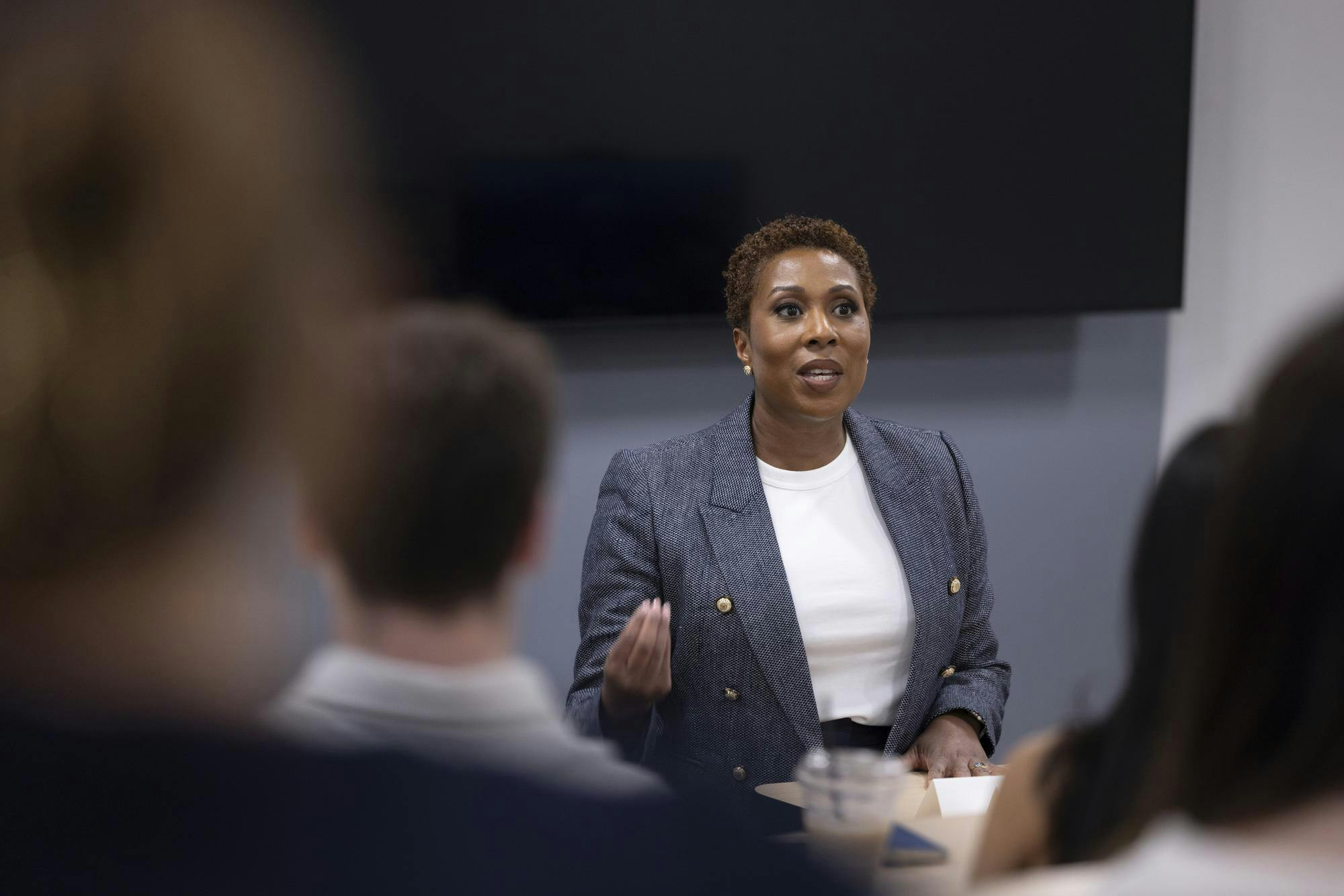
CNN anchor and senior analyst Audie Cornish visited Tufts on April 15 as the keynote speaker for the 17th Edward R. Murrow Forum on Issues in Journalism, an annual event that brings leading voices in journalism to campus to discuss contemporary issues facing the industry. There, she shared her thoughts on critical challenges facing journalists, including artificial intelligence and political polarization.
Cornish participated in both a private student session organized by the Jonathan M. Tisch College of Civic Life and a public panel sponsored by Tisch College’s Solomont Speaker Series, moderated by WNET CEO and President Neal Shapiro (LA’80).
In the student session, Cornish discussed the growing presence of AI in the journalism industry, acknowledging its efficiency in handling time-consuming, labor-intensive tasks.
“There are aspects of AI that have been fantastic. As somebody who spent time in my early newsrooms, for instance, logging tape … that is tedious, labor-intensive work that doesn’t need to be done anymore,” she said.
Still, she recognized the limits of AI and the unparalleled nature of human production.
“The human me is not replicable — the way I stutter, the way I make mistakes, the way I shuffle the papers. None of that is going to be replicable,” she said.
Cornish also emphasized the irreplaceable role of journalists as listeners.
“Our job at this point is not to be the voice of God, not to tell people things, … but … to listen and analyze and interpret and share. … AI is not going to be good at that,” she said.
When asked about dealing with rejection in the newsroom, Cornish spoke about her experiences as a woman and a person of color. She highlighted the importance of prioritizing underrepresented voices in the media while avoiding the pigeonholing of journalists of color.
“What I’ve been doing is making sure that I have a diversity of voices in the story,” she said. “If you have a choice and there’s a person of color or woman who has all the credentials, why not choose them? … I have made it my business throughout my work to put diversity at the forefront.”
Cornish also offered advice to students pursuing careers in journalism, highlighting the importance of flexibility and skill-building in the industry.
“I have started looking even at my own career as a game of [skill-building], not prestige [or] resume building,” she said. “What skills will I pick up doing this job, and are they transferable to the next one? That’s how I could go from ‘All Things Considered’ [on] NPR to CNN.”
In the public panel, Cornish addressed a variety of issues, including the influence of social media on journalism and the changing nature of journalistic practices.
“There were a lot of rules that journalists abided by that were born post-Watergate,” she said. “The rhythm of it was a little bit … like you uncover, the audience responds [then] there is consequence. That model does not work now, period.”
She also discussed the role of political figures in reshaping public discourse.
“We’re living in the end of shame. There is no more shame, right? [President Donald Trump] is not ashamed of things. He operates differently,” she said.
She also discussed the influence of the internet and social media on the press, recognizing the system as a disappointment for many who believed it would be a “utopia” and attributing “skepticism around AI” to “promises [being] broken.”
Cornish also criticized contemporary internet models for their polarizing infrastructure.
“It is divisive. Filter bubbles are real. The algorithm is real. I don’t think we have benefited from algorithmic information distribution,” she said.
Despite certain drawbacks of media influence, she acknowledged the liberating power of free speech online and its critical role in influencing her work.
“My work is public. My work is in dialogue with the audience itself. It’s in dialogue with what's happening in the culture, and that feedback is really important,” she said.
She concluded by reflecting on the enduring role of storytelling in journalism.
“All we do is want to hear each other tell stories,” she said. “That is the human condition.”