“We are stardust brought to life, then empowered by the universe to figure itself out — and we have only just begun.”
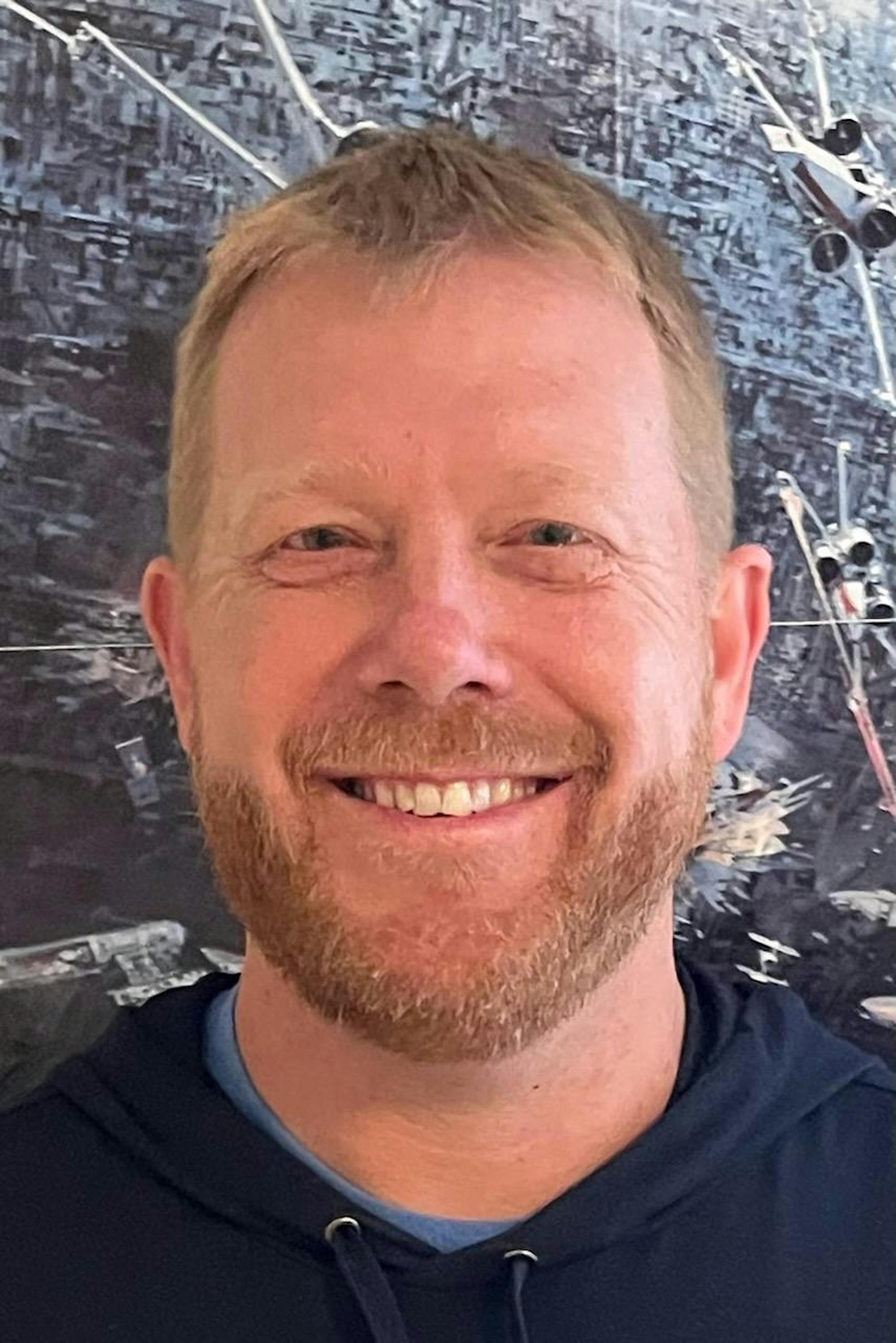
Andrew West’s journey into astronomy at Tufts has been driven by this ceaseless curiosity, as described by Neil deGrasse Tyson in “Astrophysics for People in a Hurry.” Growing up in rural Northern California, West was surrounded by towering redwoods and clear night skies. From an early age, he enjoyed watching the stars and was fascinated by them. NASA’s space program at the time also captivated his childhood mind. A few years later, his passion was further spurred by a gift from his grandmother.
“She bought me a telescope when I was 9 or 10, really simple, but she had no money and still bought me a decent telescope,” West said. “I would take it outside and look at simple things, like the moons of Jupiter, the rings of Saturn or the Orion Nebula.”
He was in awe of everything he could see, and these early experiences inspired a lasting love of science.
“When I got to high school, I luckily really loved math and science, and I had amazing math, chemistry and physics teachers who really nurtured my interest and challenged me,” West said.
Always having an aptitude for science, West pursued his childhood interest in the stars at Haverford College, where he double majored in astronomy and physics. Outside of classes, he was a sprinter for the Haverford track team and played in the wind ensemble. Upon finishing his bachelor’s degree, West had planned to take a couple of gap years to teach before pursuing a Ph.D. Instead, he ended up getting off the waitlist at the University of Washington and faced a conundrum: Should he accept his dream Ph.D. program or take a job teaching physics? After some hemming and hawing, he opted for the academic route and pursued a Ph.D.
“It was amazing. It was a good mix of working really hard and learning [the] material deeply, both in my research and in the classroom, early on,” West said.
It took him just under six years to finish his Ph.D. thesis on galaxy evolution — how gas is converted into stars. He examined past, current and future formations of galaxies from cold gas and how that differed across galaxies of various types and masses.
During this time, he further developed another interest: teaching. He taught astronomy labs and, within a few years, was offered the opportunity to teach his own introductory astronomy class to undergraduates.
“[It] was a really cool experience to get as a grad student, because [it] doesn’t happen very often,” he said.
West also taught at a program called Upward Bound, which helps underrepresented high school students prepare for college. He shared that this interest in teaching dates back to his childhood. West’s father was a community college professor, and starting in high school, he began tutoring calculus and physics. He continued this through college and even taught a class on observational astronomy while at Haverford.
West’s passion for teaching took a back seat while he focused on excelling in research. Upon finishing his Ph.D., he pursued postdoctoral research at the University of California, Berkeley. West loved the three years he spent back in California, and it was at Berkeley that his research shifted to his current field.
Although West was recruited to work on galaxy evolution, he ended up researching low-mass stars. A professor at Berkeley had read West’s paper on the topic — which he wrote with his mentor when he was low on research funds — and invited him to attend group meetings. By his third year, he had switched to working on low-mass stars due to the people he met.
“I just liked the people better … I liked the science better. It was driven more by deep scientific questions, rather than … what I refer to as postage stamp collecting. It’s like, ‘Oh, we have this new thing. Let’s go see what we can find.’ And there’s excitement in that, but it’s not as driven by deep scientific questions,” he said.
Following this transition in research, he pursued a second postdoc, this time at the Massachusetts Institute of Technology. A year later, West came full circle to teaching, taking up a faculty position at Boston University.
“I was at BU for a number of years, until my kids were born. Then I took a step back from running a big research lab and started teaching part-time here at Tufts.”
At Tufts, West is probably best known for his class “Big Bang to Humankind.” It covers the history of the universe through science. The class begins with the Big Bang and explores the formation of stars, planets, solar systems and galaxies. Transitioning from astronomy and physics to biology and chemistry, it examines the evolution of life on Earth and shifts to the anthropology of human evolution. Finally, the class discusses geology and plate tectonics, as well as carbon and nitrogen cycles, ultimately concluding with what is next for our solar system. West and two other professors — a chemist or biologist and an anthropologist — co-teach the class. All in all, it is an engaging science credit for non-STEM majors.
Unknown to most who take this class, West did not create it. In 2016, he was recruited to teach a handful of astronomy lectures. Having enjoyed the experience, he gradually took on a larger role until he assumed responsibility for the class in 2020.
This class is among his favorites, although he also enjoys teaching others. Last semester, West taught an Experimental College class on the moon and Apollo missions. He shared how he appreciated the flexible format and the novelty of teaching a science class that leaned more into the liberal arts.
“I loved that I taught a class on the moon — it was really fun. … We did labs and … some science, but a big bulk of it was actually … reading about and discussing the Apollo moon missions. … I’ve never run a class like that [before],” West said.
The class even spent a session examining actual moon rocks from the Apollo program. Another one of West’s favorite classes is a course he used to teach at BU called “Alien Worlds.” He currently teaches that class through the Tufts University Prison Initiative. The initiative, sponsored by the Jonathan M. Tisch College of Civic Life, gives incarcerated individuals the opportunity to move past their worst moment and improve their future.
“I think [TUPIT] is one of the greatest things Tufts does. … I really believe in it — it’s really changed my vision of what education is, particularly college education … and [with] who has access to it and who doesn’t,” he said.
Throughout his career, West’s passions have evolved. Although he still loves astronomy and continues to conduct research, his favorite part of science has shifted to teaching.
He shared how much he enjoys watching non-STEM students walk in knowing nothing about stars and leave being able to analyze a graph and explain the star it represents.
“I like experimenting with teaching. For me, that’s been the lovely part of being at Tufts. I’ve been able to spend time thinking about teaching and pedagogy in a way I never did before. Even though I’ve been teaching for a lot of my life … I never really got into reading the literature, [practicing] and experimenting,” West said.
One new approach he has implemented with great success in “Big Bang to Humankind” is a grading system called “specifications grading.” He shared how it helps reduce the arbitrary nature of grading.
Today, West spends most of his time teaching or with his family, but he still actively conducts astronomy research. His work focuses on low-mass stars, specifically red dwarfs. He studies spectral emissions — light emitted from elements when electrons change valence levels — to understand how a star’s magnetic field heats its upper atmosphere. The stars he studies are small, live for extremely long periods and should be too cool — albeit still around 2,000 degrees Celsius — to emit the spectral lines he observes. The additional energy comes from the star’s rotation, which generates the magnetic field that, in turn, heats the atmosphere. Younger stars have stronger emission lines, while older ones have weaker emissions, allowing West to associate ages with stars.
West’s favorite phrase rings especially true in his research: Science changes. Yet, his journey reveals that as science evolves, so does one’s own life. We are all just exploring the cosmos, waiting to discover something new.