
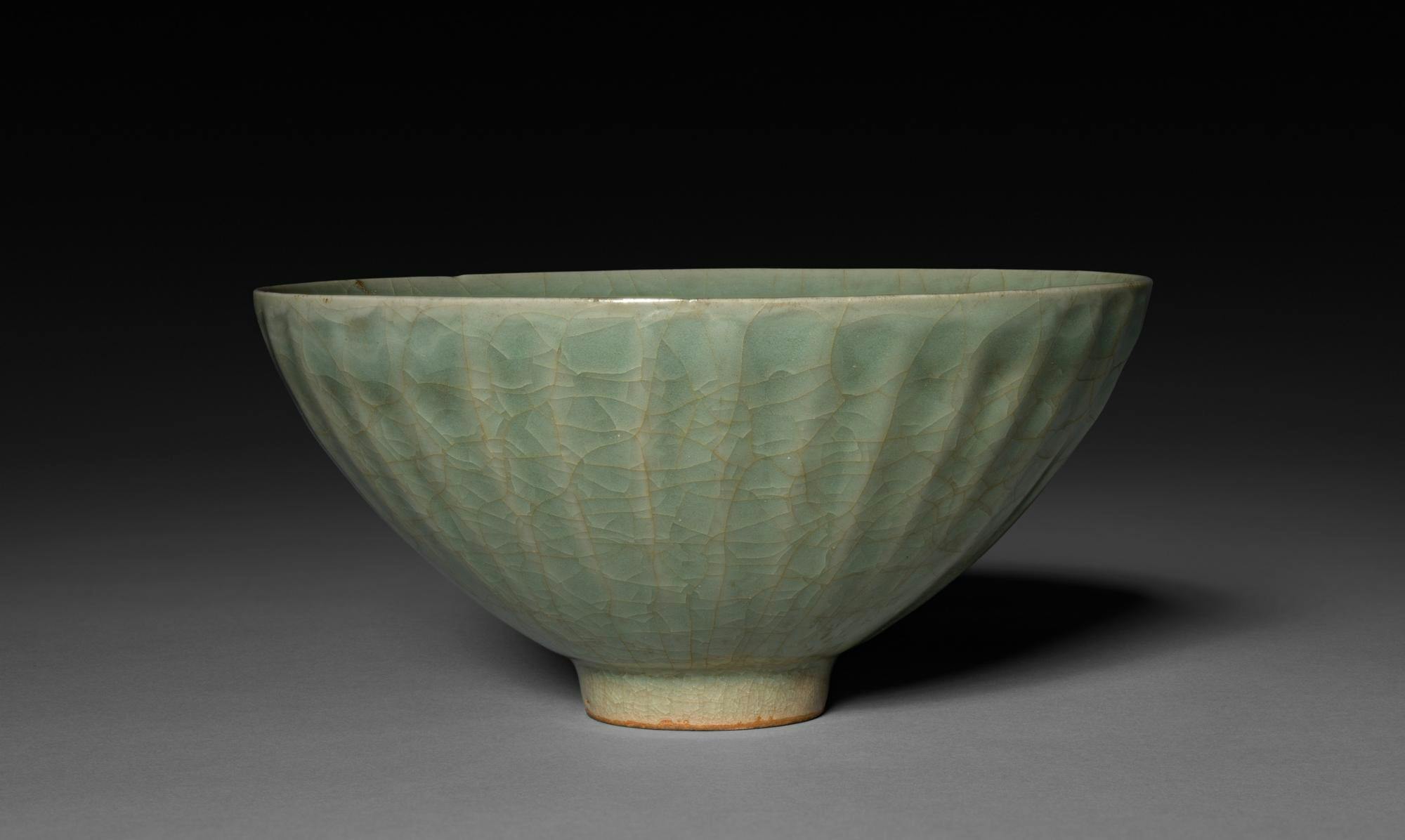
As Boston enters April, though there are hints of warming weather, a more significant change is rain replacing the continuous snow. While we trek through the muddy paths uphill and contemplate whether to bring an umbrella to class, the sky overhead is shifting through different hues. Ancient East Asian potters noticed these nuanced changes and incorporated them into their works. So today we’ll be observing the celadon glaze widely used in East Asian ceramicware, which is reminiscent of the purity of jade and the mistiness of April rain.
Before we introduce the historical development and ideological backgrounds, we need to clarify the origin of the name ‘celadon.’ Though it refers to a type of ceramics with the transparent green glaze made in East Asia, the term in the West comes from a 17th-century French comedy. Europeans associated the jade-green color with the robe of the character Céladon, and the term continues to be used to this day. In China, the term is Qing Ci (青瓷), while in Korea it is known as Cheongja (청자), and both directly translate to ‘blue-green porcelain.’ The development of the glaze is a prime example of the cultural exchange occurring and how countries responded to new influences by adapting them into their own creative production.
The characteristic green color of celadon was widely implemented in ceramics after it was perfected in the Northern Song Dynasty (960–1127 C.E.). The major kilns were located in the Ru province, hence the term Ru ceramics (汝窯). According to legend, the color of Ru ware came to Emperor Huizong of Song in a dream. In the dream, he saw the pristine sky shrouded by a gentle mist after fresh rain. He was so moved by the delicate blue-green color that he woke up and immediately ordered potters around the country to recreate that hue. When potters asked him the desired color, he gave them the poem stanza ‘After the rain, where the sky clears and the clouds break’ (雨过天晴云破处). This line has been widely used in reference to Ru ware and to praise elite craftsmen. Ru ware and the later greener Longquan celadon from the Southern Song Dynasty (1127–1279) dominated Chinese exports for 500 years until the renowned blue and white porcelain from Jingdezhen took its place.
Whereas Ru ware has a ‘rain-like’ quality and leans blue, the Korean Goryeo celadon bears closer resemblance to the gentleness of jade. The Korean Peninsula started developing highly advanced stoneware during the Three Kingdoms Period (57 B.C.E.–676 C.E.) and the Silla Dynasty (676–935). Soon after, trade with China led to significant technological advancements in glazing and kiln firing. Early Korean celadon ware shared many similarities with Chinese ceramics in glaze color, decorative motifs and vessel shapes. Goryeo (918–1392) potters, however, adapted these foreign influences into a distinctive native style by the turn of the 12th century. They developed the famous Bisaek (비색 ) color, literally meaning ‘kingfisher color,’ which can famously resemble jade, the autumn sky or the wings of a kingfisher.
But most importantly, what really sets Goryeo celadon apart is the innovative Sanggam (상감) surface technique. Sanggam is the Korean inlay technique of first carving out motifs (cranes, lotuses, etc.) when the ware is leather-hard, then filling the gaps with white or red wet clay (jinsa). The excess clay is shaved off the vessel, which is then glazed and put into the kiln, producing a natural color contrast that is preserved in the final ceramic piece. Before these patterns could only be achieved subtly, Sanggam enabled potters to vividly decorate their celadon vessels and influenced the Yuan Dynasty (1271–1368) ceramics. (If curious, the Museum of Fine Arts, Boston Arts of Korea gallery houses an abundance of masterfully glazed celadon, ranging from vases to plates. It is one thing to read about them, but another to see them in person.)
One notable topic of East Asian art that has appeared again and again throughout this column is how ancient artisans held a deep spiritual connection to nature. In comparison to Western Art, where completed works show meticulous attention to detail and careful orientation, East Asian art values spontaneity of mood and energy. It comes from the Daoist belief that everything has a natural continuation and is ever-changing. Ceramics is hard; there is a saying that you have no idea what your piece will look like until it leaves the kiln. But the natural, uncontrollable process is exactly what heightens its philosophical meaning: the greatest action is inaction.
The most masterful and prized celadon evokes an atmosphere or a distant memory within the beholder. As we enter the final month before summer break, it’s a good reminder to seek peace in the things we cannot change and simply, like in celadon-making, trust the process.



