
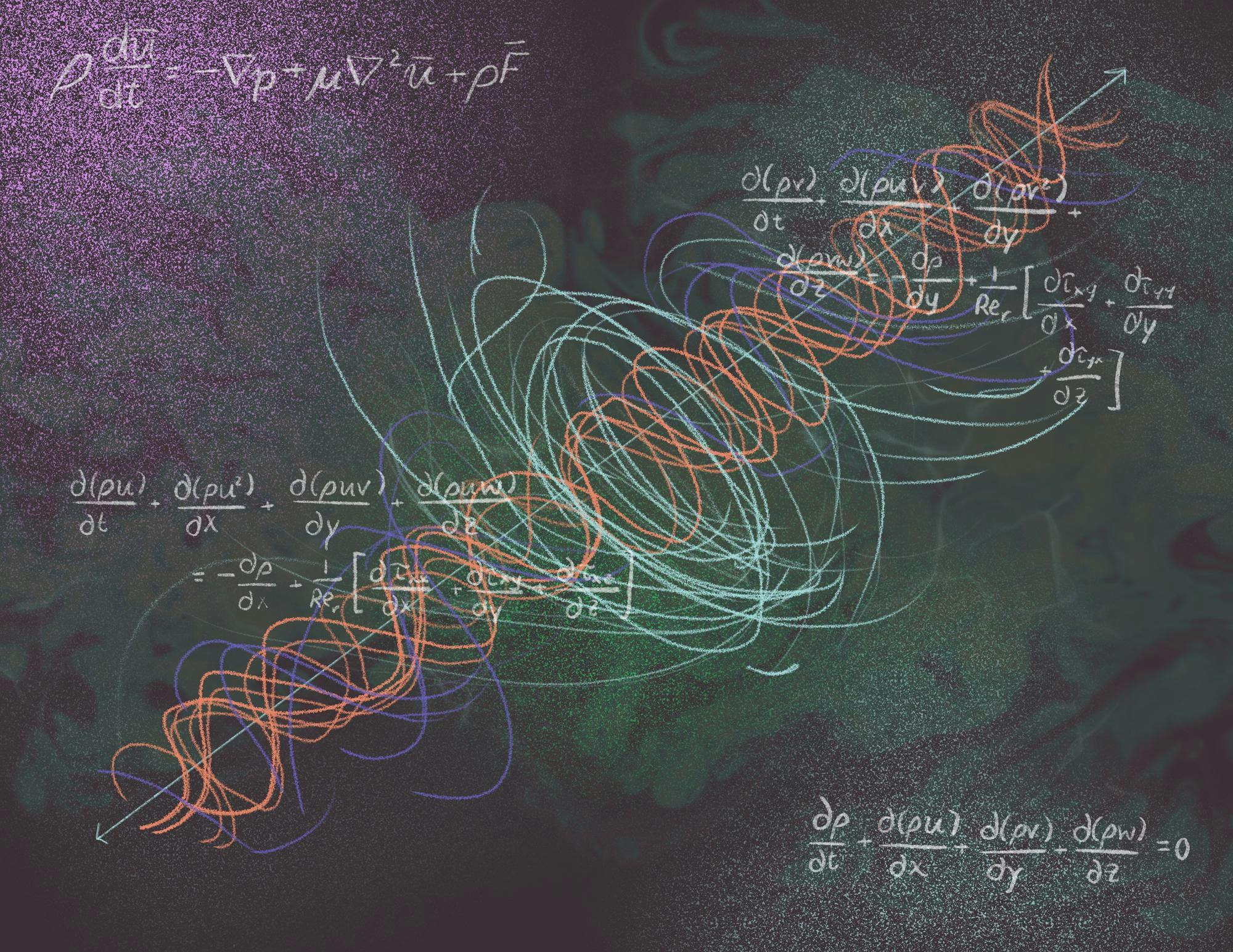
The equations at the center of the claim are two centuries old. The prize question has been open since 2000. And the computation that answered it ran for only 88 hours.
On Sept. 8, 2026, OpenAI announced that a multi-agent AI system had produced “an analytical proof and a Lean formalization that an initially smooth fluid at rest can develop a singularity in a finite time” for the 3D Navier-Stokes equations, one of the Clay Mathematics Institute’s seven Millennium Prize Problems.
Every airplane wing, weather model and blood flow simulation rests on a set of equations that mathematicians cannot fully account for yet. The Navier-Stokes equations describe how a fluid moves based on two claims: Mass cannot vanish, and momentum has to go somewhere.
These equations first began to take form through Leonhard Euler’s 1750s principles, which applied Isaac Newton’s second law, force equals mass times acceleration, to a moving fluid instead of a solid block. Euler’s equation assumed an inviscid fluid, one with no internal friction at all, which no real liquid or gas obeys.
After the work of these mathematicians, several other studies were published. Claude-Louis Navier added a viscosity term in 1822, and George Gabriel Stokes put the theory on a stronger base between 1842 and 1850. Viscosity, they explained, is a fluid’s internal friction — the reason honey drags and water does not. What Navier and Stokes left behind, however, was a system so nonlinear that the convective term driving turbulence makes the equations resist exact analysis, which is why engineers run them on supercomputers instead of solving them.
The Clay Institute’s question requested a proof for this equation. Charles Fefferman’s 2000 formulation questioned whether smooth solutions always exist and stay smooth, in all of space and on a periodic box, or whether some smooth starting state can break down. Breaking down, in that context, meant a finite moment at which the predicted velocity would run to infinity. Proving either side of the equation was valued at $1 million. The victors, OpenAI, claimed the breakdown side.
The process that OpenAI followed was as interesting as the proposed solution. The company stated that its proof came from roughly 10,000 AI agents working in parallel, concluding only 88 hours after launch. By its own description, those agents exchanged 2.7 million messages and used about 130 billion tokens on this problem alone. Translating the argument into Lean, a language that machine-checks each step of a proof, took an additional 17 hours.
OpenAI described the construction itself as a vortex that spirals inward and stretches out “like spaghetti,” and other mathematicians added to it by mentioning the surprising scale. George Karniadakis, a professor of applied mathematics and engineering at Brown University, told Nature that “for air, the singularity appears when [the] vortex becomes around 70 nanometres wide.” At that size, the assumption underneath the equations — that a fluid is a continuous substance rather than a crowd of separate molecules — has already stopped holding. A blowup does not mean a river will reach infinite speed. Instead, it means the mathematics describing the river has an edge, and someone has now walked to it.
The result does not close the question, since Fefferman’s formulation sets the external force to zero in one case while allowing a smooth force in the other. OpenAI’s proof addresses the latter, leaving the behavior of a fluid that nothing pushes as an open problem.
Human mathematicians arrived at neighboring results in the same week: Tristan Buckmaster of New York University and Levent Alpöge of Harvard posted proofs of finite-time blowup with smooth forcing hours before the announcement. Both efforts built on a technique developed by Diego Córdoba and Luis Martínez-Zoroa, whom Fefferman called “the heroes of the story.”
Terence Tao, mathematician and Fields Medal awardee, placed the achievement in a longer frame, writing of those human proofs that “the actual solving of these problems is only a proxy goal for the primary goal of developing mathematical understanding and insight.” The Clay Institute has said only that the problem has “apparently been settled” and that its review is deliberately unhurried, since it recognizes a solution only after peer-reviewed publication and community vetting.
The distance between having an answer and having an understanding is where the work now sits. Explaining why a fluid tears itself apart at 70 nanometres, and learning how the same method may apply to the five remaining Millennium problems, will take far longer than a weekend.



