
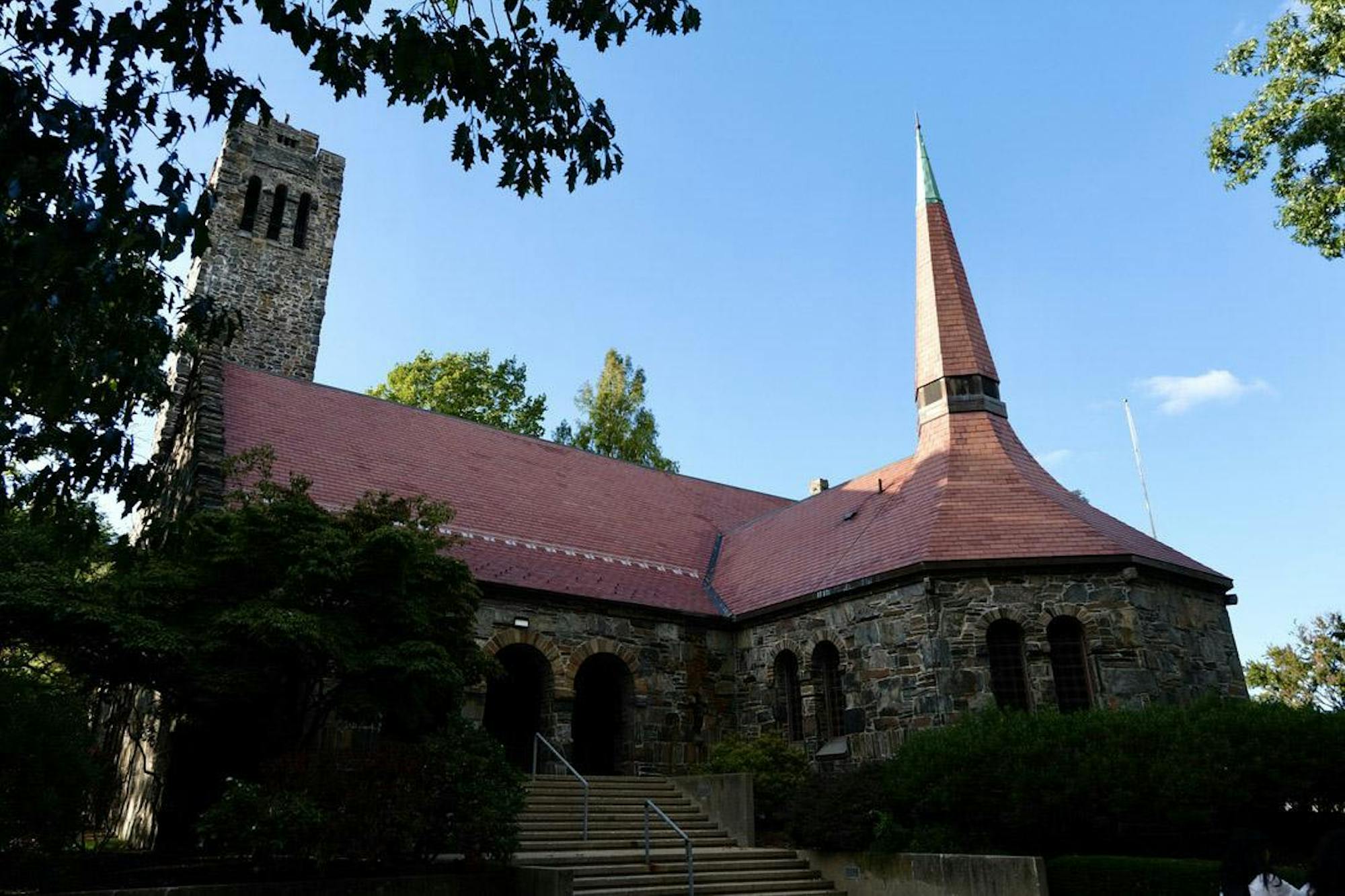
As of Aug. 1, the Tufts University Chaplaincy has been renamed the Office of Religious and Philosophical Life. The change was made in an effort to better encompass the multifaith, diverse nature of the Tufts community and to operate under a more inclusive label. The Reverend Elyse Nelson Winger, who has served as university chaplain since late 2020, described the motivation behind this transition in a statement to the Daily.
“As we’ve continued to work with our undergraduate communities and expanded our reach among graduate students, faculty and staff, we found that the Christian-centric word “chaplaincy” was not best capturing the global, multifaith, pluralistic community we have become,” Nelson Winger wrote.
For years, ORPL (pronounced like ‘ripple’) has been undergoing changes and reevaluating its presence on campus, which focuses on supporting Tufts’ religious, philosophical and interfaith groups through individualized care, community-wide outreach and program facilitation. Historically, several undergraduate student organizations that have closely collaborated with the office have been organized under the umbrella of Religious and Philosophical Student Organizations. Nelson Winger emphasized the need to reflect this extension beyond religion when reidentifying ORPL.
“It felt right to sustain this formulation and to introduce it across the University, especially since our communities have long included groups that do not identify as ‘religious,’” Nelson Winger explained. “‘Philosophical’ signifies the expansiveness of tradition and belief that we have likewise long affirmed.”
Although the office has been officially renamed, several of its original designations have remained unchanged — most notably, its core staff members still hold the title of chaplain. ORPL acknowledges that, while originating in a Christian context, the term ‘chaplain’ has since evolved to signify an individual with significant training and expertise in their tradition as well as a commitment to public service. With this, several titles have been updated to better explain each chaplain’s role to the entire Tufts community while incorporating specialization to the needs of certain groups.
For example, since Anthony Cruz Pantojas joined the office in August 2021, their official title has shifted from Humanist chaplain to associate university chaplain and director of Humanist life and Africana spiritual life. Cruz Pantojas expressed how the nuance of ORPL’s name change builds toward wider community representation in a statement to the Daily.
“I am also conscious of the dynamic between the social, the cultural, and the political, and how these should not be confined to a world religion paradigm, in part because the concept of religion or spirituality might not exist or even translate to a student’s understanding,” Cruz Pantojas wrote. “Perhaps an orientation through philosophy, ethics, or praxis might resonate because it allows for that world [to] enter into the exchange alongside others [and] provides a richer encounter.”
Cruz Pantoja noted that, while ORPL is making conscious steps toward improvement through these renaming initiatives, there is still space for growth. Their work in humanism and African spirituality seeks to address inclusivity gaps that may exist in the religious and philosophical culture at Tufts. For instance, in working toward this mission, Cruz Pantoja helps facilitate vigils, grief processing groups and death cafes — spaces where individuals of all affiliations can gather to openly discuss death.
“People whose lives are not organized around a religious framework, on most campuses still defaulting to Abrahamic or theistic forms, need meaningful and flexible ways to mark grief and transitions. … When violence or upheaval, near and far, reaches our students, they need somewhere to gather that does not require a shared creed or shared politics,” Cruz Pantoja wrote.
Students also emphasize the importance of better representing the spectrum of religious and philosophical identities at Tufts. Junior Sari Goodman, an interfaith ambassador, member of the Hillel Board and co-president of Tufts Buddhist Mindfulness Sangha, echoed the significance of reevaluating ORPL’s former name.
“Maybe some people come, and they see ‘University Chaplaincy’ and don’t feel like it’s a space for them because they don’t identify with the word ‘chaplaincy’ or with religion at all,” Goodman said. “It’s nice that now it’s not just for people that are religious, … People can come together more, across all different philosophies and ways of thinking about the world.”
ORPL is conducting several other initiatives in addition to its renaming, including the establishment of a new Graduate Interfaith Circle and a renovation of Goddard Chapel’s sanctuary “to better host the diversity of groups that use, and will use, the space.” Amid these changes, ORPL remains steadfast in its commitment to serving Tufts community members of all backgrounds.
“No matter where a person finds oneself on the continuum of religious or philosophical practice and belief, the programs, events and experiences we support through the Office of Religious and Philosophical Life are for everyone,” Nelson Winger wrote. “We want for people to show up as themselves, to come as they are, to be ready for new experiences, and to make their own unique contribution as well!”



