
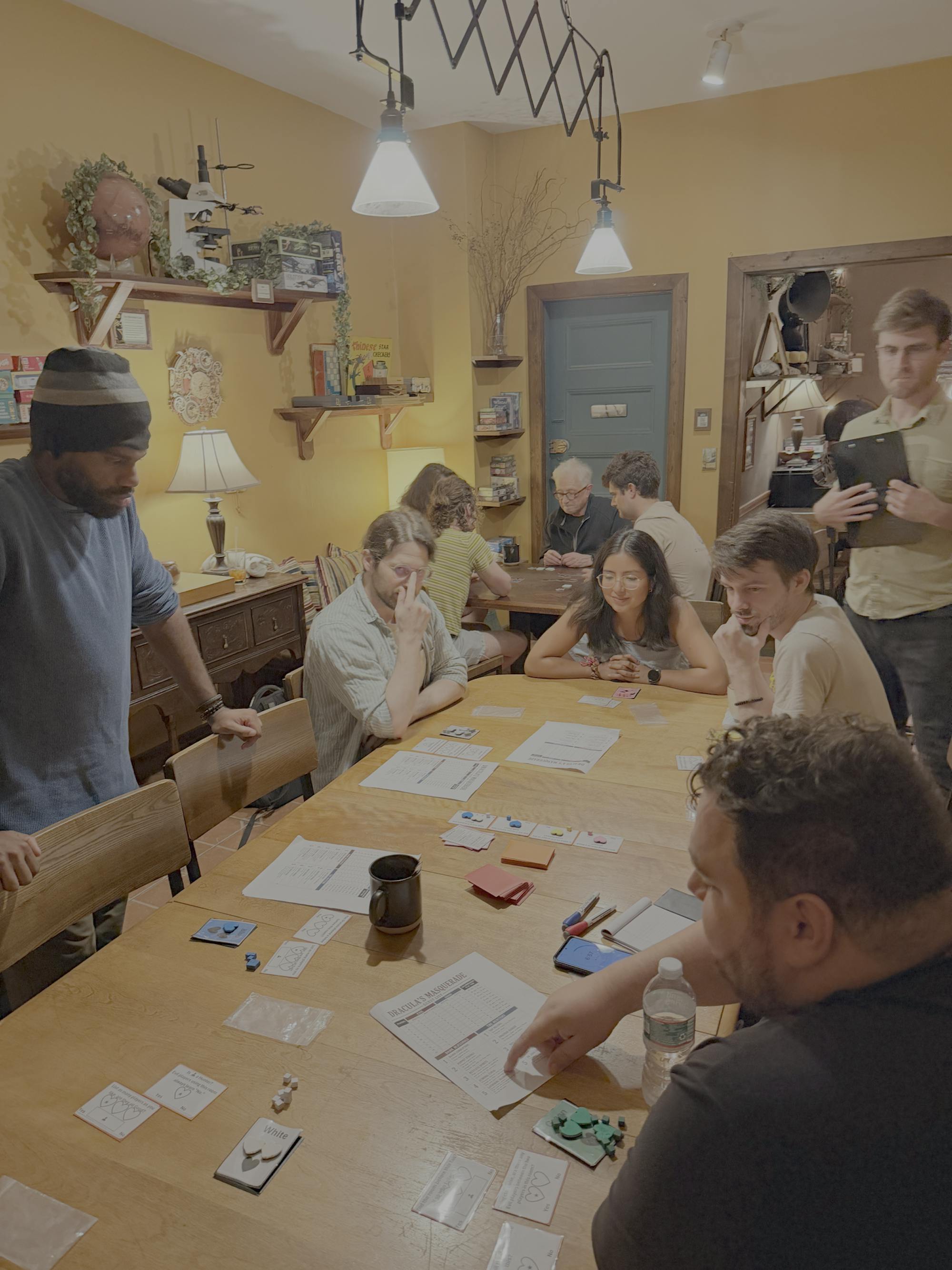
The Game Makers Guild, New England’s largest community of indie board game designers, is constantly welcoming new members.
Based in Boston, Mass., the Guild began with a group of designers working on games together at the Cambridge Innovation Center nearly 15 years ago. Although they’ve moved to different venues and expanded some programming, the collaborative spirit of the Guild remains the same. “At the heart of the Game Makers Guild, it’s an opportunity for designers to get together. … We just play our terrible games until they get better,” Guild President Jeff Johnston said.
The Guild welcomes all stages of projects. “We have a lot of opportunity to mentor people,” Johnston said. “To help … someone that really just has this set of cards and an idea and a dream, but no idea how to get from Point A to Point X.”
The Guild’s process for game creation involves multiple rounds of playtesting and curation. GMG Marketing Lead Michael Sprague defined playtesting as “playing [a game] usually with some type of hypothesis.”
Curation consists of structured playtests, described by Steve Gordon, head of GMG’s curation process, as “a formal way of kicking the tires at every stage.” For example, a structured playtest might evaluate the clarity of a game’s rulebook by asking playtesters to lead the game without additional guidance from the designer.
When a member’s game is playtested, there’s an unofficial expectation that they will return the favor. For many members, this “golden rule” is far from a burden. “I really enjoy playtesting other people’s games more than I like working on my own stuff. I have found just as much creative energy comes out of playing somebody else’s game,” Sprague said, adding that playtesting one of GMG Special Events Coordinator Nick Federico’s games gave him the inspiration he needed to work on his own rulebook.
The curation process exists as a resource rather than an obligation. “Game Makers Guild is an organization that’s just there for each individual designer,” Johnston said. “They can use us however they want to or need to, and everybody comes not only with a unique game but a unique perspective on how they want to bring this game to life.”
After workshopping their game, some designers choose to pursue publication. “The business-y aspect of it is a bit of a mental hurdle and can drag the creative energy out of it at times,” Sprague acknowledged.
Although an inconvenience, marketing oneself and one’s game is a critical part of publishing. “We’ve created this wonderful piece of art,” Gordon said. “But nonetheless, it could be the best-kept secret in the world if nobody knows about it.”
Before joining GMG, Gordon worked as an eighth-grade science teacher. “I was already making puzzles and games and stuff out of my lessons, so it wasn’t that far a reach when I stepped away from the classroom to say, ‘Hm, what else can I do?’” Gordon said.
Gordon acknowledged that he still sneaks education into his games: “A lot of times, there’s a little bit of science going on under the covers.”
Johnston’s gamemaking journey began with a conversation with a work colleague. “His bucket list item was that he wanted to walk into a bookstore and see a book on a shelf that he had written for sale, and I started to think about what would be my bucket list item,” Johnston said.
He settled on wanting to see a board game he had made. “I’m usually inspired by nostalgia from my childhood. … I usually say I have an eight-year-old and family in mind when I design a game,” Johnston said.
For Johnston, the most rewarding part of gamemaking happens “when a young family plays my game, and I just see the joy, and I see the parents connecting with the kids at the table.”
While Johnston has published games, including a family game called Toasted or Roasted, publication isn’t necessary to feel fulfilled. He showcases unpublished games at GMG events. “I can just meet a handful of families, and they’ll get this one-time experience,” Johnston said.
Federico compared playing a good game to eating good food or watching a good movie: “You want to experience that again.”
Gordon further emphasized the importance of experience. “If you’re looking for people to be scared, or looking for people to be happy, or looking for people to feel connected or just warm and fuzzy, [there are] so many different game genres [that] can scratch whatever itch you're looking for,” Gordon said.
According to Sprague, board games are marketed with a “hook” from the designer. “This is what the game is, and then when you play it, you actually get that experience. To me, that’s like a chef’s kiss. It’s a perfect game,” Sprague said.
The design process itself is an experience. Keith Donaldson is a visual artist and a recent addition to the leadership team who enjoys the problem-solving component. “I love that opportunity to go back and forth between modalities and ways of thinking,” Donaldson said.
For Gordon, human connection is the most important part of the process. While stating that he originally joined the Guild with “selfish” game design aspirations, he now collaborates on all his projects. “Now I’m having fun while I’m creating the thing,” he said.
These experiences can facilitate lasting connections for designers and players. “I design board games because I can get four total strangers together for an hour, and they leave exchanging phone numbers, ... like best friends,” Gordon said. “That human connection is what play is all about.”



