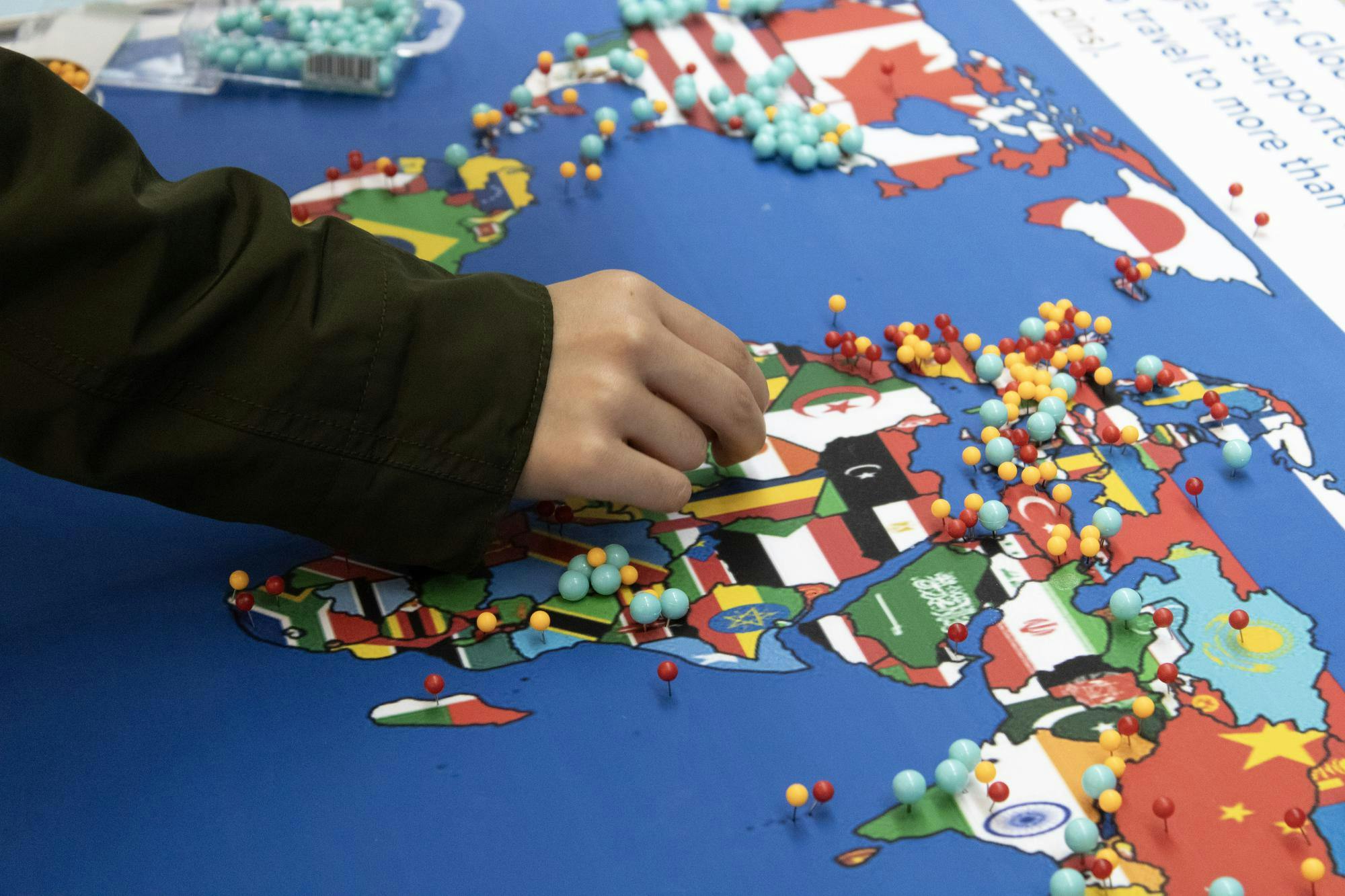
If you’re a student at Tufts University, chances are that you’ve at least dabbled in the diverse world of studying abroad. According to Global Tufts, 40% to 45% of Tufts students will partake in a study abroad program during their undergraduate career. Studying abroad gives students the chance to grow and broaden their experiences by immersing themselves in a new culture and lifestyle.
From trying new cuisines to living in a world with a completely different mother tongue, studying in another country adds to cross-cultural competence, open-mindedness and a broader global perspective.
Melanie Armstrong, associate director of Tufts Global Education Programs & Outreach, viewed studying abroad as an opportunity not only to learn about a new culture but to expand students’ horizons.
“Study abroad or education abroad is something that we feel very strongly contributes to both academic and personal growth for students,” Armstrong said. “We find that students really develop a lot of personal skills while they’re having this experience being abroad: learning how to navigate a new environment ... or doing things that are outside of the typical experience on the Tufts campus.”
Armstrong also noted the life skills and personal development that living in a foreign nation encourages, as the experience can push students out of their comfort zone in challenging and unfamiliar ways, such as learning a new language.
“We find that students really come back changed in ways that they feel more confident, more capable of dealing with unknown situations or things that maybe are a little bit challenging,” she said.
For students hoping to study abroad, the process begins by narrowing down program choices between November and February. According to Armstrong, applications require two letters of recommendation, a personal statement explaining why a student chose a particular program and how they plan to meet academic requirements abroad, and an academic transcript.
Choosing to study abroad is a big step that requires careful consideration. However, Tufts’ diverse programs offer options for everyone, with over 150 pre-approved programs plus a selection of Tufts-led programs, ranging from a program tailored to the nuances of communications and journalism in Seville, Spain, to a journey in civil and environmental engineering in Istanbul, Turkey.
Global Education also works to curate ten Tufts-led study abroad programs, with locations including Madrid, Ghana, Japan and Germany. They also work to ensure that studying abroad isn’t restricted to students who can afford an entire semester away from the Hill, offering options for students who prefer to study abroad during their summer break.
Senior Nancy Chen, a student representative for Tufts’ summer programs in Taiwan and Hong Kong, understands the value of pursuing academic passions in another country. Both programs offer a wide variety of networking opportunities while also helping students become familiar with a new, rich culture.
Taiwan’s research program lets students work with professors and graduate students across departments at National Cheng Kung University.
“I believe it’s a very good opportunity just to see what you can do as part of your research program, as well as just to understand the culture and language differences there,” she said. “It’s one of the two programs that offer research over the summer.”
While Taiwan offers an opportunity to develop language skills, Tufts in Hong Kong offers the flexibility to spend a month or two abroad while pursuing a wide variety of academic, personal and professional interests.
“You have the opportunity to be in Hong Kong for either four or eight weeks, and for four weeks, you can take classes depending on how many classes you want,” Chen said. “You can also choose to do research in Hong Kong.”
Throughout the program, students can enjoy a variety of academic and cultural opportunities without meeting a language requirement beforehand.
“Everyone there speaks English, so it’s just a good opportunity to adapt yourself to a new city, a new culture and a new society,” Chen said.
Like Tufts in Hong Kong, sophomore Henry Haug reflected on his time over the summer with Tufts Chile, where he studied global health in indigenous communities.
“It really represents a great, easy, accessible and quick way to really enrich your perspective on great global culture, as well as even just the specific lessons you might learn in the program,” Haug said. “It’s in a Spanish-speaking country, but you don’t actually have to speak Spanish to go.”
He also emphasized the program’s interdisciplinary nature, which he can later apply to his medical studies in the United States.
While Haug dedicated himself to Tufts Chile, he acknowledged the flexibility and wide range of possibilities across Tufts programs throughout South and Central America.
“There [are] also programs on ecology in Costa Rica [and] a studio fresco class in Mexico,” Haug said. “There’s really a wide range of things you can do depending on your interest, your skill level and your language level. But I think overall they’re pretty accessible.”
Fresco in Mexico is a summer program at the School of the Museum of Fine Arts at Tufts that covers the study and practice of the Fresco artistic technique, a 3,500-year-old cross-cultural painting method rooted in traditions ranging from Italian murals to Mayan temple paintings. Incorporating disciplines such as chemistry, painting and woodworking, this program allows students to study fresco in Mexico from Nahuatl, Mixtec, Zapotec and Western approaches.
Sean Glover, an assistant professor of practice at SMFA and the designer of the Fresco in Mexico course, explains the hands-on experiences that students get in the program and how it goes beyond simply studying murals.
“Many of these materials overlap with cooking, with weaving, with daily life there,” Glover said. “We’ll be working with a pre-Columbian expert who will teach some of the techniques that have been going on for thousands of years in pre-Columbian America or Mexico.”
Fresco, as seen in non-Western cultures such as India, Mexico, China and Ethiopia, has greater significance, and this unique program reflects that. Glover welcomes participants of all artistic backgrounds and experience, as it is more than just a painting program.
“There’s also a cultural component of actually seeing [and] understanding how these materials have value in different places,” Glover said. “This [is] a first step forward to decentering the conversation from thinking about it as something that belongs to ... strictly the Mediterranean.”
Along with the experiences Tufts offers, external options are also available — such as study abroad programs at Maastricht University.
Located in the heart of the Netherlands, Maastricht University offers an interdisciplinary experience in politics, business, public health, psychology and more, while students experience a classic European city.
Antonio Sanchez Ibarra, a student affairs officer at the Maastricht University Center for European Studies, emphasizes that both the university and the Dutch city are accessible, benefiting students looking for a less adventurous lifestyle.
“It’s a perfect landing for American students and, in general, students that are not used to being abroad,” Sánchez Ibarra said. “It’s very easy to travel to other bigger cities, [so] the experience doesn’t become overwhelming.”
Offering experiences that last for a semester, a summer or even for a January term, Sánchez Ibarra emphasizes the value of independent exploration while providing constant guidance and support.
“The programs are non-restrictive, so we allow our students to go to any faculty and take any course they want, as long as they cover one core course for their program,” Sánchez Ibarra said. “So they are free to explore, and they get personalized guidance from one of our course advisors. We are there to help them all the way.”
While each study abroad experience offers different academic opportunities, students agree that their new perspectives go beyond what they learn in the classroom.
“The biggest takeaway ... isn’t what you’re necessarily going to learn in the classes, but more just being in a country and forcing yourself to adapt while learning about these things is invaluable,” Haug said.