“What is the actual use of music?”
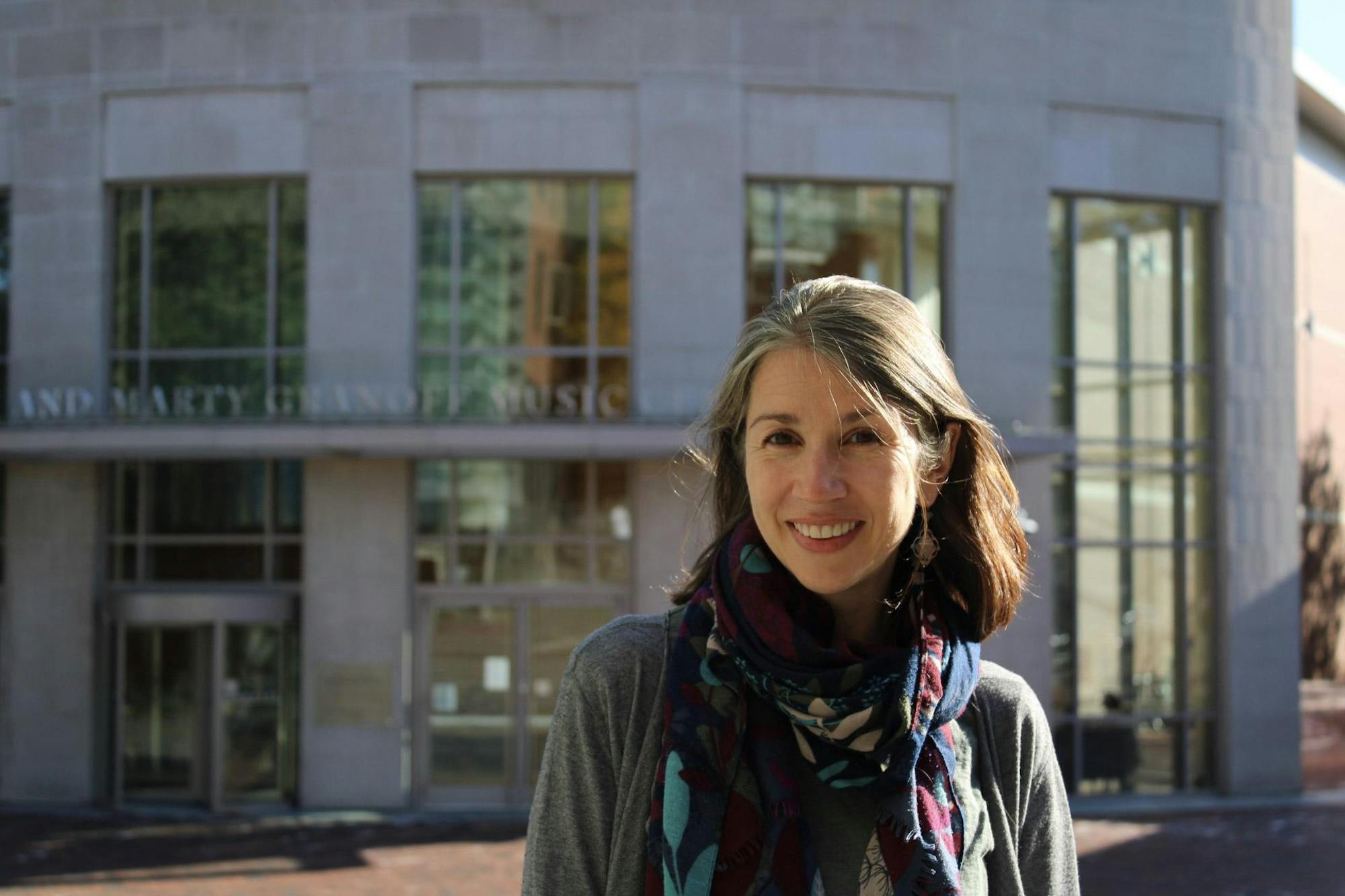
Stephanie Khoury, an associate teaching professor in the departments of Music and Studies in Race, Colonialism, and Diaspora at Tufts University, asks the big questions. At Tufts, she teaches courses that combine these two disciplines, including Music in Global Perspectives and Social Justice, Advocacy, and Music.
Khoury has quite the worldly background, having studied ethnomusicology in France, as well as traditional music and performing arts in Cambodia.
“There is a social role of music, and you have that in any music in the world,” she said. “Whether you’re playing at the symphony hall in Vienna, or you are in the countryside in Cambodia, or you’re here in the street in Davis Square.”
Khoury grew up in France and attended university there. After taking an introductory world music course, Khoury realized that she was most interested in the cultural and social side of music scholarship. So much so, in fact, that she moved from Brittany to Paris in order to study ethnomusicology and cultural anthropology. Khoury noted that, before college, she didn’t know what ethnomusicology was. Today, she has held a Ph.D. in the field for over a decade.
After earning a bachelor’s degree in Paris from the Université Paris Nanterre, Khoury set out to further her scholarship in music and theater through fieldwork in Cambodia. She first learned about Khmer shadow theatre while watching TV in her dorm room, and the rest was history.
“I [wanted] to know everything about the music of the shadow theatre in Cambodia,” she said. “I registered for a master thesis.”
Khmer shadow theatre, one style of which is known as Sbek Thom, is a Cambodian performance art form that features intricate leather puppets and combines classical dance with theatre. Sbek Thom dates back to the 9th century B.C.E., but was nearly destroyed as an art form due to the repressive Khmer Rouge regime in the late ’70s. Remarkably, the Cambodian people have maintained the tradition of shadow theatre after the Cambodian genocide, and this musical cultural reconciliation is precisely what Khoury sought to understand further.
Khoury recounted that, upon traveling to a post-genocide Cambodia, she was surprised by how heavily the preservation of shadow theatre was prioritized.
Khoury discovered that music was essential to recovering Cambodian culture. “I saw that organizing the theater was a way to get everybody involved and everybody back together,” she said. “A way to remember being together.”
From there, Khoury’s passion for social justice and Cambodian culture only grew. In Lowell, Mass., she is heavily involved in the Angkor Dance Troupe, a professional dance company founded by Cambodian refugees in the ’80s. The purpose of the troupe was to create a safe space for Cambodian youth whose families had resettled in Massachusetts post-genocide. Today, the Angkor Dance Troupe has been in full swing for over 40 years and is committed to preserving Cambodian culture through the performing arts.
Khoury is keenly aware of her privilege as an academic and seeks ways to enact social change beyond her academic work. She was especially motivated to take action after learning more about the U.S. prison system in an “Unpacking Whiteness” dialogue and discussion series hosted by Tufts.
“It was very eye opening,” Khoury said. “[Learning about] the different ways the system is working against communities of color, and, notably, in relation to mass incarceration.” As soon as Khoury learned about this issue, she asked herself, “What can I do?”
She found her answer with the Tufts University Prison Initiative. Khoury has been part of TUPIT for two years now and has found the program incredibly rewarding. She noted that the work ethic and drive of her TUPIT students is especially remarkable.
“I found motivation, dedication that is very, very heightened with a strong will to get themselves … in a situation where they can bring positive contributions to society,” Khoury said. Some of her students have even gone on to work in civic engagement after getting out of prison.
In addition to engaging with the Angkor Dance Troupe and TUPIT, Khoury spends time immersing herself in Boston’s vibrant music scene. Khoury has lived in a variety of Boston neighborhoods and dove headfirst into the area’s cultural richness.
“There is an immense diversity in Boston,” she said. “How does it translate into sound?”
In fact, Khoury has taught a class on the Boston soundscape in the past, which addresses the question: “What can we learn about the way people inhabit space … through the music that they enjoy and promote?”
This curiosity has also driven Khoury’s involvement in Somerville’s HONK! Music Festival, which just took place from Oct. 9–11. During the weekend, activist musicians flooded Davis Square, advancing their social advocacy through shared music and community.
“They parade for all things that are important to them, whether local or global,” Khoury said. Khoury appreciates HONK!’s celebratory nature most. “You can convey being a socially conscious citizen … in a very celebratory way.”
Khoury has observed a wide range of experiences throughout her career — she has witnessed communities recovering from genocide in Cambodia, TUPIT students eager to access higher education and joyful activists practicing advocacy through music. Khoury’s passion for music as an instrument of social change remains a common throughline in her experiences, and she brings that passion to her teaching.
Khoury continues to approach her scholarship with the same curiosity that she began it with. She asks herself and her students, “How do people … harness this power of music to build community, to move people, to educate people, to convey ideas [and] in many aspects, to actually have some change?”