
Editor’s Note: Michael Onysko is a former deputy news editor for the Daily. Onysko was not involved in the writing or editing of this article.
On the morning of Apr. 25, a special spark filled the air: Zara Larsson was coming to Tufts. Students eagerly applied sparkly eyeshadow, squeezed themselves into brightly colored outfits and played “Stateside” on repeat throughout the dorm halls. Spring Fling is one of the biggest events on Tufts’ campus; however, it is just one of the nearly 200 events the Tufts University Social Collective hosts every academic year.
The odds are that during a student’s four years at Tufts, they will attend at least one event put on by TUSC — whether it's Minions-themed bingo, a free Pilates class, Senior Sunrise or Spring Fling. Unlike other clubs at Tufts, many of which are tailored toward specific groups or interests, TUSC’s goal is to reach and engage the entire Tufts population as much as possible.
“Our goal is to try to have at least one event for every person on campus throughout their time at Tufts,” Ariana Farrell, a senior at Tufts and one of the co-executive coordinators for TUSC, said.
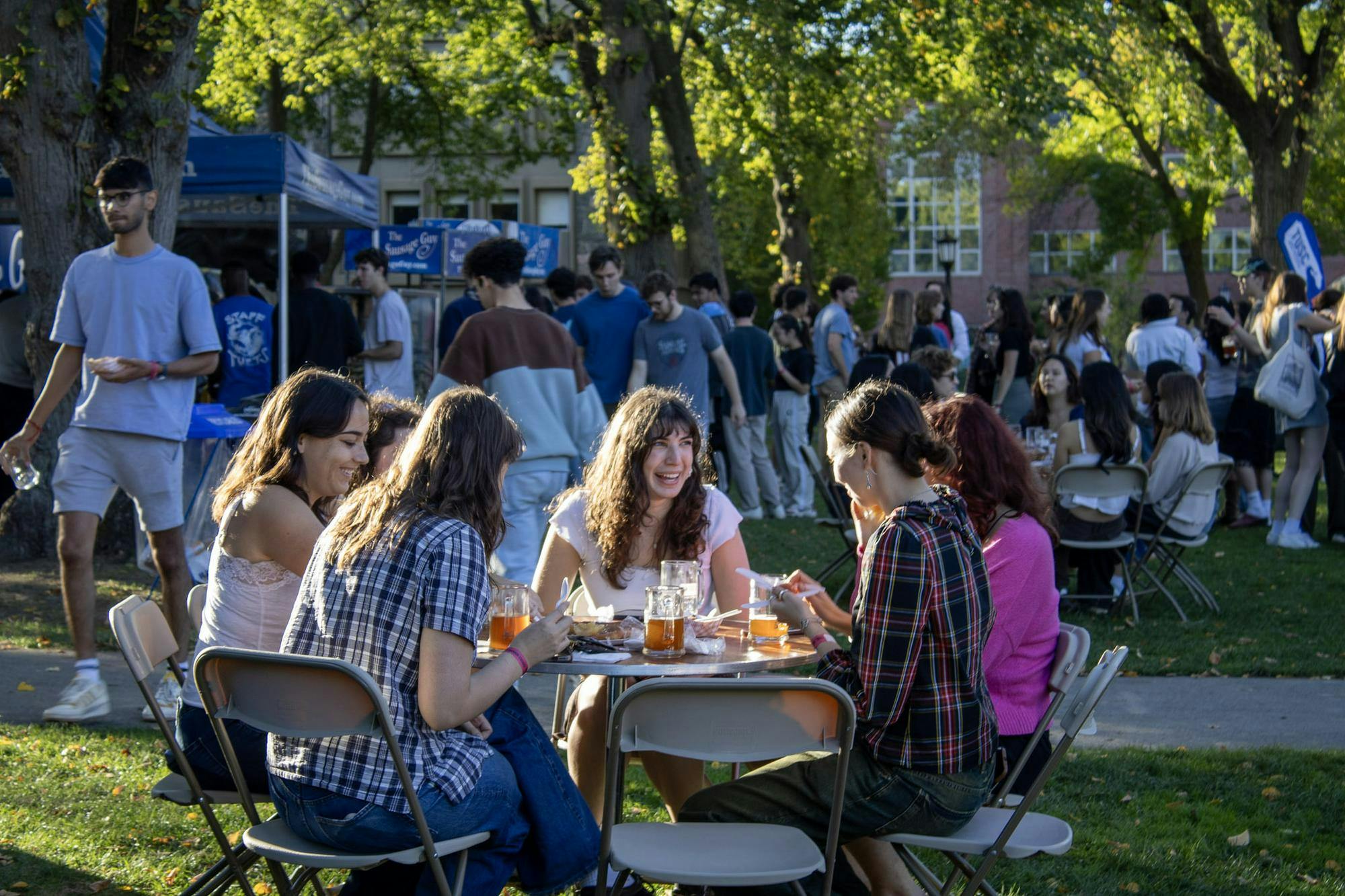
Although TUSC is best known for hosting large events like Spring Fling and Tuftonia’s Day, they also host smaller food pop-up events throughout the semester, organize late-night takeovers of Tisch Library, put together Senior Week and host fitness classes every week.
“It’s difficult to cater to everyone, but we’d like to feel like everyone’s welcome, everyone’s needs and wants are addressed and there’s a space for them,” Farrell said. TUSC uses demographic data from people who attend its events to make sure future events appeal to all students.
“People know that we’re always asking them to tap their IDs, and a lot of people wonder why,” Farrell said. “It’s so that we can look back on that data and we can see if the populations we’re matching are reflecting the overall student body population. [The] initial brainstorming [for events] is often like, ‘What group have we not hit yet? How could we do this? What other clubs could we work with?’”
The budget needed to support the scale of TUSC events is as large as you would expect — in the 2027 fiscal year, TUSC was granted a budget of $919,750 by the Tufts Community Union. The funding for student organizations is publicly available on the TCU website as part of their commitment to transparency.
“[TCU] allocate[s] monetary amounts, so our job is to make sure students have access to the student activities fee in a fair and equitable manner, and doing so transparently,”
Michael Onysko, the TCU treasurer, said.
For TCU, this allocation process falls under the jurisdiction of the Allocations Board. After each club’s budget is decided, clubs can meet with the Allocations Board to request supplementary funding or redeem their bookmarks already in their budgets.
The total amount of funding TCU received to budget for student organizations this year came to about $2.8 million, taken from the student activities fee embedded in each student’s tuition. This fee comes out to a total of $408 per student. With university tuition rapidly nearing $100,000 a year, only a small percentage of that total goes toward tangible events that students can benefit from.
“Our budget is entirely from the student activities fee, and we take that budget and do the best we can with it,” Farrell said. “We are reaching to events that are accessible to everyone on campus … if you have a Tufts ID, or [even] if you forget it and are a Tufts student, you are able to participate in events and reap the rewards, if you will, of whatever we’re offering.”
This year, many student organizations have seen a decrease in their budgets from last year, mainly because the surplus left by the COVID-19 pandemic has ended. During the pandemic, students at Tufts continued to pay the student activities fee despite a lack of on-campus programming. Tufts then put this money into an interest-bearing account, giving student organizations more generous budgets in recent years.
This year, the TUSC budget decreased by 25% because TUSC’s share of that COVID-19 surplus was depleted. Student organizations across campus also received similar funding cuts.
“For any group, that’s [a] huge [decrease], and we understand that every single group on campus is facing this. But [for] a group at our scale, that’s hundreds of thousands of dollars,” Joe Peterson, one of the executive coordinators for TUSC, said.
The loss of this fund has led TUSC to make difficult decisions about which events to keep and which to sacrifice. These cuts already saw the loss of the food truck frenzy at the Homecoming Block Party — this year, the Office of Campus Life came together to plan a smaller version of the event. Another event at risk of being cut is the Winter Formal, which usually happens at the beginning of the spring semester. These budget cuts could also lead to fewer pop-up events, fewer bingo nights and possibly lower event capacities, decreasing the number of people TUSC is able to reach.
“It feels difficult because we can’t make the money exist,” Emma Roney, TUSC's staff advisor and financial contact, said. “It feels easier beforehand to cut $1,000 from an event and say, okay, we still have $3,000 … [but] it feels harder at the event [when] there are physical people who are tied to these dollar amounts.”
Despite the 25% budget cut, TUSC will only have 13% less programming than last year.
One sector the executive coordinators refused to sacrifice was Welcome Week — the programming that happens during the first week of the semester.
“A lot of our Welcome Week events … act as a form of harm reduction,” Peterson said. This is another important function of TUSC. “We offer spaces that are safe, supervised and sober, and so especially during Welcome Week, which is one of the times during college that a student is most likely to experience an event of sexual assault or harassment, TUSC functions as a space that should be safe for them.”
The Halloweekend events have a similar purpose. They give students a space to celebrate during a weekend typically associated with drinking and partying. Normally, four TUSC events are spread throughout Halloweekend. This year, due to budget cuts, there will only be two.
“[TUSC is] a safe space on campus for late-night activities and a place where you can get together with friends in a safe manner,” Farrell said. “Losing the Halloweekend [events] was a little disappointing, but [a part of the] sacrifices we had to make with losing that money.”
Farrell also expressed disappointment about having to reduce their serving sizes at the smaller pop-up events.
“Losing the money doesn’t change our goals for the semester, but it does restrict the number of people we’re outreaching to … which is never something we want to do because we want to provide for as many people as we can,” Farrell said.
Because of the budget cuts, the executive coordinators are being hypervigilant in ensuring that every dollar allocated to TUSC goes somewhere its impact will be felt.
“Our top goal that we’re working with is sustainability from a financial sense,” Peterson said. Respecting TUSC’s financial means is important to Peterson. However, it is also important to him that TUSC continues to build and expand as a group to reflect the spirit of Tufts campus.
Although TUSC will look a little different this year, the program’s goals remain the same.
“Looking to the future, [we’re] trying to continue to be creative and come up with new things,” Peterson said. “One of our old executive coordinators said a phrase that really stuck with me: ‘Precedents is nonsense’ … I think that sometimes the best ideas are things that we’ve absolutely never done before, and I think that that’s what the campus responds to.”



