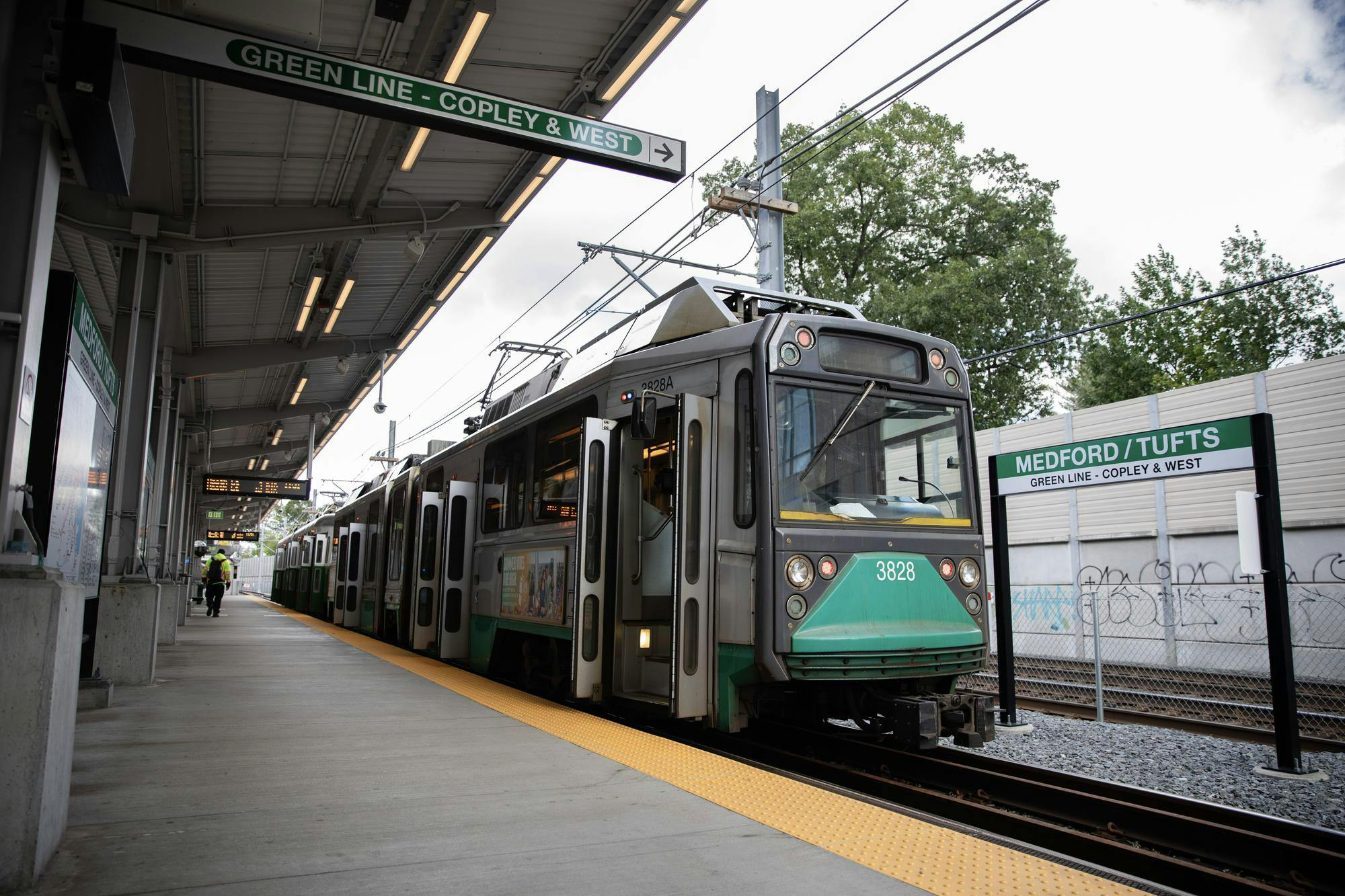
When the first Green Line train pulled out of Union Square station just before dawn on March 21, 2022, the crowd on the platform consisted of Senators Elizabeth Warren and Ed Markey, then-Governor Charlie Baker and then-Mayor of Somerville Katjana Ballantyne. It was a group that reflected just how long the community had been waiting for this moment.
After over 30 years of planning, Somerville residents finally had a train directly into Boston.
The Green Line Extension delivered on its core promise almost immediately. Roughly 80% of Somerville residents now live within walking distance of a T stop, up from 20% before the extension. But this celebrated accessibility also raised concerns over rising rents and displacement pressure, especially among immigrant populations and working-class communities. The question that we are left with now is whether the Green Line helped create Somerville’s housing crisis or simply arrived as the problem was already unfolding.
The extension happened in two phases: first, the Union Square branch, which opened in March 2022, and second, the Medford branch, which opened later that year in December.
Colleen Greer (AG ’26), a graduate of the Department of Urban and Environmental Policy and Planning, said that the project’s origins dated back much farther than many assume.
“The impetus for the Green Line and the push to build it in the first place was really an environmental decision,” Greer said.
In 1991, the Conservation Law Foundation sued the state of Massachusetts for failing to reduce vehicle air pollution that resulted from the Big Dig highway megaproject. The resulting settlement included the initiative to expand public transportation via the GLX in Medford, Cambridge and Somerville.
“It was a transit offset. … Part of the goal with the Green Line was to take cars off the street in Somerville,” Greer said.
Somerville officials, however, saw this project as more than just an environmental win. It was one that would also financially benefit the city. Then-Somerville City Councilor-at-Large Willie Burnley Jr. told the Daily back in 2022 that the city would gain more commercial property tax revenue from the development that the extension would bring. This, according to Burnley Jr., would let Somerville shift its reliance away from residential taxes and free up more money for initiatives such as affordable housing.
The idea was appealing to many: bring investment into Somerville and use some of the benefits to protect the people already living there.
Somerville, however, had already seen what a major transit project can do to a city, and the benefits do not always outweigh the shortcomings. The Red Line came to Davis Square in 1985 and demonstrated the unintended consequences that come with large transit expansion projects. When the station opened, there was an immediate spike in housing demand, along with increased rent and property taxes in the surrounding area.
In response to this, at the GLX 2022 opening, city councilors, including Burnley Jr, Ballantyne and members of the state’s congressional delegation, joined a community press conference specifically warning against letting “the Green Line become the Gentrification Line.” The goal of this was to ensure that the train expanded access, but did not push out the people it was intended to serve.
The evidence shows that those fears had some basis. Greer’s graduate thesis examined real estate sales in relation to the GLX. “Overall, areas that were the closest around stations had an extra 15% in price growth,” Greer said. “That amount of price growth falls as you get further away from stations.”
Greer also said that the price findings point to a larger problem. “There are genuine equity issues in our transit systems,” Greer said, referring to the lack of transit access in low-income communities in Boston. “But when you address it, you’re funneling investment into these communities, and then you facilitate gentrification.”
Planners are left making a choice between leaving inequities in place and risking displacement.
Not everyone believes that the GLX is the right thing to credit or blame for what has happened in the Somerville housing market since its establishment.
Joshua Michel from Somerville Yes In My Backyard, an organization advocating for “abundant housing, available to people in cities that have suffered from gentrification and expensive market rate housing,” points to the regional job growth, more than the GLX itself, as the real driver of the city’s displacement.
“The affordability crisis here in Somerville [is] born out of the fact that we fundamentally lack housing,” Michel said. “We’ve had a lot of jobs, a lot of people coming in, and no one’s built enough housing.”
According to Michel, Somerville is short roughly 10,000 homes relative to demand. While there are many current initiatives to bring more housing to the city, affordability is still the main issue.
Somerville spent most of the 20th century as a working-class residential city with a small commercial tax base of its own, while neighboring Kendall Square and Seaport became major hubs for biotech, tech and finance jobs. This regional job growth pulled higher-income workers into the area, and many looked to Somerville as a cheaper alternative to Cambridge and Boston rents. However, these cheaper rents did not last long alongside this massive increase in demand. This dynamic predates the GLX by years.
“It’s great to build, from a climate perspective, from an individual perspective … where the transit is,” Michel explained. “But it’s not the driver. It’s just one way to solve the issue that aligns with other values.”
Regardless of what the main culprit is, there’s no question that Somerville has seen massive changes in neighborhood demographics and character in recent years. Laurie Goldman, a professor in the Department of Urban and Environmental Policy and Planning, said the first step in understanding these changes is defining the terms.
“Whenever you use the term ‘gentrification,’ you must define it because people use different definitions,” Goldman said.
A clear definition matters because neighborhood change is not harmful in itself. Investment, new businesses and rising property values can benefit a community. What makes gentrification a problem is displacement — when longtime residents are forced out of neighborhoods they would otherwise have stayed in.
But displacement is not just one thing, and it’s hard to measure. “It is very difficult to find ready-made data, from census that is regularly collected, that proves displacement [are] not voluntary moves, but involuntary moves,” Goldman said.
Goldman pointed to a larger challenge in tracking displacement in Somerville and why it is difficult to find one main driver: When looking at the data, someone who leaves Somerville for a bigger apartment in Medford looks identical to someone priced out entirely.
“You can look at changes in education, income, languages spoken, place of birth or those kinds of things that are used as proxies that capture the kind of neighborhood change that is associated with gentrification that leads to displacement, but it’s an approximation,” Goldman said.
None of this is to say the costs aren’t real. The rising rents, displaced tenants and disappearing community institutions are exactly the concerns people had when they warned against letting the Green Line become the ‘Gentrification Line.’ But the debate over the GLX also reveals the limits of asking whether transit itself causes gentrification. The more difficult question is who gets to benefit from the investment once it arrives.
Greer and Michel’s findings both point to the same uncomfortable truth: Building transit in underserved neighborhoods is the right thing to do, and so is building enough affordable housing to go with it. Doing one without the other is where people and communities get hurt.