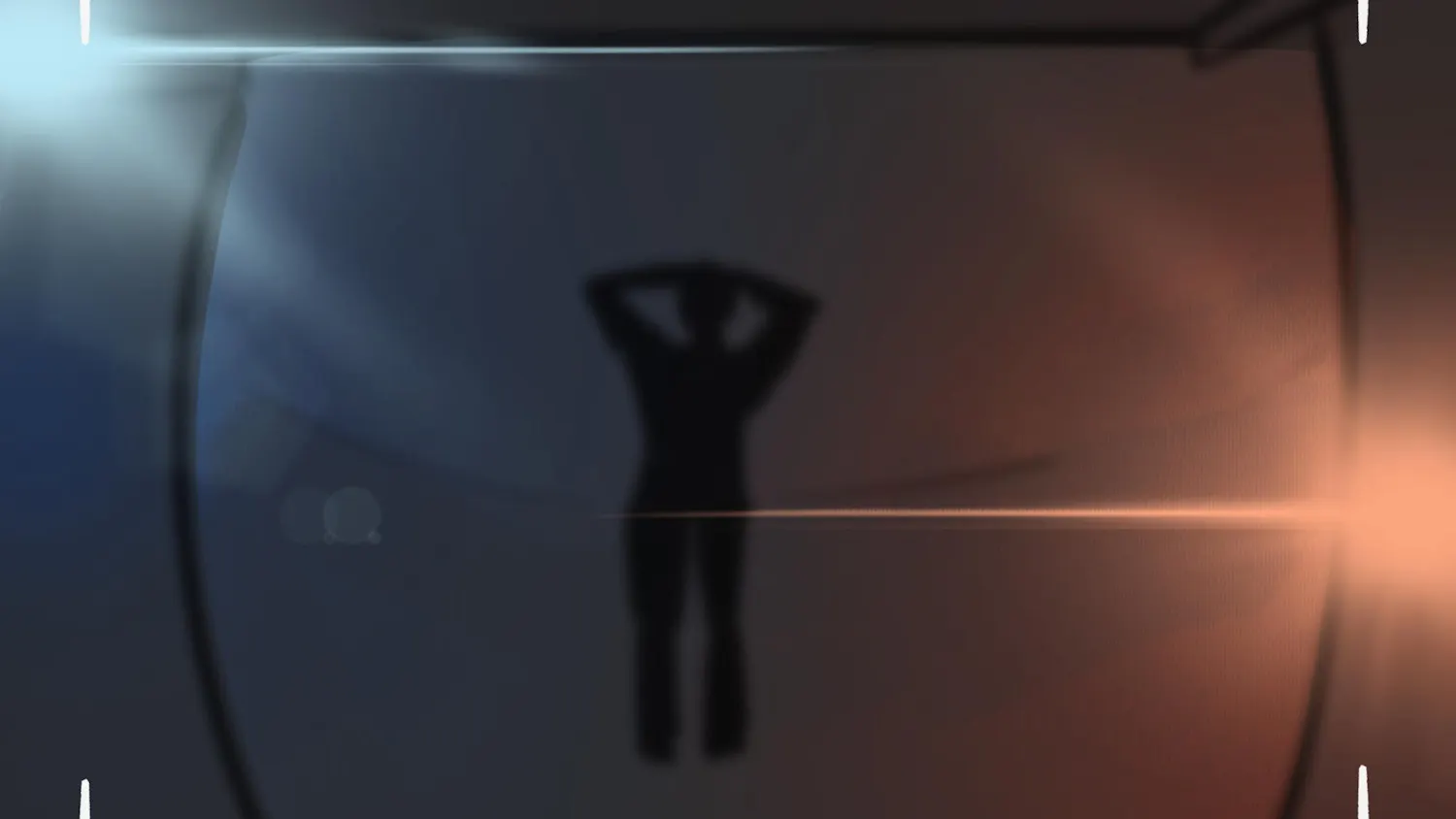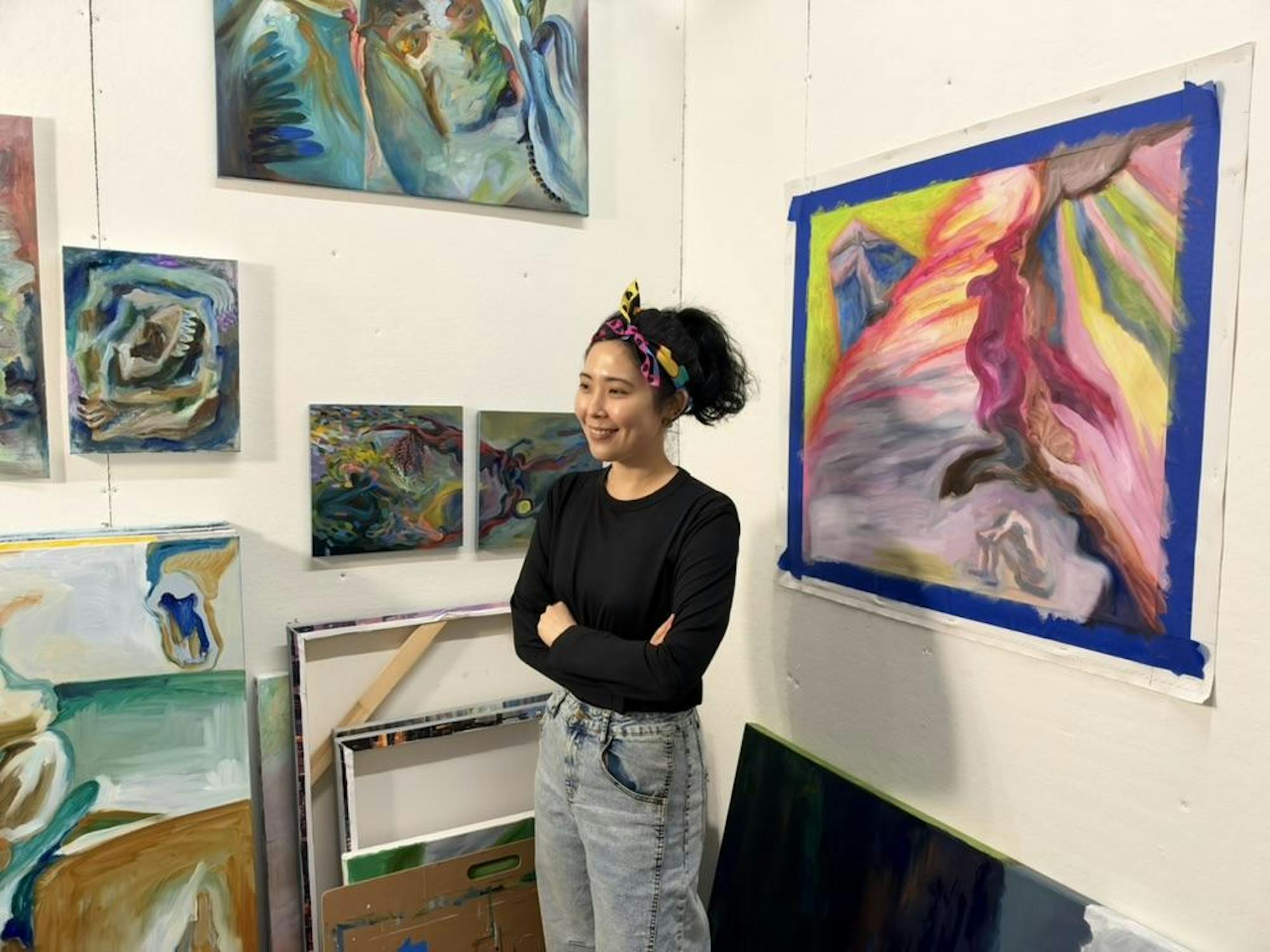
Ji Eun Lim never sat down on the benches in the New York City subway. Her roommate warned her off them on her first day in the city. So when the trains ran late and the days ran long, she crouched on the platform instead, folded down over her knees, waiting.
The crouching figure turns up repeatedly in “Ascending Through Uncertainty,” Lim’s solo exhibition, which opens Oct. 7 and runs through Oct. 29, with an opening reception on Oct. 9 at the Foundry in Cambridge. Lim, a graduate student at the School of the Museum of Fine Arts at Tufts University, describes the pose as carrying two meanings at once.
“Physically, I did that pose a lot, and my emotional state was like that: crouched,” Lim said. It was a “very strong, insecure pose.”
Lim grew up and lived in Seoul until her undergraduate years, which she says fully formed her identity before she left. “I’m 100% Korea still,” she said. “So everything was new, different and nervous.”
She landed in the United States on Jan. 1, 2017, flying into Portland, Ore. to study English. In her first two years in America, she struggled to have a peaceful night of rest, only able to sleep through the night when she returned to her parents’ house in Korea.
“For two years [in the U.S.], I couldn’t really sleep well,” Lim said. “Always woke up in the early morning, like 2 a.m., or 3 a.m., because of the [nerves].”
Some of that sleeplessness was the ordinary vertigo of leaving home and beginning a life in a completely new country. Some of it was more specific. Her downtown Portland apartment was an old wood-frame building, and the doors felt thin to her. One night, she vividly recalled a shot being fired outside.
“It was the first and last time to listen to the shooting sound as real, not from [a] movie,” Lim said. “Korea is not a gun country.”
Yet, Portland still charmed her. The city ran at a slower pace that startled her out of old habits. She described standing at the bus stop in her first month, rushing to board first as is customary in Seoul, only to realize that everyone else was waving others ahead. “I was the only person who tried to go up the bus first, because I’m Korean, and that is a very normal attitude in Korea,” Lim said. “But at some point, I became a Portlander.”
Nearly two years after arriving in the U.S., Lim moved east to New York for her Master of Arts in Teaching at the School of Visual Arts, and she unlearned her new lesson fast. After stepping back at a subway door to let people off first, the crowd surged past her, the doors closed and she missed her train.
She stayed in New York for around four years, teaching art at after-school programs and summer camps. Studio spaces were out of her reach, so she painted in her bedroom. During that time, she described a steady stream of harassment that became almost routine.
“In New York I had a lot of sexual harassment and racism experience,” she said. “Almost like once every two days. It’s countless.”
Lim recalled experiences such as a man following her off the train to her apartment, or a woman at CVS telling her to go back to China. The effects of these experiences were cumulative and lasting.
“[Some people] might [still] be a little mean to me. … That’s just their emotional state at that moment,” Lim said. “But I got too defensive and overthinking, because of my past experience.”
Through these moments, her art career was still being shaped, uncertain but exciting, and that unresolvedness showed in her paintings of a staircase.
“As an artist, everything is foggy,” Lim said. “I’m just going up and up and up, and towards [something] very unspecific, very unclear. Even I don’t know the goal.”
The show’s description calls the works “portraits of someone mid-translation,” a phrase Lim traces to a change she had originally resisted. But the longer she lived in the U.S., the more she watched her own values and habits shift and felt like she was losing the person she had been.
However, since moving to Boston, she has realized that she is still herself. It is why the figures in her paintings never settle into a singular body in particular, and why Lim refuses to explain them. When prompted to say what one painting depicts, she declined outright.
“Interpreting is just your own job. I don’t want to make it more narrow,” Lim said.
If a viewer didn’t see a crouching body and instead saw something else out of their own experiences, then she considers that a good outcome. The abstraction in her artwork and its openness is the focal point of the show, and it comes down to a belief that Lim holds.
“I think all human beings have some darkness inside them [for] any reason,” Lim said.
It may not be someone who lived between two countries as she has, but everyone has their own version that they harbor confusion and sadness around. “Everything is very invisible to all human beings,” Lim said. What she wants for any viewer of her work is to recognize something within themselves that they may have yet to acknowledge, and recognize that they are not alone in that.
Lim’s own darkness has been lifting. She came to Boston because she got married. She chose SMFA for its interdisciplinary culture, where students can move between painting, ceramics, performance and photography without having to declare a major, which is the boundary-pushing that she seeks in her art career. Currently, she works in the ceramics studio, has worked as a teaching assistant and wants to continue her career as an art educator.
Through her time in Boston, her life has gotten lighter, brighter and happier, actively shaping the work that she is producing. Recently, she has been painting from photographs and videos of herself stretching into the pigeon pose, a yoga position she loves, in brighter colors than the ones she normally reached for. While these won’t be displayed at the Foundry, the paintings are more peaceful and Lim describes them to be the next version of the crouching figures: getting out from under the sadness. These works, as she calls them, are a starting point.
In getting ready for her show, there is still a lot of work that needs to be done.
“I’m so excited and nervous. I’m so tired, because I’ve been working [on the exhibit] almost every day,” Lim said.
The show is about her experience in New York, where she felt like an animal surviving in a jungle. Boston has been different.
“Here, I feel like I’m being a human being,” Lim said.
“Ascending Through Uncertainty” opens Oct. 7 and runs through Oct. 29 at The Foundry, 101 Rogers St., Cambridge. An opening reception is scheduled for Friday, Oct. 9, from 6 to 8 p.m.