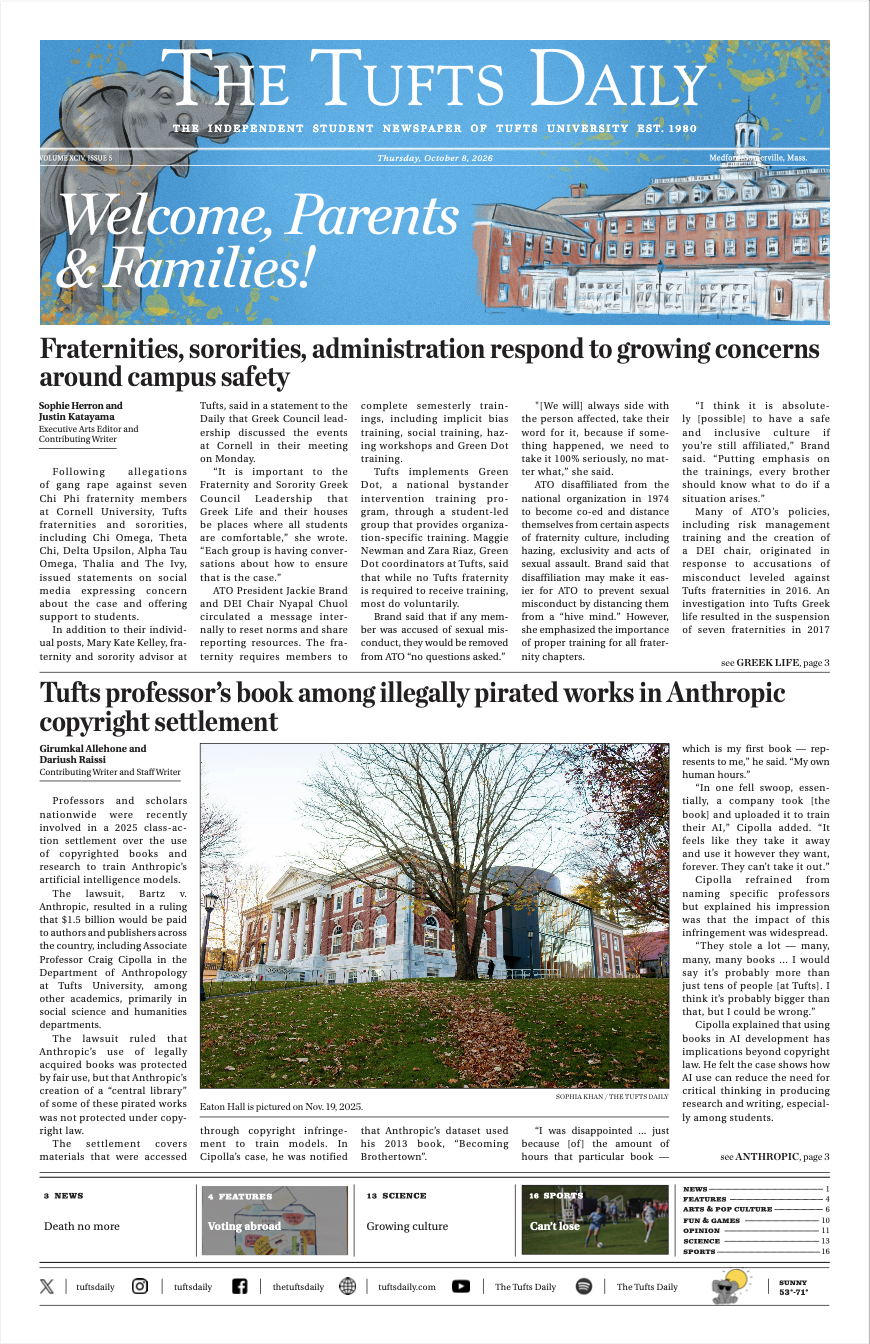
Executive Director for the Center for Health, Environment & Justice (CHEJ) Lois Gibbs and Stephen Lester, Science Director of the CHEJ, yesterday spoke to Tufts students, professors and alumni in Eaton Hall during open block about their experiences with environmental activism and the media.
The Communications and Media Studies program (CMS) and the Environmental Studies Program collaborated with the Director of the Digital Collections and Archives (DCA) and University Archivist Anne Sauer to coordinate the lecture on the same day as the ribbon-cutting ceremony for the procurement of the CHEJ's donation of Gibbs' and Lester's papers and technical files to the Tufts DCA, according to Director of Environmental Studies and Professor Colin Orians.
Orians introduced Gibbs and Lester for the first collaborative effort with the CMS department, built around the theme of environmental activism and media. Orians explained the importance of and impact the Love Canal neighborhood in Niagara Falls, New York had on increasing environmental awareness of the idea that companies pollute and are not held accountable.
"The fact that [companies] can build schools on top of waste dumps is just not fathomable," he said. "It's really the efforts of [Gibbs and Lester] fighting through incredible resistance to get the national awareness that this is not acceptable and we need to do something about it."
The movement at Love Canal, which was spearheaded by Gibbs, led to United States legislation, including the U.S. Environmental Protection Agency's (EPA) Comprehensive Environmental Response, Compensation and Liability Act of 1980, commonly known as Superfund, according to Orians. He noted that there are Superfund sites around the country, including one in Woburn, Mass., that are dedicated to cleaning up places contaminated with hazardous substances.
Gibbs talked about how the leaders of the movement communicated with locals and the media to tell the story of families affected by health complications from the toxic waste under their homes, schools and offices.
Love Canal activists began their campaign by targeting local media outlets with human-interest stories to publicize and generate awareness of the 56 percent of children born in Love Canal between 1974 and 1978 that had one or more birth defects or of the four normally-developed babies that were born out of the 22 pregnant women of Love Canal between January 1979 and February 1980, according to Gibbs.
In each article, the activists referenced former New York Governor Hugh Carey, who was running for re-election, to gain public support. They also handed out flyers in front of Carey's $1,000-per-plate dinner, Gibbs said.
"On one side of our flyer we wrote about the 56 percent birth defect thing and on the other side we talked about how we were going to hurt his campaign - how we were going to talk about how he doesn't really care about the citizens of New York or what he's doing to the good families of Love Canal," she said. "We handed [the flyers] out as people were going in and the media just loved it. The media loved it because it was an opportunity to tell a story that was different."
Gibbs and her followers' strong efforts led to Carey opening his $1,000-per-plate dinner with his plan for taking care of the Love Canal neighborhood.
"It was a matter of really framing our issues to the audience that we were addressing and moving that frame forward strategically to win the Love Canal," she said.
Gibbs is excited for the archives to be located at Tufts. She said all of her personal notes as well as formal letters from the movement will be stored in an open collection held on Level G of Tisch Library. She noted that the majority of the work in the collection is from women, who primarily led the movement at Love Canal.
Recently, Gibbs and her team went after Intimate Brands, Inc., which made its bottles using polyvinyl chloride (PVC). They created flyers about Victoria's Secret and Bath & Body Works products that used Intimate Brands, Inc. bottles and targeted students to advocate against the company. Intimate Brands, Inc. received over 4,000 emails from students and immediately decided to discontinue the use of PVC products, Gibbs said.
"We asked students to get involved in this and they loved it - because it was 'Victoria's Dirty Little Secret,'" she said. "In less than 30 days [Intimate Brands, Inc.] sat down with us in D.C. and said 'we surrender.'"
Gibbs said Intimate Brands, Inc. moved so quickly on this idea because young people were involved: people between the ages of 17 and 25.
"The power of young people in corporate America is pretty powerful because all of their marketplace preferences of shampoo and body products and linens and whatever [are] developed between 17 and 25," she said.
Lester said the CHEJ began focusing on grass-roots campaigns by word of mouth rather than advertising.
"Organizing was always the strength of what we did," he said. "We help groups get started with organization and define their goals and how to involve the community and who to talk to."
More from The Tufts Daily


Trending
Haute Take: Stay for the second set
By
Andrew-Lucien Bao
| October 13
Mass. voters to decide on future of recreational marijuana laws
By
Shayna Levy and Emily Bahar
| October 13
Daily Newsletter: October 15, 2026
By
Daily Newsletter Staff
| October 15

The Print Edition