
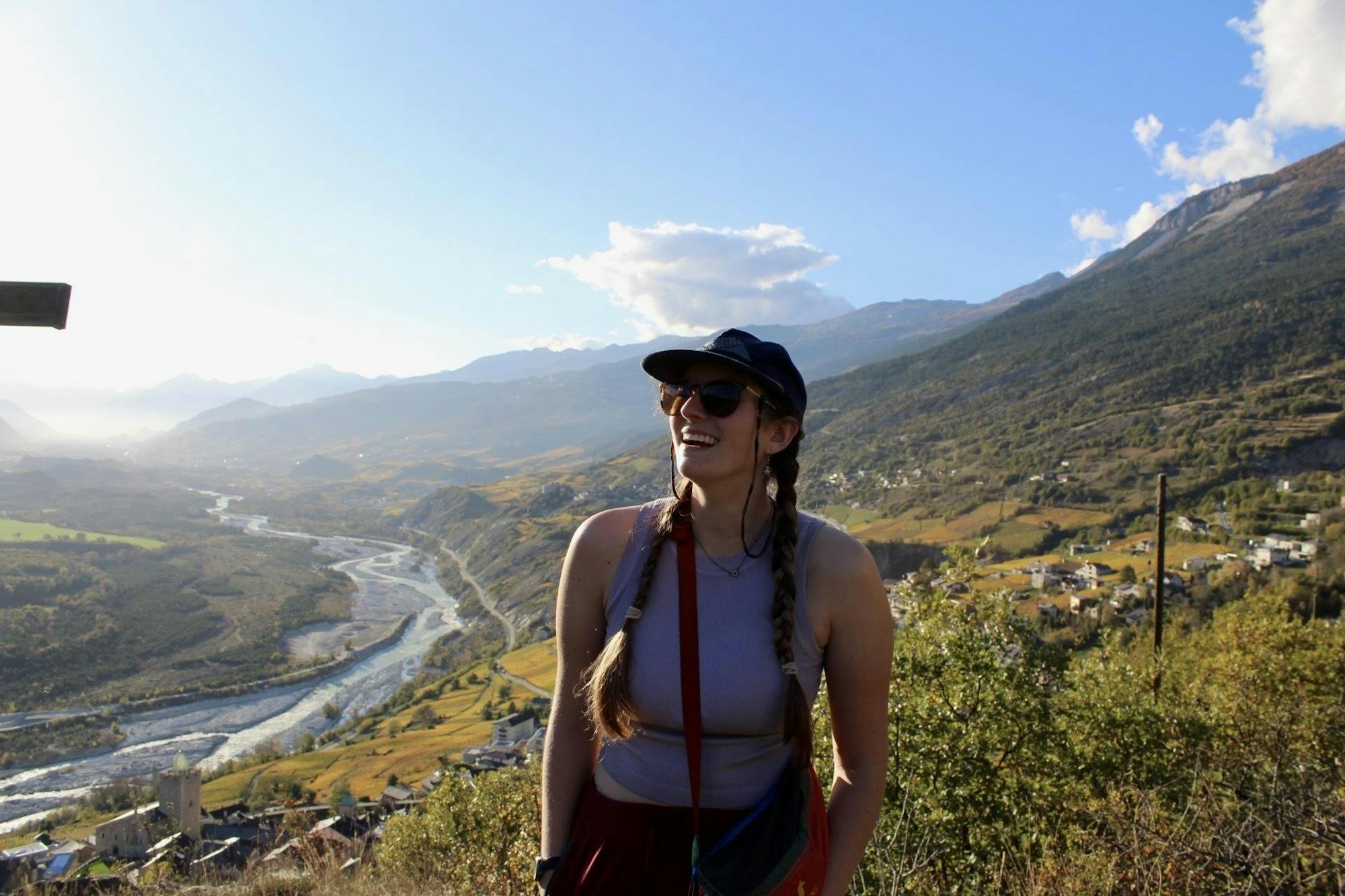
Editor’s note: The Daily’s editorial department acknowledges that this article is premised on a conflict of interest. This article is a special feature for Commencement 2025 that does not represent the Daily’s standard journalistic practices.
When asked to describe her four years at Tufts in a single sentence, graduating senior Carmen Smoak was inspired by words often attributed to writer and professor Joseph Campbell: “Say yes to the whole catastrophe.”
“It’s gonna be a mess, but it’s a beautiful mess,” Smoak said. “You might as well just say yes to the whole catastrophe and embrace it for all it’s worth.”
Smoak's early college career was full of change: After a year at Rensselaer Polytechnic Institute, she transferred to Tufts. The move wasn’t exactly a surprise, especially as she realized that she wanted to pursue more diverse interests in academics and extracurriculars.
“I knew I wanted to transfer,” Smoak said, “I had gotten waitlisted from Tufts, and I really, really, really wanted to go to Tufts. The more I learned and the more I transitioned to this combining science and social thing, I was like, ‘Tufts is a place where I can really do that.’”
Smoak has successfully utilized Tufts’ interdisciplinary offerings — she is receiving a bachelor’s degree in applied environmental studies and science, technology and society.
Not long after transferring, she joined the Tufts Mountain Club in search of community.
“I transferred, and that was hard,” Smoak said. “It was starting fresh, completely, socially, academically, in a new place. I didn’t know anyone here, and so I just threw myself into TMC.”
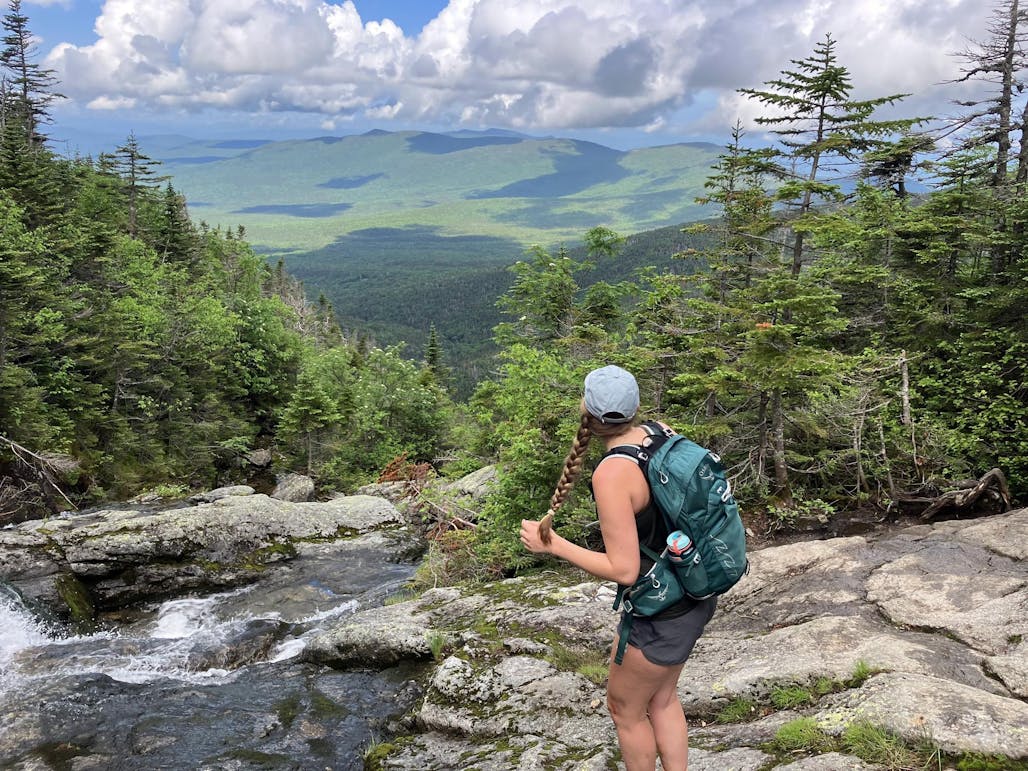
Smoak is pictured hiking in the White Mountains.
Her first October at Tufts, Smoak applied and was chosen to be a coordinator for Peakend, TMC’s annual leaf-gazing trip to the Loj in the White Mountains of New Hampshire. While there, she stumbled upon The Mountain Wanderer, a bookstore dedicated to mountain maps and guides. Inside, she found a book about hiking the “New Hampshire 48,” the 48 mountains in New Hampshire with peaks above 4,000 feet.
“I was flipping through [the book] and seeing the pages explaining how to do the hikes. I realized a lot of the hikes weren’t insane; this is an achievable goal.” Smoak said. “I was like, ‘I’m in a new place. I want to meet new people. I want adventures. I want all of these things that I didn’t get to have before.’ I wanted a goal that was just mine, something that I could really commit to. So I was like, ‘What if I did that?’”
It didn't take her long to get started.
“I was so anxious to start, so impatient. I got a few people from Peakend that were really into the idea of doing a night hike. We decided to night-hike one of the mountains … Tecumseh,” she said. “And then we went and we night-hiked it, and it was awesome and silly and goofy. And I had so much fun with those people, and I’d never met some of them before.”
Her experience joining the Daily was just as spontaneous.
“I never in a million years thought that I would do journalism,” Smoak said. However, when pulled aside by the fall 2022 executive features editor, Mark Choi (LA’24), who told her that through the Features section, she could report in an area she loved — environmental science — she said yes.
As she spent more time on the Daily, she began exploring new subject matters to write about and rose in the ranks to be the executive editor of both the Features and Science sections.
“Here I am, three years later. I’ve been an exec twice, in two different sections,” Smoak said. “I’ve written articles about a lot of sparse topics — actually a lot fewer environmental articles than you‘d think — because it became a way that I could explore stuff that I wasn’t learning in my classes.”
This semester, as the executive science editor, she’s been able to combine more of her academic interests into her writing, such as through an article she wrote based on her capstone project about solitary bees and an article on the science of film photography, using knowledge pulled from a class she took on the topic.
This film photography class has acted as a gateway for Smoak to learn more about her family’s history. At the beginning of the course, her father gave her an old film camera that he had used throughout her childhood.

“[My dad] said to me, ‘Your mother gave this camera to me at our wedding as a wedding gift, and it has documented the first half of our family’s life,’” Smoak said. “I had this camera that has … documented our family’s life, but what if it could document more? What if it could document the history of our family, or another aspect of our family?”
While Smoak grew up in South Carolina, her grandparents hailed from Arlington, Mass., next door to the campus she now calls home. Her grandfather went to Tufts, and the couple were married in Goddard Chapel. Smoak enjoyed following in their footsteps and using photography to connect to their world, which she otherwise knew little about.
“It was really special to get to go and explore those places that are kind of responsible for my existence,” she said.
Smoak has also been a Sustainable Solutions Fellow in the Office of Sustainability since the beginning of her junior year, when the program began. In this position, she’s been able to do research and modelling that present tangible changes the university can make to improve sustainability. Recently, her work has focused on helping the university reduce emissions in response to a law that will likely soon be passed in the city of Somerville.
Smoak reflected on how her experience as a fellow has affected her view of the university as well as the future of sustainability on campus and beyond.
“I see [Tufts] from the inside,” she said. “I could tell you where energy for every building comes from, and seeing that as a system makes me understand both why it is so difficult to make sustainability change, but also I’ve been able to see how many people are passionate about doing it and that are trying. I think that’s been a little more reassuring. I actually feel like I’ve made progress; I feel like all of us in the fellowship are actually pushing a ball forward.”
Although Smoak has been busy with her academics, the Daily and her fellowship, she’s been able to make her way through much of the New Hampshire 48, one peak at a time. The experience has been just as, if not more, life-changing than expected.
“I got what I wanted out of it. I’ve made so many friends, and I’ve made so many memories, and I have so many silly pictures from hikes,” she said.
Reflecting back on the past three years, Smoak gave advice to her sophomore self.
“Nothing in the next three years is going to look like you think it’s going to look like, and the surprises are going to be the best parts,” she said. “And they are going to teach you more and take you more places than any of the things that you wanted to happen, or that you held so tightly on to.”
On May 13, Smoak finished hiking the New Hampshire 48 atop West Bond.



