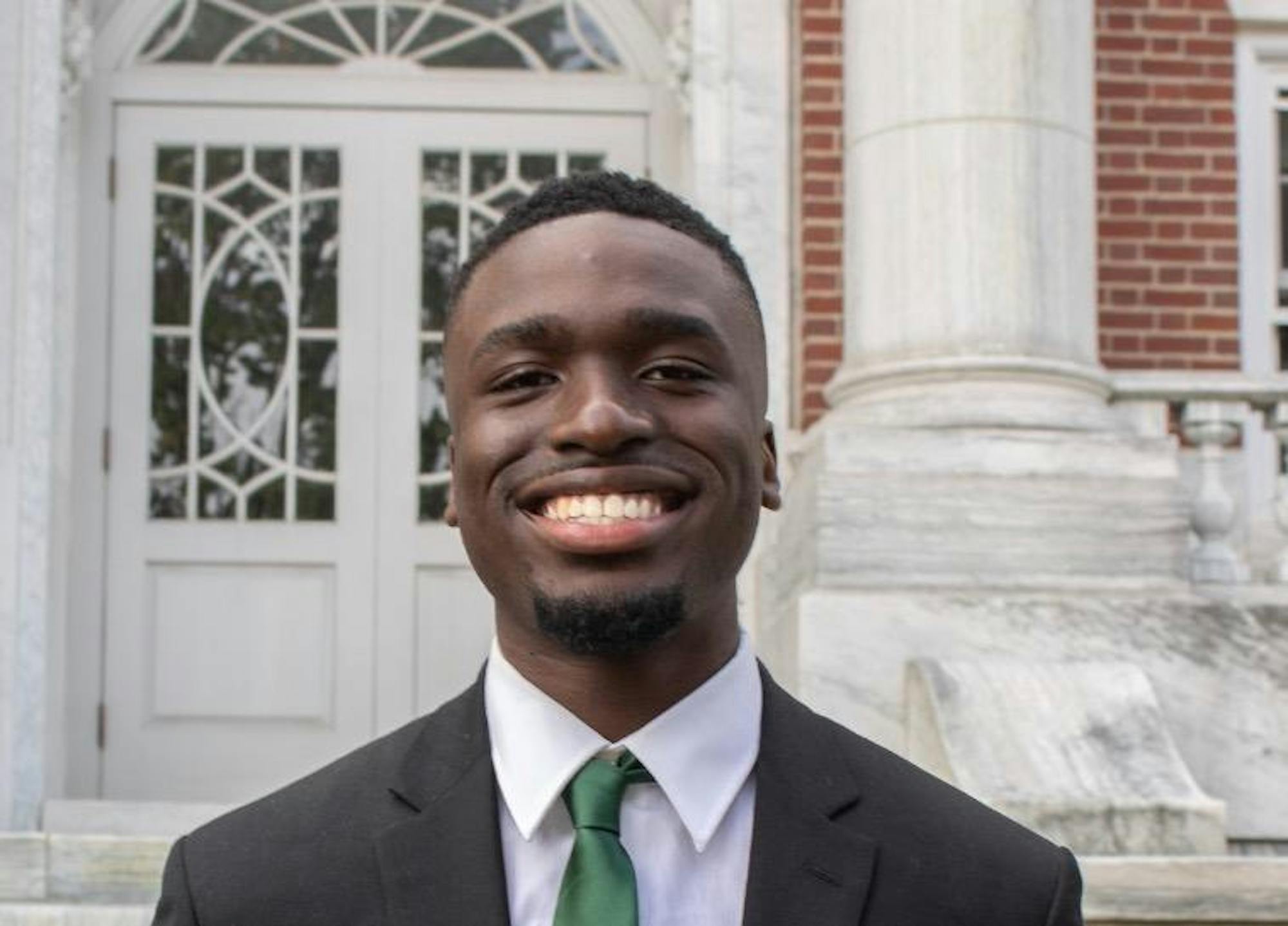
Outgoing Tufts Community Union Senate President Joel Omolade sat down with the Daily to reflect on his presidency and the Senate’s accomplishments. Originally from the Bronx, N.Y., Omolade is a senior majoring in political science and community health and a member of the Children of Cultures of Africa dance team. He is also the former president of Tufts’ resident assistants union.
Editor’s note: This interview has been edited for length and clarity.
TD: How has your term as TCU President been? What have you accomplished? And what are you most proud of?
JO: This has been such an amazing year. I think there were so many small victories, large victories. On the bigger side were putting medications in vending machines on campus and working with the Office of the President on more career-focused and professional development programs, which are going to be implemented in the next few years. The small stuff like increasing gym hours, working with the Food Insecurity Subcommittee, the “Lyft a ’Bo” initiative [helping students pay for rideshares to the airport or train station for fall break], the Health Service surveys — there were just so many small things, large things, things behind the scenes that I’m really just so proud of.
TD: When you were running last year, one of your most important goals was to make sure that more students felt like they had a seat at the table. How did you go about bringing more people to the table, and how successful do you think your efforts have been?
JO: Starting off the year, we were able to partner with the Office of the President on the “Meal with Sunil” series, an opportunity for student leadership clubs to have direct communication and meetings with [University] President [Sunil] Kumar to ask him hard-hitting questions to create a really impactful dialogue. I think it was super fruitful and I know a lot of student organizations are able to benefit from that.
This year as well, we created subcommittees, which was an opportunity for people who weren’t on the Senate to still have a role in creating Senate projects and Senate initiatives.
With the collaboration with the Office of the President, we had a student leadership town hall in February. We were able to have President Kumar meet with a lot of other student leaders and have a mini town hall where they were asking really impactful, important questions and [have] really great dialogue.
Being on the Senate, I’m privy to a lot of conversations on matters that don’t affect me as much as they do a lot of other students on our campus. I’m really happy that we’re able to have so many students be a part of “the room where it happens” — to quote “Hamilton” a bit — to be able to ask these questions, and to be able to hear straight from the source.
TD: Has the TCU Senate become more active in the labor space this year, especially with the ongoing contract negotiations with the full-time lecturers?
We were able to publish a statement within that same week of that initial walkout putting our solidarity with the workers. That statement was read in front of the Board of Trustees. One thing I’m glad about, and something that didn’t exist when I was the president of the RA union, was seeing that student government support. A lot of other faculty reached out to us and said, “Thank you for being able to stand on our side.” Obviously, the work isn’t over. The work stops when the labor union finally gets a fair contract, but I’m glad that we’re able to at least be advocates in these really important rooms.
TD: This past semester has been a particularly tumultuous time on campus. How has the TCU Senate been navigating these past few months, and what responsibility do you think that the Senate should have in moments like these and going forward?
JO: There’s a lot of behind the scenes things that the university is working on. In all honesty, especially as someone who can be very critical of the university at times, I have full trust and I’ve only been positively surprised by the work the Tufts administration has [done] to support and protect a lot of our students, especially in the face of other universities that haven’t had that positive response. Seeing Tufts being one of the first, briefly the only, university that was in support and sticking up for international students, was really encouraging to see.
In terms of the simple ways that student government can be a resource, we’ve been working behind the scenes just trying to communicate resources, especially to students who are most impacted by what’s going on. We’ve been having some dialogues with the Office of the President, the Department of Public Safety as well, to make sure that every student feels safe on this campus, and what happened a few weeks ago doesn’t happen again. On our side, while it’s been a little bit more behind the scenes, we’re so proud about what we’ve been able to accomplish, especially in face of such adversity.
TD: Going forward, what would you like to see change about the TCU Senate?
JO: We’ve been discussing the creation of more committees, especially since we saw how fruitful the subcommittee system was. We’ve been discussing creating more advocacy committees — more opportunities for student clubs who are already killing it and leading the game when it comes to these conversations about what’s going on nationally or globally, to be in these rooms with Senate, with administrators, and to really have the voices be heard.
We really realized the Senate is not the voice but more so the microphone. And the best way that we can keep on with our mission is to get more and more different student voices to amplify [for] that microphone.
TD: What are your post-graduation plans?
JO: After graduation, I’m working as a paralegal for the next few years while I’m studying for the LSAT. I’m also really passionate about marketing and communications. Hopefully, I can find some way to bridge my interest in law, policy and marketing, and from there, maybe consider working for public office and trying to support more people in the future.
TD: If you could give one piece of advice to underclassmen at Tufts, what would it be?
JO: It would be to say yes to everything. At first I didn’t even think about the Senate honestly, and I didn’t even think about running for Senate president. The Senate has taught me so much about the work that I want to do in the future, my own interests and everything. I would recommend for any [first-years] who are trying to figure out more about who they are: Sign up for Senate. Put your name in the hat. Run and just see what happens.
TD: All right, is there anything else you want to say about your time as president?
JO: This has been a year where I think Senate has cemented itself on campus. I think it’s been a year where the Senate has really shown that our voice does matter, and we’ve tried our best to make sure that everyone knows what’s going on on our campus and how to best effect change. A lot of the projects and legislation that we have already created and curated is only going to be better in the future years. I’m honored to be able to witness and help to facilitate any of that, and I’m just really excited to see what the future is going to look like.