
The Medford/Somerville campus underwent a significant number of small and midsized renovations in advance of the 2025–26 school year. They go beyond the completed renovation of Blakeley Hall, now part of sophomore housing, and the start of construction on a new upperclassmen residence — both of which have been widely publicized.
Nathan Scott, Tufts’ associate director of capital programs, wrote in a statement to the Daily that seven midsized renovations were completed this summer. Some high-profile changes, such as the renovation of Bacon Hall and the relocation of the campus mail room, are most apparent. Other less noticeable changes include an HVAC replacement at Dowling Hall, new roofing over the Chase Gym and the Student Health Services building at 124 Professors Row, renovation of the Cabot ASEAN Auditorium, the replacement of Ounjian Field and the demolition of the former Zeta Psi fraternity house at 80 Professors Row.
Scott also noted smaller renovations across campus, which were largely comprised of resurfacing and installing HVAC units. Replacement of hot water piping near Talbot Avenue, as well as steam piping and vaults in the upper campus, also began this summer and is expected to be completed later this fall.
Not included in Scott’s list were also several Tisch Library renovations. These facelifts include a new accessible entrance to the building and new first-floor bathrooms with expanded capacity and a gender-neutral layout. Construction is also underway on a new media studio designed for faculty to record lectures, with work expected to continue throughout the fall.
According to Dorothy Meaney, the director of Tisch Library, the restroom renovation resulted from an issue with capacity.
“We didn’t have enough bathrooms in the building,” Meaney said. “We had two bathrooms and a big storage area, and so that has been turned into a 14-unit all-gender restroom. [It is a] pretty big improvement to the student experience on the main level of the library.”
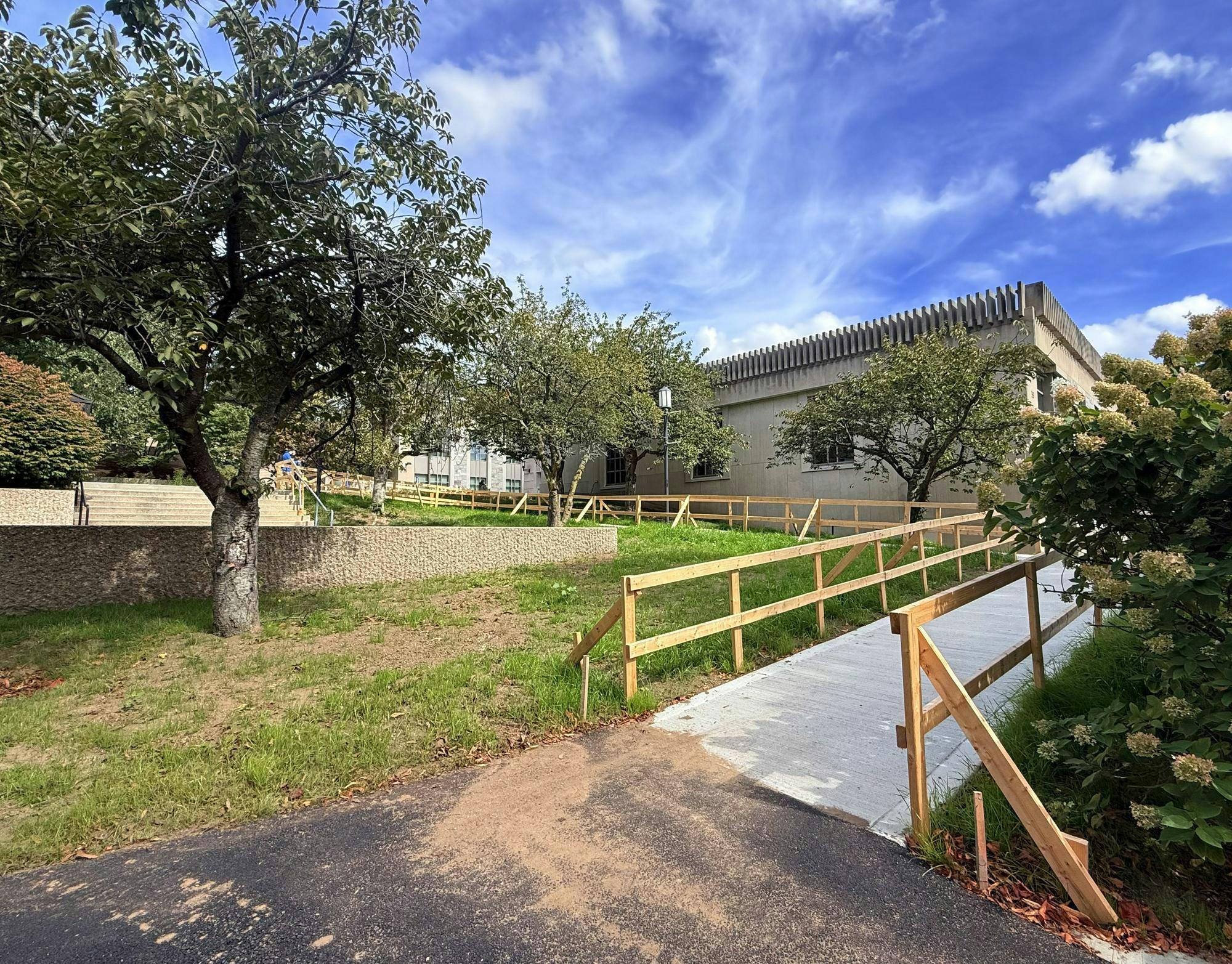
Furthermore, sidewalks outside Tisch were outfitted with temporary wooden railings, which will later be replaced with a permanent structure. The work coincided with efforts to improve accessibility elsewhere, including resurfacing on Capen Street, Fairmont Street and Harvard Terrace.
Campus Services Manager Henry Puza explained in a statement to the Daily that the sidewalks were changed to meet requirements from the Americans with Disabilities Act as well as to replace original asphalt that “had significantly deteriorated and was in dire need of repair.”
“This is the beginning of an ongoing effort to improve universal accessibility across the campus over the coming years,” Puza wrote.
According to Meaney, this initiative manifests into new funding for library renovations, which is conditional on adding more accessible infrastructure.
“[The accessibility renovations] were required by the amount of money we’re spending on the current projects, but in anticipation of doing larger renovations, we were going to have to do those anyway, so it made sense to get them done now,” she said.
Meaney detailed that funding, along with planning time, were the biggest obstacles to completing library renovations sooner.
“It takes a lot of years to plan and raise money and to do something major,” Meaney said. “So that’s the other thing that triggered these two accessibility improvements: The restrooms on the outside are in anticipation of doing larger renovations.”
Katelyn Gosselin, director of campus planning, also emphasized how much time it takes to plan summer renovations.
“Projects typically are in planning and design for at least a year, and sometimes even longer,” Gosselin wrote. “The capital project process is lengthy, involving careful study of renovation approaches, evaluation of University space needs versus building inventory and capacity, and engagement of outside experts for design, permitting, construction.”
Robert Corbett, executive director of capital programs, also described the typical schedule of summer renovations.
“There are many projects in various stages of planning and design. Construction starts have a variety of factors, including contractor/material availability, budget approval, and logistical coordination. We generally set our slate of projects to be completed next summer over this upcoming winter,” he wrote.
Gosselin added that the COVID-19 pandemic “affected the schedule for some projects, but otherwise no projects were put on the backburner due to logistical issues.” He emphasized that accessibility will continue to be a priority for future projects.
“Specific to accessibility, the University is completing an assessment for the Medford and Somerville campuses. We plan to use the findings to integrate accessibility improvements into future projects across campus,” Gosselin wrote.
She continued that Tufts’ goal is to “incorporate accessibility enhancements into most projects and campus improvements moving forward.”
Overall, Gosselin expressed optimism about the progress of this year’s projects.
“We are excited to see these projects completed for the University, delivering meaningful improvements that will benefit the students, faculty and staff,” she wrote.



