
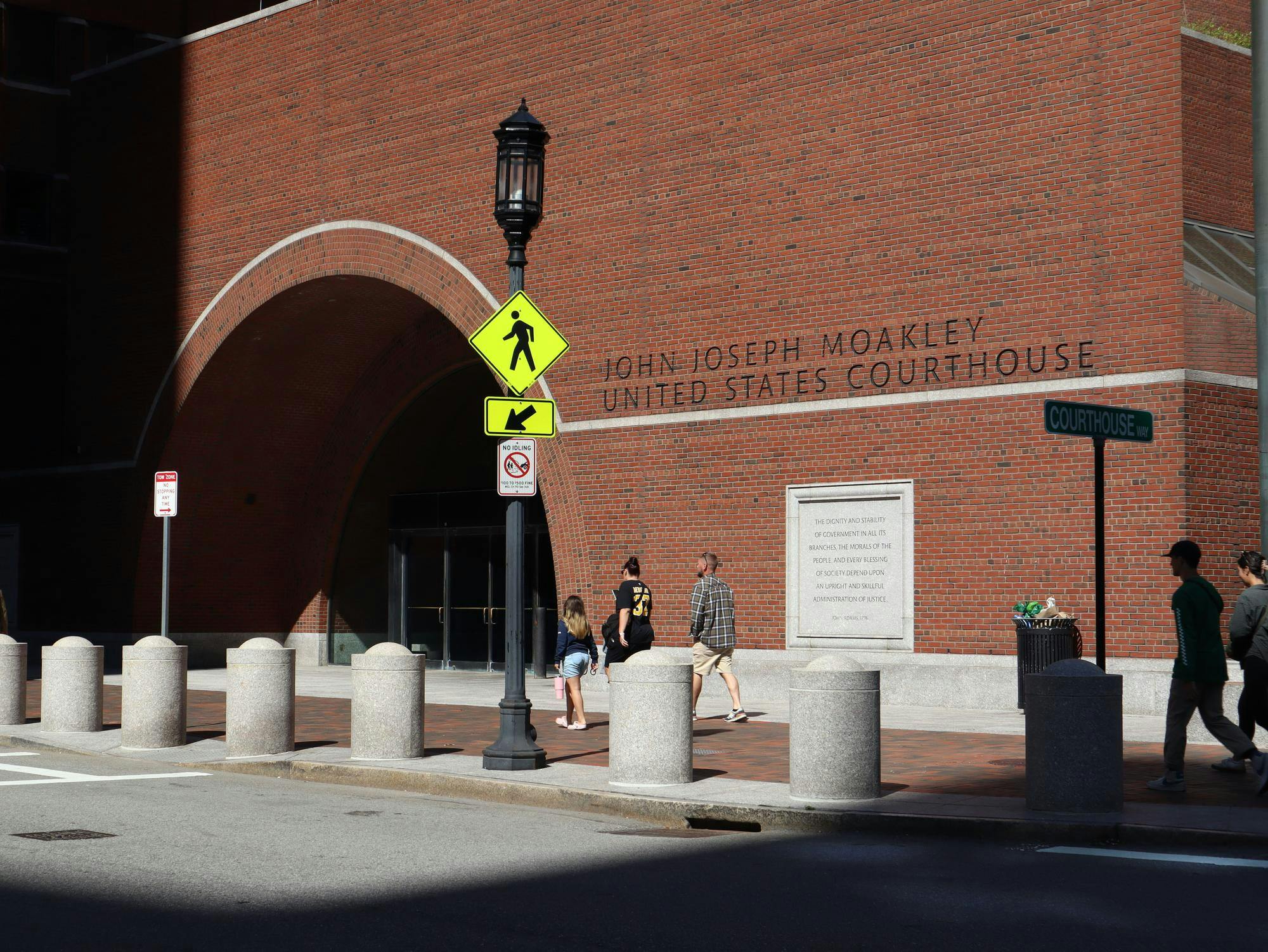
On Tuesday, a federal judge in Massachusetts ruled that the Trump administration had illegally used the threat of deportation to silence noncitizens in higher education who protested the war in Gaza in support of Palestine. In his ruling, U.S. District Judge William G. Young reiterated evidence and information surrounding the government’s decision to revoke several F-1 student visas, including that of Tufts graduate student Rümeysa Öztürk.
The plaintiffs — the American Association of University Professors — argued that President Donald Trump’s administration employed an “ideological deportation policy” against noncitizen students who had engaged in pro-Palestine activism, violating their First Amendment rights.
Young wrote that while there may not have been an explicit policy to deport all pro-Palestine noncitizens, the federal government’s arrests were intended to create a chilling effect.
“This case -- perhaps the most important ever to fall within the jurisdiction of this district court -- squarely presents the issue whether non-citizens lawfully present here in United States actually have the same free speech rights as the rest of us,” Young wrote in his ruling.
“The Court answers this Constitutional question unequivocally, ‘yes, they do,’” he wrote.
On the same day as Young’s decision, the 2nd U.S. Circuit Court of Appeals heard several habeas corpus petition cases considering whether district courts can oversee claims by noncitizens over violations of their First and Fifth Amendment rights, including a hearing for Öztürk’s own habeas lawsuit against the federal government.
Young did not issue an order in Tuesday’s case and stated in his ruling that he would set up a later hearing to issue some form of non-monetary relief for the plaintiffs.
Andre Watson, assistant director of the National Security Division of ICE, concluded in a referral letter to the secretary of state that by co-authoring the op-ed, Öztürk had associated in activity that “may undermine U.S. foreign policy by creating a hostile environment for Jewish students and indicating support for a designated terrorist organization.”
The Department of Homeland Security’s targeting of Öztürk, as noted in Watson’s referral letter, was based on her co-authorship of an op-ed opposing Tufts’ investments in Israel — a viewpoint shared by Tufts Students for Justice in Palestine. Tufts SJP was suspended in November 2024 for sharing images of weapons and calls for an intifada.
Stuart Wilson, deputy assistant secretary for visa services in the U.S. Bureau of Consular Affairs, prepared an action memo that recommended the State Department silently revoke Öztürk’s F-1 student visa, while admitting that no evidence was provided to show she had participated in any antisemitic activity.
“Although information provided by DHS/HSI/ICE does not establish any potential ineligibility for Öztürk, you may in your discretion and in accordance with Department policy in 9 FAM 403.11-5(B), approve revocation of her F-1 visa effective immediately based on the totality of the circumstances,” Wilson concluded in the action memo.
In a hearing on July 9, ICE official Peter Hatch testified that the agency had used Canary Mission, whose goal is to “document individuals that promote hatred of the USA, Israel and Jews,” for leads in its investigation of noncitizen pro-Palestine student activists.
DHS officials instructed Hatch and a new team to compile a list of students who had engaged in pro-Palestine activism using profiles on Canary Mission, including that of Öztürk.
Young wrote that the intention of the administration’s targeting of noncitizens who had engaged in behavior it deemed to be antisemitic was to silence future pro-Palestine student protests and infringe upon their First Amendment rights, something that Öztürk is now fighting in court.



