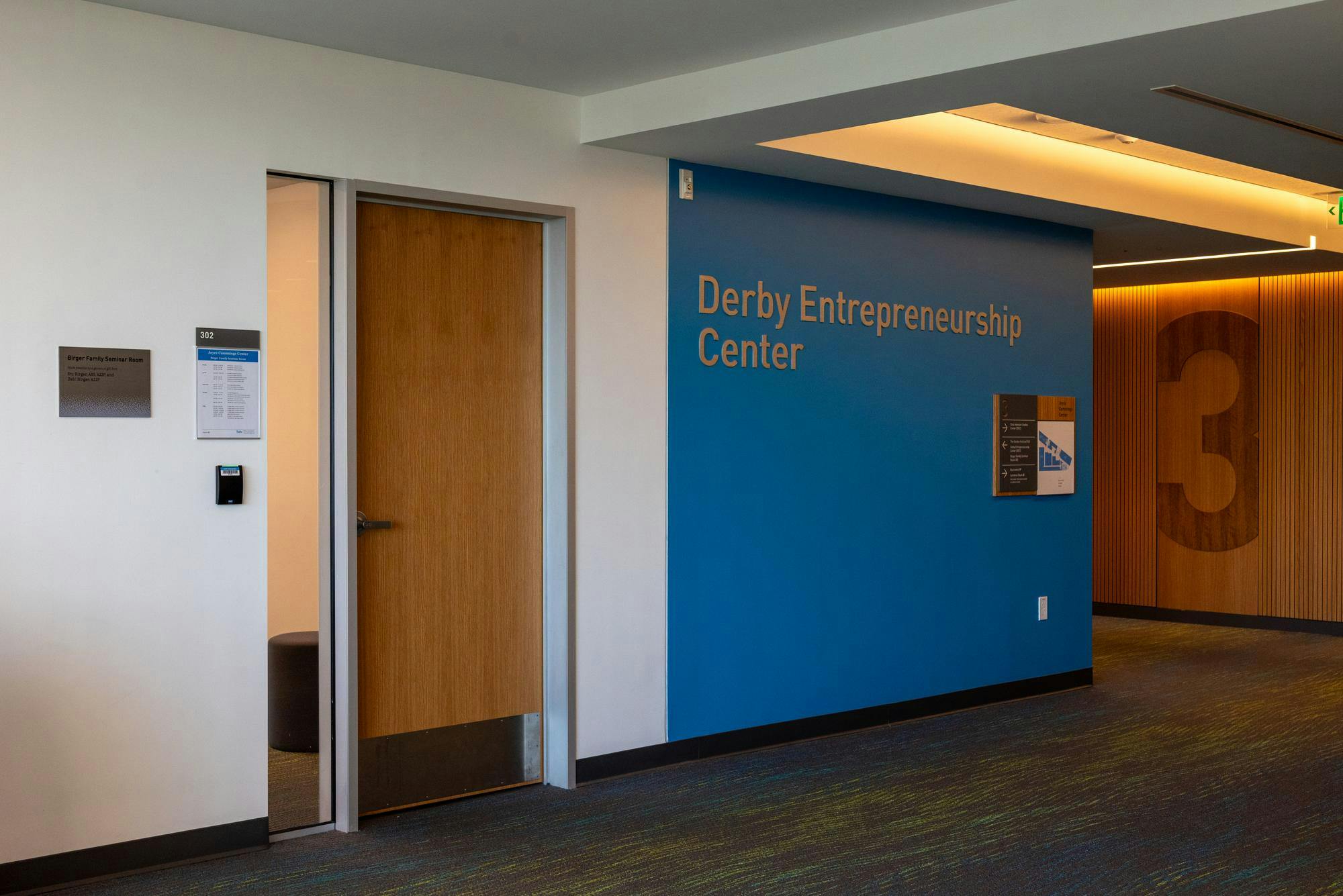
On Sept. 19, I attended the Cross University Student Innovators Mixer at Tufts, hosted by the Derby Entrepreneurship Center, right after 2025 Startup Boston Week. While Elaine Chen, director of the Derby Entrepreneurship Center, kindly told me that I, too, am an ‘innovator’ despite never having started a business myself, I knew I was part of the majority of Tufts students who have never seriously considered launching a startup at this stage in life. To put it bluntly: There are far fewer startups coming out of Tufts compared to many other universities, and I’m one of the reasons why there isn’t one more.
As a liberal arts university in the Northeast, Tufts isn’t particularly known for teaching students how to achieve hyper-pragmatic or business-oriented ends as much as it is known for cultivating a student body with strong character and civic awareness. We can’t really compare ourselves to schools in the San Francisco Bay Area, where the phrase ‘AI startup’ is probably immersed in everyday life. Nonetheless, despite this geographic and cultural distance from major startup hubs, I still believe there’s tremendous value in fostering a stronger entrepreneurial culture at Tufts.
This past summer, I met many founders who pushed me to reflect on the merits of entrepreneurship. They were at different stages of the business cycle, running B2B, B2C and B2G ventures across industries like AI, consulting, automation and film production. However, they all shared remarkably similar attributes: charisma, goal orientation, acute market awareness and the impressive ability to concretize and execute highly abstract ideas. While these qualities aren’t exclusive to entrepreneurs, the nature of their work uniquely cultivates them. I find it inspiring to be around people with such qualities, and I think Tufts students would benefit greatly from being part of a community that embraces and learns from such a mindset.
As I’ve discussed in a previous article, Tufts lacks a strong business education department, which limits opportunities for students to develop and pursue startup ideas. To better promote entrepreneurship and help more ideas materialize, there are a few first steps the university can take. First, the curriculum could be reformed to better foster entrepreneurial thinking. Many economics courses currently lack coding components, making it harder for students interested in business to develop the technical and analytical skills needed for innovation. There are also very limited financial modeling classes, and one of the only ones available — financial accounting — doesn’t count toward either the economics major or the finance minor, leaving students with little incentive to take it. The structure of the entrepreneurship minor could also be improved. Currently, it is composed almost entirely of three-hour-long classes, which can deter students who are interested but hesitant to commit to such large time blocks, like myself.
Still, despite limited resources that are currently available at Tufts, students should be encouraged to take greater advantage of the entrepreneurial opportunities in the Greater Boston area. As one of the world’s leading hubs for biotechnology, research and innovation, the city presents endless opportunities that Tufts students — situated in the middle of it all — can capitalize on. With universities like Boston University, Harvard University, MIT, Northeastern University and Boston College all hosting business and management schools, and Babson College — a school wholly dedicated to entrepreneurship education — located in Massachusetts, Tufts students have access to an incredible network of both successful entrepreneurs and student founders. The Greater Boston area is also filled with startup labs and founder/hacker houses quasi-affiliated with these universities that students can engage with. There’s no shortage of resources. What’s needed is greater visibility, and Tufts should ensure students are aware of and encouraged to make use of these external opportunities and partnerships.
I think all dreams materialize through a mix of drive, courage, wishful thinking and at least some reassurance that practical professional resources exist to help make them happen. At Tufts, we don’t lack creativity or ambition. What falls short are the avenues for us to effectively use the resources available, and the transparency about what those resources actually are. As a result, many dreams never have a chance to grow. Tufts and the Derby Entrepreneurship Center’s priority should thus be to promote startup events and entrepreneurial culture more actively, teaching students how to make effective use of the incredible opportunities that Boston offers for innovation. In doing so, we can inspire more student founders and cultivate a more balanced campus community composed not only of critical, civically-engaged thinkers but also of pragmatic, action-oriented builders.